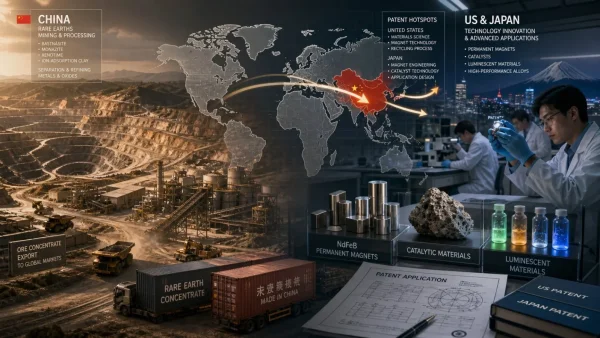
China’s grip on rare earth supply is not translating into control of the most valuable technologies built on those minerals. A new study finds the United States and Japan hold many core patents for advanced rare earth functional material technologies, exposing a strategic weak spot in Beijing’s industrial playbook.
Why the patent gap matters
Rare earths power modern life and hard security alike. They sit inside fighter jets, missiles, radar and sonar systems, as well as automobiles, smartphones and satellites. Patent leadership in downstream materials decides who captures the highest margins, not who mines the ore.
The study underscores that China’s dominance in extraction and processing has not secured leadership in the intellectual property that shapes product performance and pricing power. That asymmetry has consequences for trade leverage and the resilience of global manufacturing hubs.
Who leads where
China accounts for about 70 per cent of global rare earth mining and nearly 90 per cent of processing capacity. Those figures have long been read as strategic advantage, reinforced by tighter Chinese export controls that recently disrupted supply chains in India, Japan and Europe.
Yet the research highlights a different map of control over the technologies that matter most to end products. Japan retained an overall technological lead in permanent magnets, while the US led in most core technologies linked to catalytic materials, luminescent materials and polishing materials.
Downstream tech defines value
Downstream products made from processed rare earths, including permanent magnets, catalysts, luminescent materials and polishing materials, account for more than 80 per cent of rare earth-related patents worldwide. These categories are described as the industry’s most commercially important applications.
Three takeaways stand out:
– Patent control steers pricing and performance
– Mining strength alone does not secure value
– Tech gaps weaken trade leverage
China’s innovation bottleneck
The study points to China’s innovation system as a key reason for the shortfall. While the country files many rare earth patents, only a relatively small share qualify as high-value international patents with broad commercial influence.
Researchers also flag that numerous scientific advances have not matured into commercially significant patent portfolios. They cite weak coordination among universities, industry and intellectual property management as barriers to converting research into market power.
Implications for competition
If patents define who profits from rare earths, then the balance currently favours Washington and Tokyo in crucial niches. The study found that China held an advantage in only a limited number of technologies and continued to lag Japan and the US in several key manufacturing processes and material systems.
That dynamic limits Beijing’s ability to turn resource heft into lasting technological dominance. It also cushions rivals from supply-side shocks by anchoring value in know-how that cannot be embargoed as easily as raw materials.
What to watch next
The researchers recommend a targeted response: focus resources on identified technological gaps, fund dedicated research programmes and strengthen collaboration between industry and academia. The aim is to lift the share of high-value international patents and close process-level gaps where performance is set.
For global manufacturers, the findings help explain why supply anxiety alone no longer dictates strategy. As patent leadership concentrates in the US and Japan, firms will continue to hedge, balancing material sourcing from China with technology partnerships where the critical IP resides.