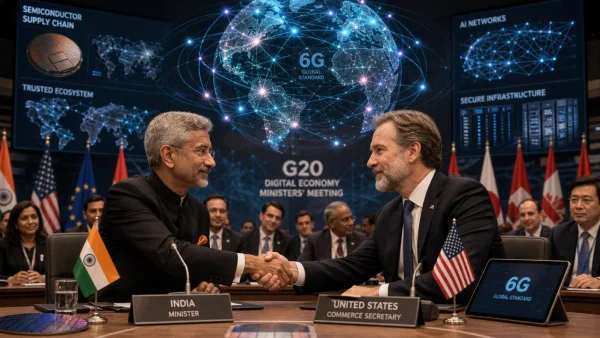
In a 25-nation effort to see how 6G is built, commercialised and secured, India has made its mark on what will be tomorrow’s telecom rules. The US Department of Commerce made public India’s involvement after discussions at the G20 Innovation Ministerial, an early entry for New Delhi into the standards-setting tent.
India’s 6G move signals standards ambition
With the United States and 24 others, India is in a coalition that makes no bones about linking next-generation networks to common goals of competitiveness, innovation and security. The US Department of Commerce says the group is there to steer the development and deployment of 6G infrastructure.
As the department put it on X, India has come alongside the US and 24 countries to make sure 6G reflects shared security interests and spurs innovation. It is a position that affords influence over technical baselines and the supply chain as research timelines pick up speed around the world.
How the decision came together
The news comes on the heels of a bilateral between Jitin Prasada, the Union minister of state for commerce and industry, and his US counterpart, Commerce Secretary Howard Lutnick. They met on the periphery of the G20 Innovation Ministerial to talk 6G.
Prasada headed the Indian contingent to the G20 Innovation Ministers’ meeting in Chapel Hill, North Carolina, on September 1 and 2. The event was put on by the White House Office of Science and Technology Policy and the US Department of Commerce.
Official objectives of the alliance
What the US Department of Commerce has outlined on X are goals of substance for governments and industry. In short, the initiative is about:
– Making next-generation networks a reflection of mutual security concerns
– Bolstering the collective standing in telecom
– Fostering 6G innovation
Beyond 6G: deepening tech ties
But 6G was only one part of the equation. In their talks, Prasada and Lutnick looked at ways to cooperate on data centres, AI and semiconductors. Prasada put forward a mechanism for AI safeguards, proposed to build on the technology partnership and saw room for more US investment in ISM2.0.
‘Semiconductors. AI. Data centres. These are critical building blocks of the emerging digital economy,’ wrote Prasada on X, underlining the strategic importance of the sectors. He characterised the exchange as an attempt to open up technology-led opportunities and practical cooperation between the two nations.
There is a clear link between network standards and the compute capacity or data ecosystems found in chips and AI. For firms looking at the next round of services, a harmonised way of doing things can do away with fragmentation and put deployment on a faster track.
Delegation details and G20 context
According to the Ministry of Electronics and IT, Prasada was in good company at the meetings. With him were Ajit Kumar, Joint Secretary at MeitY, and senior people from the Department of Science and Technology, the Department for Promotion of Industry and Internal Trade and the Embassy of India in the US.
An Innovation Ministerial Statement was put out at the end of the proceedings to the effect that 'emerging technologies have the potential to unlock prosperity, enhance productivity, and expand opportunity for all our peoples.’ It is a reminder of why nations are getting in early to have a say in how foundational tech is shaped.
For the wider alliance, having India on side lends heft to the push to tie 6G to security and competitiveness. For India, it is a way of turning the scale of its digital economy and innovation agenda into some upstream influence.