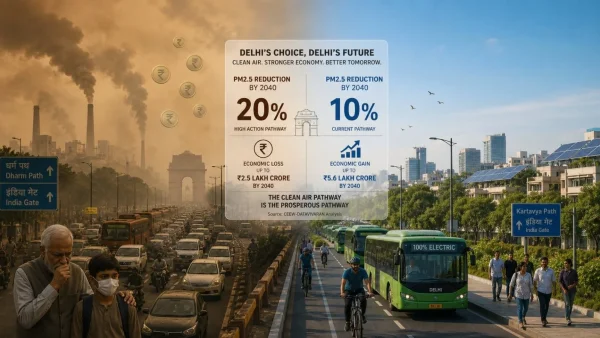
There is an avoidable bill for any delay in Delhi’s clean air efforts, according to the UN-backed document. On schedule to meet the 2026 benchmarks and the city will see a 20% drop in PM2.5 levels by 2040. Allow for an eight year slip and you are left with only a 10% gain and more risk.
The health-economic calculus
The human toll of inaction is evident in the figures. In 2025 alone, some 6.4 million people around the world are expected to die prematurely from outdoor pollution such as ozone and PM2.5. Add to that the 2 million or so premature deaths from household air pollution, 300,000 of them children.
Then there is the economics: for every US$1 put into integrated climate and clean air programmes, the report says one can expect US$15 in return. The benefits are manifold, from lower healthcare costs and less physical damage to the value of lives not lost and a more productive workforce.
‘Hidden Assets: The Economic and Health Case for Climate and Clean Air Action’ is the title of the UNEP and CCAC assessment released on the International Day of Clean Air for Blue Skies. It is being put forward as the first global economic evaluation of its kind, with a focus on China, India, Mexico and Nigeria – nations home to over 40% of the population.
Delay costs compound quickly
An analysis of the situation shows that each year of inaction is a forfeit of US$1.5 trillion in market and non-market benefits, or 0.5% of GDP. One can expect implementation to be delayed by 7.5 to 8 years on average; institutional barriers will account for some 2.4 of those years in a 15-year span.
Such a lag is enough to halve the emissions reductions on the table for 2035. In Delhi’s case, an eight year slippage would mean residents face higher health risks for longer, with the cumulative PM2.5 reduction by 2040 falling from 20% to 10%.
In terms of policy timing and impact, the headline numbers are:
– A 20% cut in exposure by 2040 if 2026 standards are met
– An eight year delay sees that trimmed to 10%
– Over US$1.5 trillion in annual losses per year of delay
– Delays of 7.5 to 8 years are the norm
What integrated action looks like
The assessment puts forward 25 practical ways to deal with both air pollution and climate at once. This includes electrification and stiffer vehicle norms, cleaner cooking and heating, better waste and wastewater systems, low-sulfur fuels for shipping, curbing HFCs and associated gas recovery, as well as changes in agriculture and food systems.
These are aimed at methane, black carbon and hydrofluorocarbons in everything from industry and transport to residential use. By improving the economic, social and institutional conditions, the report says all 25 could be in place a decade earlier, which would do much to reduce PM2.5 and ozone precursors between 2025 and 2050.
The growth upside
Put these measures in place and the annual economic benefit is projected to be 2.8% of global GDP by 2035, rising to 4.5% in 2050 and 11.4% by 2100. To put it in perspective, fossil fuel subsidies were 2.18% of global GDP in 2022 and healthcare 9.3% in 2023.
A prompt start would halve carbon dioxide emissions by 2050 and trim methane by 60%. Key air pollutants like nitrogen oxides and sulfur dioxide would be down some 70%. That translates to avoiding 0.34 C of warming by 2050 and 1.4 C by 2100.
Given that land heats up faster than the rest of the planet, the avoided warming in many places could be 1.5-2 C by 2100. Under this scenario, carbon dioxide would be net negative by century’s end and major pollutants could be reduced by as much as 85%.
Why this matters for Delhi
It is a matter of when for Delhi. The report makes plain that securing integrated action sooner means an easier time for the economy and the populace. Stick to the plan and there is a 20% cut in exposure by 2040; let it slide and the gains dwindle to 10%, leaving deeper losses in their wake.