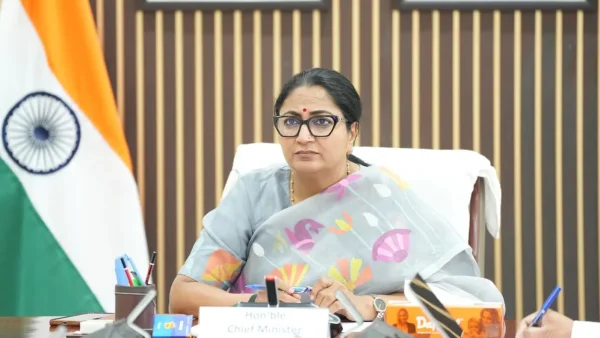
With the water situation in Delhi only getting more acute, the CM made it clear that we have an ironclad guarantee from Haryana for a 1,000 cusec flow. After sitting down with Saini, this was the kind of assurance we needed to see some stability, given the way river levels and production have been sliding.
Haryana puts 1,000 cusecs on the table for Delhi
It is what the Delhi Jal Board was looking for. They had put out a figure of 900 to 924 cusecs in the last few days. One of our officials at the DJB put it plainly: the state next door has come on board to give us 100 cusecs over and above the 924 we were due.
“We are putting our focus on immediate relief as well as the hard infrastructure,” said Gupta. “When you are landlocked like Delhi and you are at the mercy of Haryana and UP for your raw water, you can’t afford to not have that kind of coordination when things get tight upstream.”
What’s behind the shortage
Water Minister Parvesh Sahib Singh says the numbers don’t lie. The pond level at Wazirabad, which should be at 674.5 feet, is down to about 668. That lack of raw water has put a dent in our output of 80-100 MGD, and you add in the dry spell up in the Yamuna and it makes for a tough spot.
You can see the strain in the figures. For some time now the DJB has been having to work to hold the line on its average. We are running some 90 million gallons a day under our 1,002 MGD target for the year, by their count.
There isn’t much room to manoeuvre even in the good months. If you include the tubewells, the DJB is usually churning out between 990 and 1,000 million gallons of drinking water a day. Any more than that and you are pushing it.
Making do and minding the complaints
Where the water is thin, we are sending in the tankers. Gupta says we have 980 of them on the road, doing 6,000 runs a day. We are even using smaller vehicles to get into the nooks and crannies of the denser colonies.
The phone lines have been hot. In the last seven days the DJB has had 11,055 calls to deal with, and they say they have put to rest over 8,500 of them. I have told my people to wrap up the open cases and for the field officers to be on top of it personally if they have to.
We are also looking for every bit of extra we can get. The chief minister notes that with some new borewells in the Yamuna Khadar, we have added 10.5 MGD to our daily tally.
No tolerance for waste
I have made it known that any leak is to be treated with the utmost importance. “Every drop is of value,” said Gupta, and there is no excuse for throwing any of it away. We need to be harder on theft and the kind of losses that happen in distribution.
My instruction to the men on the ground is to have enough tankers where they are needed and to up the number of trips if the area is asking for it. “We want to put availability back up as fast as we can, even as the extra water from Haryana makes its way into the city’s network,” said Gupta.
The government has put a few things in motion right away:
– A closer eye on supply in the hard-hit areas
– Fixing any and all leaks and bursts without delay
– More tanker runs where they’re needed
– Going out in the field to look into the bigger complaints
Inter-state coordination and what comes next
You can’t have stability in Delhi in the short run without the help of Haryana. Before Gupta and Saini had their discussion, flow through the Munak Canal was down to 900 or 924 cusecs. Now that there is a promise to keep it at 1,000, the authorities are banking on better raw water numbers.
For Gupta, the talks were about looking after Delhi’s interests and making sure people have something to drink. When river levels wane, you have to work with the states upstream.
Long-term fixes under evaluation
There is an effort to move beyond the current crunch and put in place some lasting infrastructure. IIT Roorkee is running a feasibility study on a pipeline from Haryana to stem the tide of water loss.
On the ground, they are already de-silting the Yamuna by Wazirabad and have blueprints for more treatment plants and borewells in the Khadar area. It’s all to make the system more resilient when the seasons change.
Pipeline study and conservation push
Gupta made it clear that long-range planning is moving in lockstep with the relief work. If the pipeline is a go, it could be a game-changer for how we move raw water and stop the kind of losses that eat into your output.
Then there is the matter of conservation. We are in the process of tending to 500 new rainwater harvesting sites and have already started on 1,000 older ones; the tenders are out, she noted. Some of these are being put in at 75 CM Shri schools, with more to come for the public at large.
She has also put the word out to put in a dual supply system in phases so we can put treated sewage to use for washing cars and tending to the greenery.
Why it matters now
Delhi is more at the mercy of the weather than before, and the lull in the Yamuna is a case in point. The city is already chugging along at 990 to 1,000 million gallons a day, so any hiccup in the raw water is felt in every neighbourhood.
The 1,000 cusecs from Haryana gives us some room to breathe, but we still have to be on top of maintenance and keep our side of the inter-state deal to hold things steady. The real challenge is to see the pipeline and the rest of the plan through to the finish line.
“I am on a war footing to see that every one of my citizens has enough clean water,” the chief minister said. “It is a question of giving you some respite now while we build a system that won’t let this happen again.”