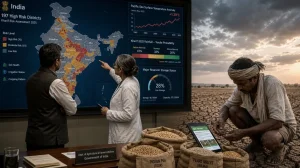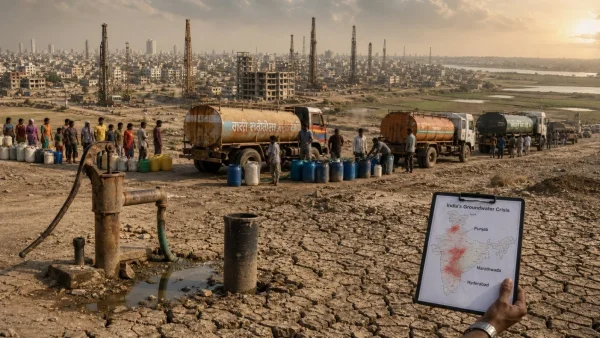
The warning on India’s groundwater has become a matter of urgency. Put simply, a fresh national assessment has put Hyderabad in the number one spot for stress among the metros. And it’s not just there: in Karnataka, villages are queuing up for tankers; in Marathwada they’ve had to double down on emergency supplies; and in Punjab they are seeing an extraction rate you won’t find anywhere else in the country.
You can see the stakes right now in the form of dropping aquifers, more contamination and public coffers being put under strain. The 2025 Dynamic Groundwater Resource Assessment Report from the Union ministry of Jal Shakti gives you the numbers, but if you talk to state officials, they will tell you it has been a summer of hard choices and plain scarcity.
Hyderabad becomes the flashpoint
By the numbers, Hyderabad is the most groundwater-stressed of all the big cities in India. In Greater Hyderabad, 26 mandals and tehsils are in the red – either over-exploited or in a critical state. That is more than you see in Delhi or Bengaluru.
The thing is, there is no part of the Hyderabad district where you can be sure of safety. Not one of the 16 units we assess is in good shape. Only one is semi-critical; the rest of them are either critical or have been over-drawn. You can see it in Khairatabad, Ameerpet, Himayatnagar, Bachupally, Serilingampally, Hayathnagar and Saroornagar.
If you ask the authorities, it’s the sprawl, the building and the borewell drilling. “We have rainwater harvesting pits in less than 15% of the city,” says K Laxma, who runs the Telangana Groundwater Department. Even with 900 to 1,000 mm of rain in a year, there isn’t enough open ground to let it in, so it just goes down the drain.
The depth of the water tells its own story. “Maintain your recharge pits and you can keep the water within 10 metres. But without it, we are looking at 20 metres and more,” Laxma puts it.
Then you have the geology to contend with. “In a place like Mumbai or Delhi, it’s different. Here in Hyderabad we are on rock, so percolation is harder,” says B Venkateswara Rao, a retired professor from JNTUH. Add in the fact that the harvesting systems aren’t always well put in place, and you have a problem on your hands.
And the amount we are pulling out is no small matter. There are 2.5 lakh borewells in the district on paper, but the real figure is likely much higher. For Greater Hyderabad as a whole, we’re talking 10 lakh. Some of them, it seems, have been put in illegally, going past the 400-foot mark set by the 2002 Water, Land and Trees Act.
Marathwada’s tanker lifeline grows
Things have moved fast in Marathwada. We are now running over 400 water tankers in the field, up from 156 or so last month. Chhatrapati Sambhajinagar is where you will find most of them – close to two-thirds of the total.
The official count for the district is 259. Then you have 85 in Jalna, 17 in Dharashiv, 14 in Nanded, 11 in Parbhani, and a handful in Beed, Latur and Hingoli. To make up for it, the revenue department has taken on 1,150 private wells to top up the tankers.
Lack of rain is only making it worse. We have had 38 mm since the 1st of June, which is 23% short of what we should have. In some areas the gap is even wider: 73% in Chhatrapati Sambhajinagar, 62% in Jalna and 55% in Hingoli.
Some 127 villages and hamlets were down to their last drops, with 85 of those in Chhatrapati Sambhajinagar. With the heat in late April hitting 43C, evaporation has been a factor and storage in our reservoirs is down to 41%.
For the most part, a complaint is what gets a tanker on the road. “We have standing orders to send one if the villagers say they are short,” an official will tell you. He would also add that with the heat and demand on the rise, people need to be sensible with what they have.
Karnataka’s villages run dry
It is the same story in the countryside of Karnataka, where the shortage of drinking water has been felt before the summer even fully set in. The Rural Water Supply and Sanitation Department has 344 villages in 58 taluks on its list. Ramanagara’s Bengaluru South is the hardest hit, with 55 of them.
Raichur is next with 41. You can also see it in 27 villages in Uttara Kannada and 26 in Tumakuru.
With the water table in retreat, the authorities have had to make do with emergency measures to see people through and keep access to water steady.
The numbers tell you how much we are up against it. Some 210 villages are on the hook for water tankers, and 125 for private borewells. In the districts where it’s been hit hard, 99 tankers and 282 borewells are being put to work to make sure no household is left out.
It’s not an easy job of it. “Haliyal and Mundgod are the worst of it,” says Dileesh Sasi, CEO of the Uttara Kannada zilla panchayat. “You have depleting levels and the terrain makes for a constrained supply.” And in Kumta, the village has to make do with tankers because the borewell water isn’t up to snuff.
Then there is the matter of money. While 11 districts have come through without any shortages thanks to better infrastructure and some forethought, the rest are feeling the pinch. For 2025-26, we were given Rs 60 crore for drinking water emergencies but have only seen Rs 43.7 crore come in.
“We are on top of it and making sure every home has what it needs in terms of quantity and quality,” says Randeep D, who heads the rural water supply and sanitation department. But with a tab of Rs 132.2 crore, they’ve only been handed Rs 91.5 crore so far.
Punjab’s extraction emergency
In Punjab, the problem is of a different order but just as serious. “Nineteen of our 23 districts are dark zones now,” Rajya Sabha MP Satnam Singh Sandhu told Parliament, putting the onus on the overuse of water for paddy.
He has the state’s extraction at 156.36% – well above the 60% norm for the country. “We are in a water emergency,” he said, and not without cause. He also pointed to the uranium in the groundwater. “Over 62% of the samples have more of it than you’ll find anywhere else in India. It is a potential cancer risk.”
If we don’t change course, Sandhu says, we could be looking at groundwater 300 metres down by 2039. It’s a case for a complete rethink on what we grow and how we put the water back.
Union jal shakti minister CR Patil, for his part, said the Centre has put aside Rs 32,000 crore this year to turn around these dark zones under the Viksit Bharat Guarantee for Rozgar and Ajeevika Mission. The money is going to where it is needed most.
Patil was quick to note that the public has to be part of the solution. With 44 lakh conservation structures already in place, the Karmabhoomi se Matrabhoomi push is on to get NRIs and others to invest in their home villages, with an eye on a crore of them.
Telangana’s wider stress and quality concerns
It is not just in and around Hyderabad that Telangana is being put to the test. Of 620 units in the state, 473 are fine; the remainder are in some form of distress.
And then there is the quality. You can find fluoride in parts of Bachupally, Balanagar, Malkajgiri, Ghatkesar and Medchal. For those who are already having to dig deeper, it is one thing too many.
By the book of the Central Ground Water Board, anything over 100% is over-exploited, 90-100% is critical, and so on. The way things stand in some of the metro’s units, you can see how fast you can run into a deficit.
What the numbers signal now
Whether in a city ward or a hamlet, the report and what is on the ground show we are all in the same boat. When you put the strain of hydrology, infrastructure and climate on a system, it doesn’t take long for it to show. You can see the human cost in everything from the queues for tankers to the state of your tap water.
What we’re seeing as red flags in different parts of the country:
– 26 units in Hyderabad are either over-exploited or in critical shape
– Not a single “safe” unit in the 16 we looked at in the district
– 344 villages across 58 taluks in Karnataka have been hit
– Marathwada is running more than 400 tankers now, a jump from 156 or so
– In Punjab, they’re pulling out 156.36% of what’s there
Then there are the moves being made by those in charge:
– 99 tankers and 282 borewells put in place in Karnataka
– More than 1,150 private wells in Marathwada have been taken up
– A Rs 32,000 crore set aside for conservation this year
– 44 lakh water structures put in all over the country, with an eye on one crore under a national push
The way forward: some hard work and willpower
Hyderabad is a case in point for how a city can outpace its aquifers if you don’t keep up with recharge. The word from experts is to be more forceful with rainwater harvesting, in places where the rock won’t let the water percolate, and to tend to the pits you already have.
Telangana’s numbers make it plain why you have to plan for open space and green cover. If you don’t, 900 to 1,000 mm of rain is just something that goes down the storm drain instead of into the ground for when you need it.
In the countryside, you have to fund the emergency side of things as well as the long game. You can see in Karnataka the tension between putting out a fire and building something that lasts. Tankers get you through a few weeks; regulation and recharging are what will hold up for years.
Take Marathwada. With 41% live storage and a rainfall shortfall, you can watch the problem ripple through. It’s 43C out there, so evaporation is a factor and people want more. Whether the summer is a hard one or not comes down to the monsoon and how you handle your reservoirs.
Punjab is another story of extraction and what you plant. Once you’re at 156.36% and the dark zones are piling up, you have no choice but to conserve and diversify. And with the contamination issues, it’s as much a health matter as it is about having enough.
The money and the targets from the centre show what they want to do, but it’s on the ground where it will be made or broken. Groundwater isn’t bottomless, as the report puts it. To stave off a deeper crisis, you need to put in the work on recharge and management.
It’s a story being told in India right now, one block and one borewell at a time. Every town and hamlet has to ask itself: what’s left in the ground, and what are you going to do about it?