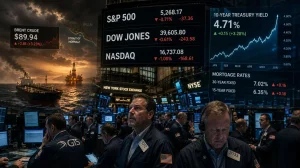
Futures on Wall Street were higher today as the US stock market made an attempt to put behind it a sell-off driven by yields; traders are wagering that a steady hand in the bond markets will have a calming effect. It is a rebound in the face of fresh debate on where equities are headed with tighter financial conditions, the climb in oil and the like.
Market mood shifts as yields steady
What sent things into a slide on Thursday was a brisk reversal in borrowing costs. Yields on the 10- and 30-year Treasury notes put in more than five basis points, erasing earlier declines. By Friday those had been put to rest and sentiment was back in order.
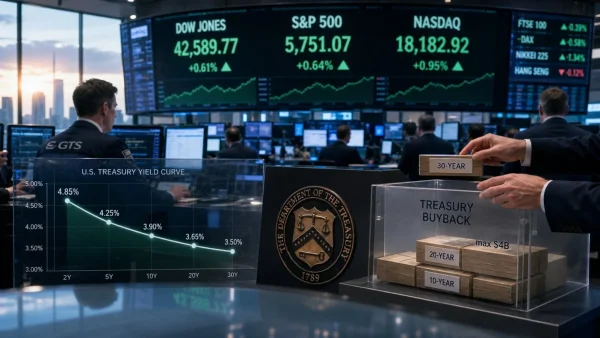
An assertive posture from the US Treasury to see to the functioning of the market has much to do with the calmer atmosphere. The Department has put out word it will at least double its intended purchases of longer-term government debt, and Scott Bessent, the US Treasury Secretary, has intimated the repurchase programme may be broadened still further.
Futures bounce, but weekly picture still fragile
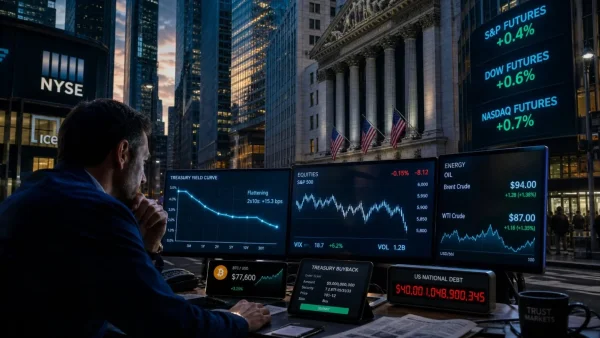
You can see the tentative relief in the futures. An early read had S&P 500 and Dow Jones Industrial Average futures both up 0.3%, with the Nasdaq-100 at 0.6%. In the course of later trade, the figures ticked up: the Dow tied to futures was about 0.6% higher, the S&P 500 0.4%, and the Nasdaq-100 advanced 0.7%.
The overall backdrop is not so rosy, however. After the S&P 500 and Nasdaq Composite gave up 0.9% and 1% respectively on Thursday, they are heading for weekly losses in the region of 1.9% and 2.5%. The Dow is down some 1.8% for the week and the S&P 500 is set to post its first weekly loss of the month.
Debt management, deficits, and valuation pressure
Volatility this summer has brought to light a fault line in the form of investor unease with the way debt is being handled and the size of the deficits. There are warnings from the market that if the Treasury’s approach is uneven, it could lock in higher costs for capital markets, business loans and mortgages.
Bessent has stated the government intends to make the Treasury buyback programme bigger, with individual operations running past $4 billion. For all the official desire to remove friction, equities are no less prone to rate shocks. That is particularly true of the capital-heavy technology and AI names whose valuations are predicated on lower discount rates.
Then there is the question of fiscal anxiety. With the national debt now in excess of a record $40 trillion, one cannot help but worry about budget deficits and what returns investors will call for. It raises the stakes for risk assets and bond auctions as the year wears on.
Energy rally tightens the screws on inflation
And oil is throwing in another wrinkle of complexity.
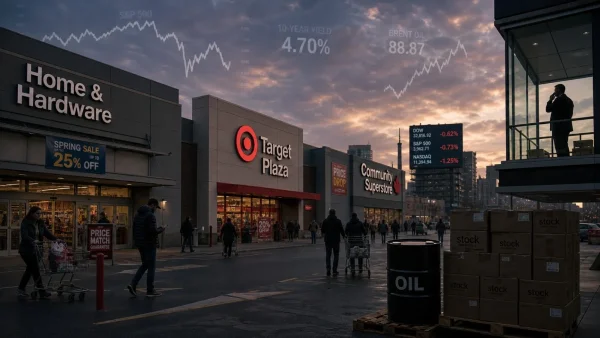
Brent crude, the international standard, has put in a sixth straight day of gains to reach $94.34 a barrel, up $0.56 and well positioned for a second consecutive week of higher prices. The US benchmark West Texas Intermediate is not far behind, with a $0.52 advance taking it to $87.35.
There is a geopolitical element to that upward trajectory. The US is making a push to cordon off Iran’s economy – an “economic D-day” in the words of President Donald Trump – with the specifics of the plan due out on Monday. Should there be any threat to supply, it would only add to the inflation picture and drive energy costs up.
That is what investors are considering: how much of this oil price action will make its way into headline inflation and from there affect rate calls and equity valuations. The debate is evident in the sell-off at the longer end of the Treasury curve.
Crypto and currency signals show shifting risk appetite
One can see the change in risk appetite in digital assets as well. Bitcoin broke the $70,000 mark for the first time in more than two months following a meeting between the president and heads of the crypto industry, and has since run above $77,600 for a 18% gain in 48 hours.
On the currency side, the yen has been steady despite a second month of acceleration in Japan’s key price index. That leaves the Bank of Japan in position for another rate hike in the near term, and talk of a September move is growing.
Taken together, these are signs of a recalibration across asset classes, not a uniform retreat. Stability in the bond market is the pivot point for that rotation.
What investors are watching next
In the coming sessions the test will be whether policy can put some anchors on yields and calm the volatility; for the moment there is little interest in one-day bounces. A few things to keep an eye on:
– Monday’s details on the US programme aimed at Iran
– The behaviour of longer-dated Treasury yields
– How the Treasury handles its buyback operations
– The inflationary effect of Brent’s six-day run
Under the headlines lies the matter of whether support in rates can stand up to persistent fiscal headwinds. When yields go up, so do borrowing costs, which can put a damper on growth and stock valuations. It is a source of tension in the market right now.
Technology has been the bellwether for this kind of tug-of-war. Growth shares have lagged as yields have ticked up, a clear sign of their sensitivity to the discount rate. To see any lasting improvement in sentiment, there must be proof that policy can shore up the long end of the curve without stoking fresh inflation fears.
The whiplash of the past week offers a lesson: markets are trading at the crossroads of geopolitics, liquidity and policy credibility. Futures may put in a quick recovery of 0.3% to 0.7% on the major indices, but for that to hold one needs steadier energy prices and a clearer message from Washington.
Wall Street is being pragmatic about it. The approach is to respect the bond market and watch the oil while waiting for policy news. Provided yields stay in check and crude cools off, equities will find a better base. Otherwise, expect the summer pattern of relief rallies running into resistance to persist.