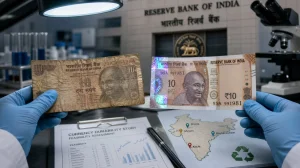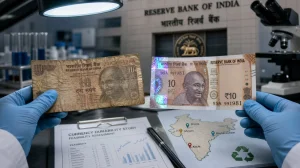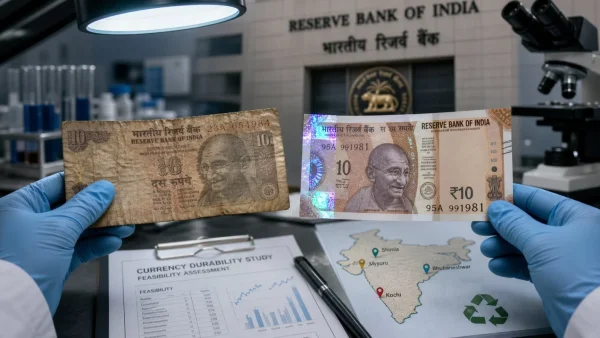
The Reserve Bank of India (RBI) has received approval to conduct field trials of one billion ₹10 polymer notes and one billion ₹20 polymer notes. The move has sparked curiosity and speculation, with many wondering whether India is preparing for a major currency overhaul—or whether it signals an underlying crisis.
The short answer is no.
The RBI has clarified that these are field trials, not a nationwide replacement of paper currency. Regular issuance will depend on the outcome of the trials.
Still, the announcement raises three important questions: Why introduce polymer notes now? Why weren’t they introduced during the 2016 demonetisation? And does India really need them?
Is India Facing a Currency Crisis?
There is no indication that the move is linked to a currency crisis.
Unlike demonetisation in 2016—which involved withdrawing ₹500 and ₹1,000 notes overnight to tackle black money, counterfeit currency, and unaccounted cash—the polymer note initiative is aimed at improving the durability and efficiency of currency, not changing the monetary system.
The RBI has made it clear that:
Existing paper notes will continue to circulate.
Polymer notes are being introduced only for limited field testing.
There is no plan to replace all paper currency immediately.
In other words, this is a technological experiment rather than an economic emergency.
Why Polymer Notes?
Polymer banknotes are made from a special plastic substrate rather than cotton-based paper.
Countries including Australia, Canada, the United Kingdom, New Zealand, Singapore, and Romania have already adopted polymer notes for many denominations.
The advantages include:
Longer Life
Polymer notes typically last two to four times longer than conventional paper notes.
Since ₹10 and ₹20 notes change hands frequently, they wear out quickly. Longer-lasting notes could reduce replacement costs over time.
Better Security
Polymer notes can incorporate advanced security features that are difficult to counterfeit, such as:
Transparent windows.
Complex holographic elements.
Improved micro-printing.
Enhanced anti-copy technology.
Cleaner Currency
Unlike paper notes, polymer notes absorb less moisture and dirt.
They are generally:
More resistant to water.
Less prone to tearing.
Easier to clean.
Better suited for humid climates.
Why Only ₹10 and ₹20?
The RBI has chosen low-denomination notes because they experience the highest circulation and wear.
Testing them first allows the central bank to evaluate:
Durability.
Public acceptance.
Printing quality.
Cost-effectiveness.
Performance under India’s diverse climatic conditions.
If successful, the RBI could consider expanding polymer technology to other denominations in the future.
Why Wasn’t Polymer Introduced During Demonetisation?
This is one of the most frequently asked questions.
The answer lies in the priorities of 2016.
During demonetisation, the government’s immediate objective was to rapidly replace invalidated currency with new banknotes. The focus was on restoring cash availability as quickly as possible.
Introducing polymer notes at that time would have required:
New printing technology.
Different manufacturing processes.
Specialized machinery.
Fresh procurement systems.
Extensive testing.
These requirements could have delayed the urgent replacement of currency, making the cash shortage even more severe.
For that reason, the RBI continued using the established cotton-paper system during demonetisation.
Is Polymer Currency Needed Today?
There are arguments on both sides.
The Case For Polymer Notes- Supporters argue that polymer notes:
Last significantly longer.
Reduce long-term printing costs.
Improve counterfeit resistance.
Require fewer replacements.
Perform better in India’s tropical climate.
Although polymer notes cost more to produce initially, their longer lifespan can lower overall lifecycle costs.
The Concerns- Critics point out that:
Initial production costs are higher.
Printing infrastructure may need upgrades.
Recycling polymer notes requires different processes.
India already has effective security features on existing notes.
Some experts also question whether the financial benefits justify a nationwide transition, especially when digital payments continue to grow rapidly.
Why the Field Trials Matter
Rather than committing immediately to polymer currency, the RBI is taking a cautious approach.
The field trials will help determine:
How well the notes withstand daily use.
Public acceptance.
Printing and distribution efficiency.
Cost implications.
Suitability for India’s weather conditions.
Only after analysing these results will the RBI decide whether wider adoption makes economic and operational sense.
The Bigger Picture
The polymer note initiative should be viewed as part of the RBI’s long-term effort to modernise India’s currency rather than as a response to any immediate economic challenge.
Just as countries periodically upgrade passports, driving licences, and security features on banknotes, currency technology also evolves.
Whether polymer notes eventually become a permanent feature of India’s cash economy will depend not on politics or speculation, but on one simple question: Do they offer better value, greater security, and longer durability than the paper notes Indians use today?
For now, the answer will be determined not by headlines—but by the results of the RBI’s field trials.