In 1968, India made an ambitious commitment that many education experts still cite today: public expenditure on education should gradually rise to 6% of the country’s Gross Domestic Product (GDP). More than five decades later, that benchmark remains largely unmet, despite repeated endorsements by successive governments.
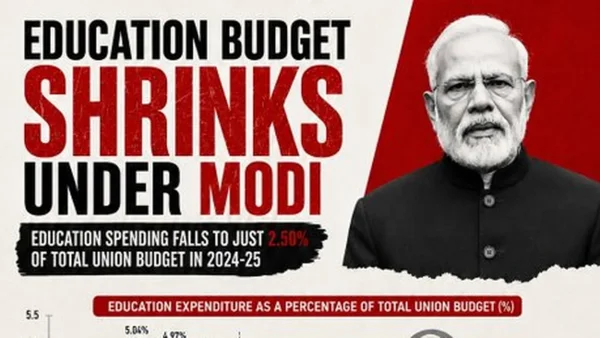
The issue has resurfaced following political criticism that the current government, like many before it, has failed to allocate sufficient resources to education. While parties often blame one another, the larger question remains unchanged: Why has India never consistently reached the 6% target?
The Origin of the 6% Benchmark
The recommendation first appeared in the 1968 National Policy on Education, drawing on the earlier Kothari Commission’s vision that education should be treated as a national investment rather than a recurring expense.
The objective was clear:
Expand access to quality schooling.
Improve teacher training and salaries.
Strengthen higher education and research.
Reduce educational inequality.
Build the skilled workforce needed for long-term economic growth.
Over the years, the target was reaffirmed in later policy documents, including the National Policy on Education (1986) and the National Education Policy (2020), demonstrating broad political agreement on its importance.
The Reality: A Target That Has Remained Elusive
Despite bipartisan support in principle, India’s public spending on education has generally remained below the recommended 6% of GDP.
Education spending fluctuates from year to year depending on economic conditions, tax revenues, and government priorities. It also includes spending by both the Union and state governments, making comparisons more complex than looking at the Union Budget alone.
Most analyses indicate that India’s combined public expenditure on education has typically been in the range of around 3% to 4.5% of GDP, depending on the methodology and the year.
This means that the long-standing 6% goal has remained aspirational rather than achieved.
Is This Only About the Current Government?
Political parties frequently accuse one another of neglecting education funding. Critics of the current National Democratic Alliance (NDA) government argue that education has not received the priority it deserves and point to budget allocations they view as inadequate.
The government, however, argues that spending should be judged not only by headline allocations but also by reforms and outcomes. It has highlighted initiatives such as:
Implementation of the National Education Policy 2020.
Expansion of digital learning platforms.
Increased focus on skill development.
New institutions and infrastructure.
Greater emphasis on vocational education.
At the same time, education economists caution that reforms often require sustained financial backing to deliver meaningful results.
Why Has the 6% Target Been So Difficult to Achieve?
Several structural factors have contributed:
Competing Budget Priorities
Governments must divide resources among health, defence, infrastructure, agriculture, social welfare, and debt servicing, often limiting the scope for large increases in education spending.
Shared Responsibility
Education is primarily a concurrent subject under the Constitution, meaning both the Union and state governments share responsibility for funding. Fiscal constraints at either level can affect overall spending.
Economic Cycles
Periods of slower economic growth can reduce government revenues, making it harder to expand public expenditure.
Implementation Challenges
Increasing allocations alone does not guarantee better outcomes. Efficient utilization of funds, teacher recruitment, infrastructure development, and governance remain critical.
Why Education Spending Matters
Economists widely view education as one of the highest-return public investments.
Greater investment can contribute to:
Better learning outcomes.
Higher literacy rates.
Improved employability.
Increased innovation and research.
Greater productivity.
Long-term economic growth.
Countries with stronger education systems often treat education spending as a strategic investment rather than simply another budget item.
The Bigger Debate
The debate over education funding extends beyond party politics. Every major government since the 1968 policy has publicly supported stronger investment in education, yet none has consistently achieved the recommended benchmark.
This suggests that the challenge is not simply political but structural. The real question is whether India can translate decades of policy consensus into sustained financial commitment.
As the country seeks to become a global knowledge economy, the discussion is likely to intensify. Whether future governments finally move closer to the long-promised 6% target may prove to be one of the defining tests of India’s educational ambitions.
For nearly six decades, the aspiration has remained the same. The debate today is no longer about whether education deserves greater investment—but whether India’s budgets will eventually reflect that consensus.