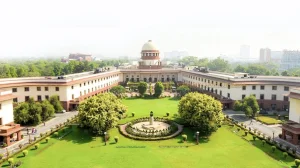
The Supreme Court of India has passed an interim order prohibiting the extraction, modification, dissemination, posting, reposting, uploading, or monetisation of audio-video recordings of judicial proceedings on social media and other digital platforms without prior permission from the competent authority.
The Bench, led by Chief Justice of India Surya Kant, clarified that the restriction does not affect news reporting, but applies to the circulation and use of official recordings of court proceedings on digital platforms.
The interim order has immediately triggered a nationwide discussion on where the balance should lie between judicial transparency, open justice, and protecting court proceedings from misuse in the digital age.
Permission Required Before Sharing Court Recordings
Under the interim directions, no person may:
Extract portions of official court recordings.
Edit or modify judicial proceedings.
Upload or repost recordings on social media.
Disseminate recordings across digital platforms.
Monetise court hearing videos.
Such use would require prior permission from:
The Secretary General of the Supreme Court, or
The Registrar General of the concerned High Court.
At the same time, the Court made it clear that journalistic reporting of court proceedings remains unaffected, preserving the ability of the media to report on judicial developments.
Concerns Over Misuse in the Digital Era
Although the detailed reasoning will emerge through the judicial process, the order comes amid growing concerns over the rapid circulation of edited clips, short excerpts taken out of context, misinformation, and the monetisation of judicial content on digital platforms.
Supporters of such safeguards argue that selectively edited courtroom videos can distort legal arguments, influence public opinion before cases conclude, and undermine confidence in judicial institutions.
The order seeks to regulate the use of official recordings while maintaining access to judicial reporting through established news channels.
The Constitutional Debate Begins
The order has reignited an important constitutional discussion.
India follows the principle of open justice, under which court proceedings are generally conducted in public to promote accountability and public confidence.
At the same time, courts have increasingly confronted new challenges posed by digital technology, including viral clips, artificial intelligence, deepfakes, and content stripped of legal context.
The central question is no longer whether court proceedings should be transparent.
It is how transparency should operate in an era where a 30-second clip can shape public perception more than hours of legal arguments.
Social Media Divided Over the Interim Order
The Supreme Court’s directions generated immediate reactions online.
Among the discussions:
Some users welcomed the move, arguing it could reduce misleading edits and prevent courtroom proceedings from becoming viral entertainment.
Others expressed concern that requiring prior permission could limit public access to judicial proceedings and reduce transparency.
Several legal commentators noted that the Court specifically clarified that news reporting remains unaffected, distinguishing journalism from unrestricted redistribution of official recordings.
A section of social media users criticised the order and speculated about the Court’s motives. These opinions represent online commentary and should not be interpreted as factual explanations for the Court’s decision.
A Digital Challenge for Every Democracy
The debate extends far beyond one interim order.
Courts around the world are grappling with the same dilemma:
How should judicial proceedings remain open?
How can courts prevent manipulated or misleading content?
Where should the line be drawn between transparency and responsible dissemination?
As courtroom proceedings become increasingly digital, these questions are likely to become more significant rather than less. The Strong
Open Justice Is Not Only About Access—It Is Also About Trust
The Supreme Court’s interim order has not closed courtrooms to the public, nor has it prohibited news organisations from reporting judicial proceedings.
Instead, it has placed restrictions on the digital redistribution of official recordings—a move that has sparked legitimate debate about transparency, accountability, and the future of open justice.
Whether the order ultimately strengthens confidence in the judiciary by preventing misuse, or raises continuing questions about public access, will depend not only on the wording of the rule but also on how it is implemented in practice.
In a constitutional democracy, justice must not only be done—it must also be seen to be done. In the digital age, the challenge is ensuring that what the public sees reflects the complete pursuit of justice, rather than fragments capable of shaping perception without context.