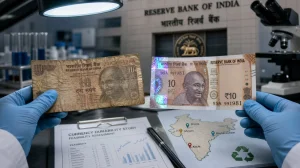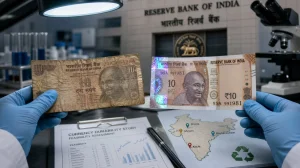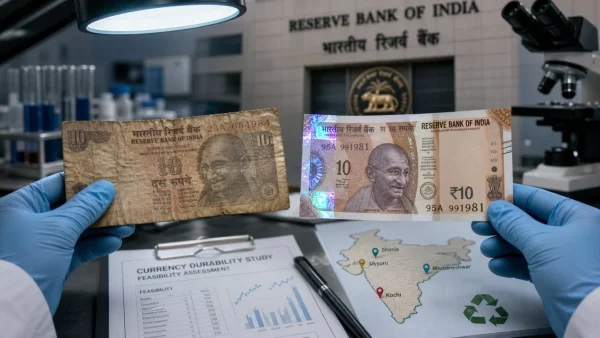
India is once again preparing for a change in its currency, with reports suggesting that the Reserve Bank of India may introduce polymer (plastic) ₹10 and ₹20 notes. The official argument is straightforward: polymer notes last longer, are cleaner, and are more resistant to counterfeiting than traditional paper notes.
On the surface, the proposal appears reasonable. After all, countries like Australia, Canada, and the United Kingdom have successfully adopted polymer currency. But in India, every major currency decision carries political and economic baggage, and this proposal is no exception.
The Questions People Are Asking. Why now?
India has lived with paper currency for decades. If polymer notes are genuinely superior, why weren’t they introduced during the 2016 demonetisation,
when the entire currency system was being overhauled?
Why spend on changing notes during periods of economic stress? With concerns over inflation, fuel prices, and cost of living, some citizens question whether replacing low-denomination notes should be a priority.
What is the total cost? Printing polymer notes requires different materials and technology. Citizens are entitled to know whether the long-term savings justify the upfront expenditure.
Will procurement be transparent? Whenever a large government contract is involved, people naturally ask who will supply the materials, who benefits, and whether the bidding process will be competitive and publicly scrutinized.
The first question many citizens are asking is simple: Why now?
The country underwent one of the biggest currency transitions in history during the 2016 demonetisation exercise. Nearly every citizen stood in queues, banks were overwhelmed, and the government argued that the exercise would modernize India’s financial system. If polymer notes represented the future, why weren’t they introduced during that massive overhaul? The timing naturally invites questions.
Another concern is one of priorities.
India continues to grapple with rising living costs, fluctuating fuel prices, unemployment concerns, and pressure on household budgets. Against this backdrop, replacing ₹10 and ₹20 notes may not appear to be the most urgent national priority for many citizens. While governments can pursue multiple objectives simultaneously, taxpayers deserve to understand why this investment deserves attention now.
Supporters of polymer currency argue that these notes last significantly longer than paper notes. A polymer note can remain in circulation several times longer than a cotton-paper note, potentially reducing replacement costs over time. They also claim polymer notes are more resistant to moisture, dirt, and counterfeiting.
These are legitimate advantages.
However, introducing polymer currency is not free. It involves procurement of specialized materials, modifications to printing infrastructure, and logistical adjustments. Naturally, citizens have a right to know:
What will the transition cost?What are the projected long-term savings?Has an independent cost-benefit analysis been published?Which companies will manufacture or supply the required materials?Will procurement follow a fully transparent competitive bidding process?These are questions of governance, not politics.
Recently, some commentators on social media have speculated that the move could benefit particular corporate groups, including the Adani Group. At present, there is no publicly available evidence that the proposed polymer notes are being introduced to benefit Adani or any other specific company. Such allegations require proof, not assumption.
Nevertheless, transparency matters precisely because it prevents unnecessary suspicion. If procurement is open, competitive, and publicly disclosed, speculation naturally loses credibility.
The issue, therefore, is not merely about plastic currency. It is about public trust.
Governments often expect citizens to trust their intentions, but trust is strengthened by openness rather than secrecy. Every major public expenditure should withstand public scrutiny, especially when it involves national currency.
The debate also highlights a larger question about governance.
Should administrative energy be focused on redesigning ₹10 and ₹20 notes when millions of Indians remain more concerned about inflation, fuel prices, employment opportunities, healthcare, and education? Citizens may reasonably disagree on the answer, but the discussion itself is healthy in a democracy.
Voices from the Public
Across social media, reactions have ranged from curiosity to sarcasm.
“The ₹20 note may become waterproof before our roads do.”
“They changed the notes once. Now they’re changing the material.”
“Inflation is permanent. Paper currency isn’t.”
“Plastic notes won’t tear, but household budgets already have.”
Humour often reflects public frustration more effectively than statistics.
The Bottom Line
Polymer notes are neither inherently good nor inherently bad. If they genuinely reduce costs, improve durability, and strengthen security, they deserve serious consideration. But every policy should also answer the questions of timing, transparency, and public priorities.
A democratic government should welcome scrutiny, publish detailed cost-benefit analyses, disclose procurement processes, and allow independent evaluation. That approach builds confidence far more effectively than expecting citizens to simply accept another currency experiment.
Whether polymer notes become a symbol of modernization or another subject of political debate will depend not on the material they are made from, but on the transparency with which they are introduced.