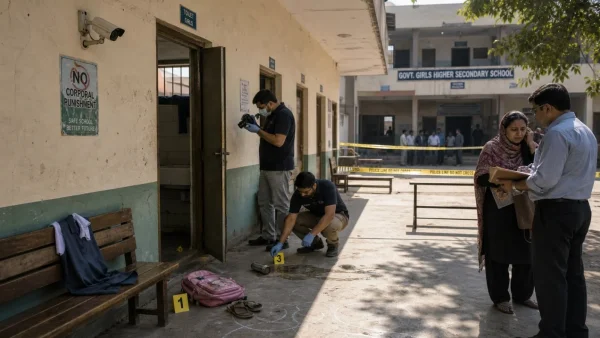
The death of a Class 7 student identified as Avni, reportedly enrolled at a government girls’ school in Mayur Vihar, has raised serious questions about student safety and the use of corporal punishment in Delhi’s government schools.
According to allegations made by the girl’s family, Avni was punished after she allegedly failed to bring a book to school. The family claims that she was made to stand in the sun and was physically assaulted before allegedly being locked inside a bathroom.
Her condition reportedly deteriorated following the incident. She was subsequently taken for medical treatment, where she later died.
The allegations have triggered demands for a thorough investigation into what happened inside the school and whether appropriate safeguards were in place to protect students.
Family alleges punishment turned fatal
The family’s account raises disturbing questions about the nature of the disciplinary action allegedly taken against the student.
They allege that Avni was punished for not bringing a required book to school and was made to remain outside in the heat. The family further alleges that she was beaten and subsequently confined in a bathroom.
These claims are extremely serious but must be established through the official investigation. At present, the allegations should not be treated as a judicially established account of the events.
The circumstances between the alleged punishment and the child’s medical deterioration will be particularly important to investigators.
Directorate of Education orders investigation
The Delhi Directorate of Education (DoE) has reportedly ordered an investigation into the circumstances surrounding the student’s death.
The inquiry will be crucial in determining what happened before Avni became ill, who was responsible for supervising her, whether any physical punishment took place and whether school authorities followed prescribed child-safety procedures.
Investigators should examine school records, statements from students and staff, CCTV footage where available, medical records and the family’s complaint.
If the inquiry establishes that a teacher or other school employee physically assaulted or unlawfully confined the child, the authorities must determine the appropriate disciplinary and legal action.
Bigger question: can punishment ever justify violence?
The case raises a fundamental question about the treatment of children in educational institutions.
A student forgetting a book is a routine disciplinary matter. It should never become an excuse for conduct that puts a child’s health or safety at risk.
Schools are entrusted with children for several hours every day. Teachers have authority over students, but that authority carries an equally important responsibility: to protect children, not expose them to violence or humiliation.
Any system of discipline must therefore operate within child-protection laws and government rules.
Questions for Delhi’s education authorities
The investigation should not stop at determining whether one individual committed misconduct. It should also examine whether there were systemic failures.
Several questions require clear answers:
1. Why was a Class 7 student allegedly made to stand in the sun as punishment?
If the allegation is established, authorities must determine who ordered the punishment and whether it violated school rules.
2. Was the student physically assaulted?
Medical evidence and witness statements should establish whether injuries were sustained and, if so, how.
3. Why was the child allegedly confined in a bathroom?
If the allegation is proven, investigators should establish who ordered or carried out the confinement and how long the child remained there.
4. When did school authorities first realise that the child was unwell?
The response time could be critical in determining whether appropriate medical assistance was provided.
5. Were parents informed immediately?
The school should explain when the family was contacted and what information was communicated to them.
6. Were there previous complaints about the staff involved?
Any earlier complaints concerning corporal punishment or inappropriate treatment should be examined.
7. What safeguards were actually operating inside the school?
The government must establish whether teachers and staff were adequately trained on child protection and whether complaints were being monitored.
What action should follow if the allegations are proved?
If the investigation confirms that the child was physically assaulted, deliberately exposed to dangerous conditions or unlawfully confined, the matter should not be treated as an ordinary disciplinary dispute.
Authorities should consider:
Immediate departmental action against responsible staff.
Appropriate criminal proceedings wherever the evidence warrants them.
Examination of the school’s child-safeguarding procedures.
Preservation and forensic examination of relevant CCTV footage.
Statements from teachers, students and other witnesses.
Review of the child’s medical records.
A determination of whether there was negligence in obtaining medical assistance.
A review of previous complaints against the accused staff members.
Appropriate support and assistance for the bereaved family.
Questions for the Education Ministry and Delhi Government
The incident also raises a broader policy question: how effectively are child-protection rules being implemented in government schools?
It is not enough to have rules prohibiting corporal punishment on paper. Students and parents need confidence that those rules are actively enforced.
The Education Department should therefore clarify the outcome of the investigation publicly, while protecting the privacy and identity of the deceased child.
If the inquiry finds wrongdoing, the public deserves to know what action was taken and what safeguards have been introduced to prevent another tragedy.
At the same time, allegations against teachers or school officials should not be treated as proven until the investigation establishes the facts.
A child’s safety must come before discipline
Schools are supposed to be places where children learn, develop confidence and receive protection while in the care of adults.
If the family’s allegations are confirmed, the case would represent a deeply disturbing failure of that responsibility.
A forgotten book can be replaced. A disciplinary issue can be addressed through counselling or a warning. A child’s life cannot be replaced.
The Directorate of Education’s investigation must therefore be comprehensive, transparent and evidence-based.
For Avni’s family, the most important questions are now painfully simple: What happened inside the school, who was responsible, was timely medical help provided, and could her death have been prevented?
The answers should not be buried beneath departmental procedures. They must be established through a credible investigation and, if wrongdoing is proved, followed by meaningful accountability.