For millions of Indian children, going to school is supposed to be one of the simplest and most fundamental parts of childhood.
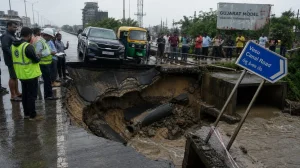
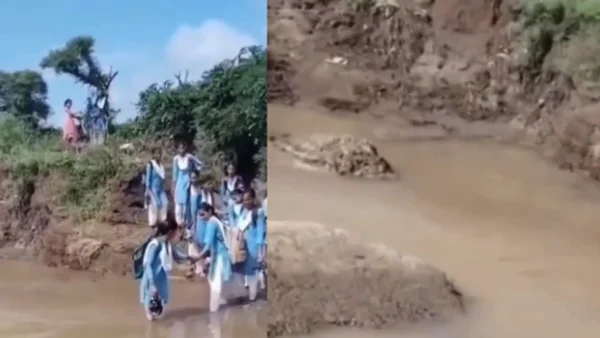
But in parts of Madhya Pradesh, getting to school can reportedly involve navigating dangerous roads, waterlogged stretches and inadequate infrastructure—turning an ordinary school journey into a daily test of courage.
Images and videos circulating on social media showing children struggling to cross difficult stretches on their way to school have triggered anger and concern, with citizens questioning how children are expected to pursue their education when basic access to schools remains unsafe.
The question being asked is uncomfortable:
“If India is preparing to become a developed nation by 2047, can we first make sure a child can reach school safely in 2026?”
A dangerous journey to education
For children living in remote and rural communities, access to education often depends on the availability of safe roads, bridges, transport and footpaths.
When these facilities are missing or damaged, children can be forced to take unsafe routes simply to attend classes.
During the monsoon, the problem can become even more serious.
Heavy rainfall can transform unpaved roads into muddy tracks, flood small bridges and culverts, and make streams and low-lying crossings dangerous.
For an adult, such a journey may already be difficult.
For a young child carrying a schoolbag, it can be frightening—and potentially life-threatening.
The development paradox
India’s political discourse frequently focuses on ambitious targets.
There are discussions about becoming a developed economy, building world-class infrastructure, expanding expressways, developing smart cities and achieving major economic milestones by 2047.
These goals are important.
But development is ultimately supposed to improve people’s everyday lives.
And that raises a basic question:
What does development mean to a child who has to risk their safety simply to attend school?
A country cannot measure progress only through GDP figures, highways and large infrastructure projects.
It must also ask whether a child in a remote village has a safe road, a functioning bridge, reliable transport and a secure route to school.
The cost of unsafe infrastructure
Unsafe access to schools can have consequences far beyond the immediate physical danger.
When travelling to school becomes difficult or hazardous, children may miss classes or stop attending altogether.
The impact can be particularly severe for younger children and families in remote areas.
For parents, the decision can become heartbreaking:
Send the child to school and worry about their safety—or keep the child at home and sacrifice their education.
No family should have to make that choice.
Where is the basic infrastructure?
The issue raises questions for local authorities and state governments.
If a road becomes impassable during the monsoon, is there an alternative route?
If children have to cross a stream or damaged bridge, has a safe temporary crossing been provided?
If the school is too far away for children to walk safely, is public or school transport available?
And if these problems have existed for years, why have they not been permanently resolved?
These are not demands for luxury infrastructure.
They are demands for basic public safety.
From promises to priorities
Political leaders often speak about India’s future and the country’s ambitions for 2047.
But the future is being built by today’s children.
Those children need functioning schools—but they also need a safe way to get there.
A modern education system cannot exist in isolation from the infrastructure surrounding it.
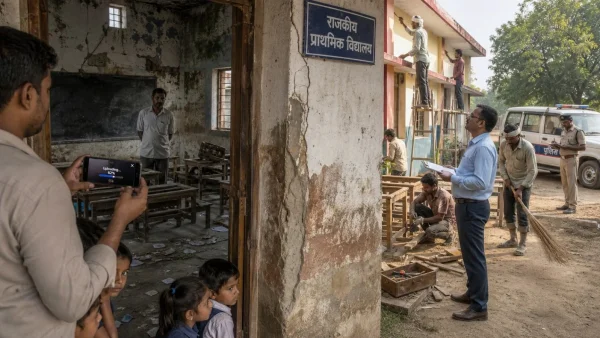
A school building is not enough if children cannot safely reach it.
The 2047 question
The year 2047 is more than two decades away.
There is plenty of time to discuss long-term national ambitions.
But some problems cannot wait two decades.
A child walking to school today needs a safe path today.
A damaged bridge needs repair today.
A dangerous crossing needs protection today.
And a village cut off during the monsoon needs an emergency transport solution today.
Development should begin with dignity and safety
The debate should not be reduced to one viral video or one political party.
The larger issue is whether governments at every level are prioritising the basic infrastructure that determines whether rural children can access education safely.
India’s ambition to become a developed country is entirely compatible with demanding better roads, bridges and public services in rural communities.
In fact, that is what development should mean.
Not merely bigger highways.
Not merely bigger buildings.
Not merely bigger economic targets.
But a country where a child can leave home in the morning, walk to school without fear, sit in a classroom, learn—and return home safely.
The simplest measure of progress
India can continue talking about 2047.
But perhaps the most meaningful measure of progress is much closer than that.
Can every child in Madhya Pradesh—and across India—reach school safely in 2026?
Because before we promise children a developed India tomorrow, we owe them a safe road to their school today.