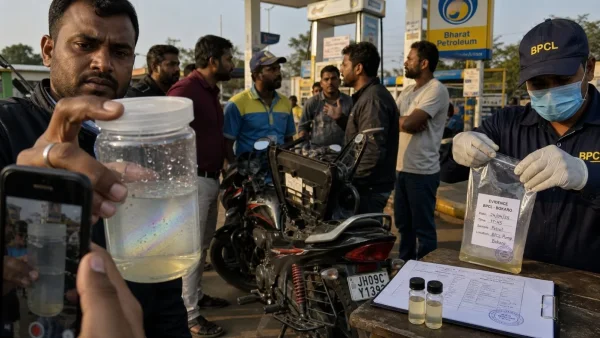
A video showing people questioning the quality of petrol at a Bharat Petroleum (BPCL) fuel station in Chas, Bokaro, has triggered concern among motorists and renewed scrutiny of fuel-quality checks at retail outlets.
The controversy reportedly began after a customer complained that his motorcycle developed problems shortly after being refuelled at a BPCL outlet near Telidih More, along the four-lane road towards Bandhgora. According to local reporting, the customer alleged that his vehicle stopped after filling petrol and that its components were subsequently affected.
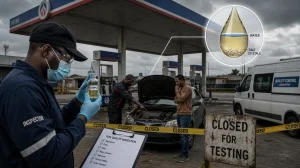
As suspicion spread, customers reportedly asked the petrol-pump staff to provide fuel in a separate container for inspection. A video recorded during the confrontation subsequently circulated on social media, with viewers claiming that the liquid appeared unusually cloudy or different from normal petrol.
Some social-media posts have sarcastically described it as “M100” rather than E100. But such descriptions are not technical findings. The appearance of fuel alone cannot establish whether it contains water, has been adulterated, or has suffered some other form of contamination.
What triggered the dispute?
According to local reports, a Chas resident identified as Ashish had filled his motorcycle at the Bharat Petroleum outlet and later complained that the vehicle stopped working.
The customer reportedly suspected that the fuel itself was responsible. Other people at the station then questioned the quality of the petrol and demanded that fuel be drawn into a bucket or container so that they could examine it.
The resulting footage became the focus of the controversy.
The most important question now is not what the liquid looks like in a mobile-phone video, but what laboratory testing shows.
A viral video is not a laboratory test
Petrol can become contaminated by water or other substances at different points in the fuel-storage and distribution chain. Water can potentially enter underground storage tanks through several mechanisms, including leaks, condensation or flooding, which is why fuel-quality and water-ingress checks are important.
But a visual inspection cannot conclusively determine the composition of a petroleum product.
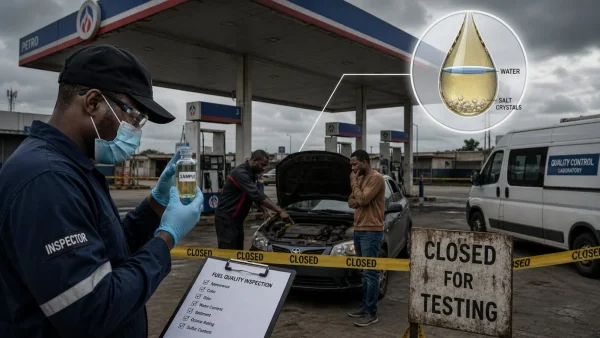
A proper investigation would require authorities to collect sealed samples from the relevant storage tank and dispensing equipment and send them for testing under the applicable fuel-quality standards.
That distinction is crucial because social-media videos can establish that consumers had concerns, but they cannot by themselves establish adulteration, contamination or criminal liability.
Government says fuel-quality monitoring has been strengthened
The Bokaro controversy comes at a time when fuel quality has already become a major public issue.
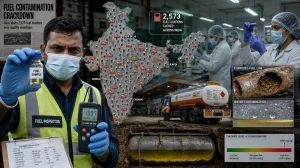
On August 4, 2026, the Ministry of Petroleum and Natural Gas said that fuel quality is regularly monitored by oil marketing companies and that additional checks—including water-ingress testing multiple times a day at more than 87,000 retail outlets—had been instituted.
The ministry also said that more than 2,000 fuel samples had been tested for chloride and sulphide contamination, with two cases of chloride contamination detected nationally at that point. According to the ministry, sales at those affected outlets were suspended and oil companies were instructed to take preventive measures across the supply chain.
The government has simultaneously warned people against circulating unverified fuel-contamination claims that could create unnecessary panic.
What should happen at the Bokaro outlet?
If customers genuinely suspect contaminated fuel, the appropriate response is an immediate and documented inspection rather than a social-media trial.
Authorities and the oil company should establish:
The exact fuel batch supplied to the outlet.
The condition of the underground storage tank.
Whether water was detected inside the tank.
The outlet’s recent water-ingress and quality-testing records.
Samples from the storage tank and dispensing nozzle.
Whether samples from affected customers’ vehicles contain abnormal substances.
Whether other customers experienced vehicle breakdowns after refuelling.
Whether the outlet complied with prescribed fuel-quality procedures.
Whether any equipment malfunction could have contributed to the incident.
If laboratory testing confirms contamination, the responsible authority should determine where the contamination occurred and whether customers suffered measurable losses.
Previous fuel-related concerns in Bokaro
This is not the first fuel-related controversy to attract attention in the district.
In June 2026, authorities conducted raids at multiple locations in and around Bokaro after reports of illegal storage of petrol, diesel and ethanol. Officials reportedly seized fuel and storage drums and said action would continue against illegal fuel businesses.
That case is separate from the current BPCL-pump allegations and should not be treated as evidence that the retail outlet involved in the viral video was engaged in illegal activity.
What happens if contamination is confirmed?
If an official inspection confirms that fuel sold at the outlet was contaminated, the matter could have consequences for both the outlet and the wider supply chain.
Depending on the findings, authorities could order:
Suspension of fuel sales from the affected tank or outlet.
Sealing of contaminated stock.
Collection and laboratory testing of samples.
Inspection of storage infrastructure.
Investigation into the source of contamination.
Action under applicable petroleum and consumer-protection regulations.
Assessment of claims from customers whose vehicles were damaged.
Corrective measures before the outlet resumes normal sales.
Any compensation, however, would depend on the investigation establishing the cause of the damage and the applicable legal and contractual mechanisms.
What motorists should do
Motorists who believe their vehicle has been affected by contaminated fuel should avoid immediately discarding the remaining fuel or repairing the vehicle without documentation.
They should preserve, where possible:
The fuel receipt.
Vehicle repair bills.
Details of when and where the fuel was purchased.
Photographs or videos of the fuel or vehicle.
The vehicle’s service and breakdown records.
Any diagnostic report from a qualified mechanic.
The customer can then make a formal complaint to the oil marketing company and the appropriate consumer or regulatory authority.
The bigger issue: trust at the fuel pump
For millions of motorists, a fuel station operates on a basic assumption: the product being sold is what the dispenser says it is.
When a vehicle breaks down immediately after refuelling, that trust is naturally questioned.
But the answer cannot come from a viral video alone.
The strongest response would be a transparent inspection, independently documented sampling and laboratory testing. If the fuel is clean, the results should reassure consumers. If contamination is confirmed, those responsible should be identified and appropriate action should follow.
For now, the Bokaro video has raised a legitimate public question—but whether the liquid shown was actually contaminated petrol remains a matter for laboratory verification, not social-media speculation.
The public deserves that answer quickly, clearly and transparently.