A deeply disturbing incident reported from West Bengal has triggered questions about political violence, freedom to raise civic concerns and the safety of ordinary citizens who speak about public infrastructure.
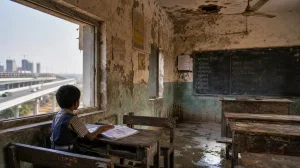
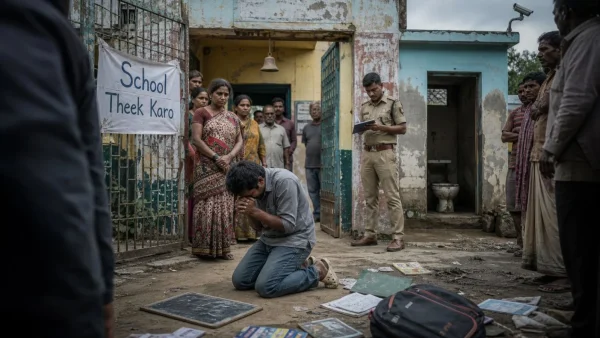
According to accounts circulating online, Shaik Abdul Hafeez, associated with a campaign called “School Theek Karo”, had visited and highlighted the condition of a government school where he had reportedly studied.
The campaign’s basic demand was hardly revolutionary: improve government schools and provide students with better facilities.
But what followed, according to the allegations circulating online, was devastating.
Hafeez’s father was allegedly attacked by a group of men after his son raised questions about the condition of the school. He reportedly died following the assault.
These allegations require independent verification through police records, medical documents, eyewitness accounts and statements from the family. At present, the political attribution of the alleged attackers should not be treated as established fact without evidence.
A Campaign Called “School Theek Karo”
The reported campaign focuses on a simple idea: citizens should document deficiencies in government schools and demand improvements.
That can include basic facilities such as:
Functional classrooms
Toilets
Drinking water
Electricity
Furniture
Safe buildings
Teachers and teaching resources
Clean surroundings
Government schools are not private property.
They are public institutions, funded substantially through public resources and intended to serve children.
Questioning their condition is therefore a legitimate part of democratic citizenship.
The Most Disturbing Question: Why Would a School Dispute Turn Violent?
If the allegations are established, this is no longer merely a story about a school.
It becomes a story about intimidation.
A citizen points out poor infrastructure.
Someone allegedly objects.
An attack allegedly follows.
And a family loses a loved one.
That sequence, if proven, would represent a frightening breakdown of democratic norms.
People should be able to criticise a government school without fearing retaliation.
A broken toilet can be repaired. A broken family cannot.
A Son’s Question, A Father’s Death
The emotional dimension of the case is particularly painful.
The campaign reportedly involved Hafeez documenting the condition of his former school.
Instead of the discussion remaining focused on whether the school needed repairs, the controversy allegedly escalated into violence against his family.
His father’s death has now turned an education campaign into a tragedy.
The central question is therefore not merely:
“Who attacked him?”
It is also:
“Why did anyone believe violence was an acceptable response to criticism?”
Political Allegations Must Be Investigated, Not Assumed
Social media posts have reportedly attributed the alleged attack to political workers.
That is a serious allegation.
But responsible journalism requires distinguishing between what has been alleged and what has been established.
Police should publicly clarify:
Who was attacked?
When and where did the incident occur?
What injuries were recorded?
What was the medical cause of death?
Who has been named in the complaint?
How many people have been arrested?
What sections of law have been invoked?
Is there CCTV or other evidence?
Has a political connection of the accused been established?
Until those questions are answered, claims about the attackers’ political affiliation should remain allegations.
The Bigger Issue: Can Citizens Question Public Institutions?
This incident raises a question much larger than one school.
A democracy depends on citizens being able to say:
“This road is broken.”
“This hospital isn’t functioning.”
“This school needs improvement.”
“Where did the public money go?”
Those aren’t anti-national questions.
They are citizenship.
If people become afraid to document failures in public institutions because they fear retaliation, accountability disappears.
And when accountability disappears, poor governance becomes much easier to hide.
Government Schools Belong to the Public
There is another important dimension.
A government school isn’t the personal property of a politician, bureaucrat or local political organisation.
It belongs to the public.
Parents send their children there.
Teachers work there.
Taxpayers help finance it.
The government administers it.
Therefore, citizens have every right to demand that it function properly.
The correct answer to a complaint about a school should be an inspection—not intimidation.
What Should the West Bengal Government Do?
If the allegations are accurate, authorities should immediately ensure a transparent investigation.
1. Register and investigate the case
Every person named in the complaint should be investigated according to law.
2. Establish the cause of death
Medical and post-mortem records should be examined independently.
3. Examine CCTV and digital evidence
Nearby cameras, mobile footage and other evidence could establish what happened.
4. Protect the family
If the family faces threats, adequate protection should be provided.
5. Investigate the alleged political connection
If political workers are accused, their affiliation and role should be established through evidence.
6. Audit the school
The original issue should not disappear amid the violence. The government should inspect the school and publicly disclose what improvements are required.
Don’t Let the School Disappear
From the Story There is an unfortunate possibility in cases like this: the alleged violence becomes the entire story while the original complaint disappears.
That would be a failure.
If Hafeez was raising legitimate concerns about the condition of his former school, authorities should address those concerns regardless of what happened subsequently.
The school should be inspected.
Its infrastructure should be assessed.
Required repairs should be identified.
And public funds allocated for education should be accounted for.
The tragedy should not bury the question that started it.
Education Should Never Be a Political Battlefield
Children don’t care which political party controls the state.
They care whether their classroom has a roof.
Whether there is a functioning toilet.
Whether they have drinking water.
Whether they have teachers.
Whether they can study safely.
That is why government-school infrastructure should ideally remain above political confrontation.
A child asking for a better school should never become a political threat.
Final Word
The reported death of Shaik Abdul Hafeez’s father following an alleged attack is a deeply disturbing claim that deserves a fast, impartial and evidence-based investigation.
If someone was killed because of a civic campaign, the implications would go far beyond one family. It would raise fundamental questions about political violence and the space available to citizens who criticise public institutions.
But the facts must come first.
Who attacked the man?
Why was he attacked?
Was the attack connected to his son’s campaign?
Were political workers involved?
What does the police investigation show?
And perhaps the most important question: If citizens cannot ask for better schools without fear, what exactly is democracy asking them to remain silent about? A government school can be repaired.
A political disagreement can be resolved.
A complaint can be investigated.
But a life lost can never be restored.