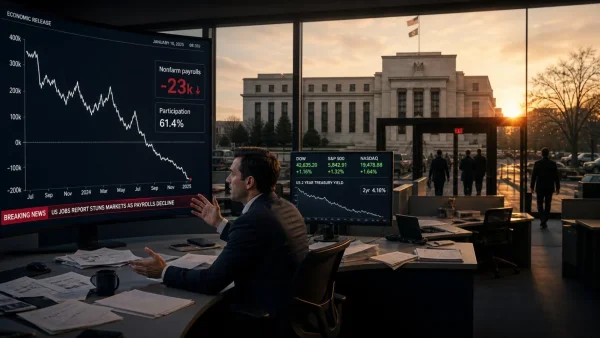
In some ways the July numbers have upended the summer story on rates and growth. Not only did employers let go of 23,000 jobs, but prior months were not as strong as first thought; May and June figures were revised lower by 103,000 in all. As people have walked away from the job market, the unemployment rate has slipped to 4.1%, fueling more debate over how the Fed will respond.
There is a certain mix here of fewer positions and fewer applicants. The participation rate has come in at 61.4% with 264,000 Americans leaving the labour force altogether. While it may take some of the edge off wage pressures, such a cooling market can be hard on household incomes.
Markets shift focus to Fed
Traders had been prepared for a rate hike in September before the report came out. What happened instead was a paring of those wagers: US stock futures went up and Treasury yields came down. The two-year yield is now 4.16 per cent, down 9 percentage points, as investors sense the policymakers will want to see more data before acting.
The central bank left its benchmark overnight rate where it was last week, in the 3.50%-3.75% bracket, despite three officials wanting a quarter-point move. All eyes will be on the inflation print next week as the Fed weighs sticky prices against the mounting risks to employment.
One has to look at the forecasts to see the miss. Estimates ran the gamut from 10,000 to 140,000 added jobs, with 80,000 the consensus for July. It is a reminder of how fast the momentum has dissipated following the resilience of earlier in the year.
A cooler labour market behind the headline
‘Slow hire, slow fire’ is how economists put it. Layoffs are still historically uncommon but there is no aggressive expansion from employers. Some are having trouble to put bodies in seats, others are turning to technology to do the work.
Year over year average hourly earnings are up 3.2%, the most modest increase in five years. It does little for purchasing power when energy is expensive because of the situation in Iran, but it should assuage some of the inflation concerns.
Private-sector payrolls put in a second month of 30,000 growth, driven by healthcare and social assistance. The overall picture was dimmer thanks to government and consumer-facing sectors, which point to uneven demand.
From the July report, these are the official figures worth noting:
– Nonfarm payrolls down 23,000
– Unemployment at 4.1%
– Participation rate of 61.4%
– A 264,000 shrinkage in the labour force
– 103,000 cut from May and June in revisions
– 30,000 rise in private payrolls
– Fed policy rate holding at 3.50%-3.75%
Where the jobs were lost and gained
Nearly 60,000 local government jobs were shed, mostly in education. One count puts it at 50,000 in the public schools, a seasonal thing that usually right itself once classes are back in session. The federal side also saw a decline.
Restaurants and bars in leisure and hospitality trimmed 26,000 headcount, taking the sector to its lowest in close to a year. Retailers were down 19,000. You would have thought the FIFA World Cup, which wound up on July 19, might have given hiring in these areas a lift, but it did not.
Then again, not everything has softened. Manufacturing and construction kept climbing. The administration is touting 22,000 in construction and 5,000 in factories. There is talk among economists that data-centre work could underpin construction demand well into 2026.
Financial activities stand out as a weak link, with employment at a four-year low. The white-collar jobs in that sphere are considered more vulnerable to the kind of restructuring AI brings about.
Why it matters now
After a quiet 2025 and a mild rebound in the first half, the labour market is in a state of recalibration. Even though domestic demand picked up in the second quarter to its best level in over three years, higher energy costs and new tech are tempering the desire to hire.
The fact that the unemployment rate has fallen is due to a lack of jobseekers. Put aside the pandemic and a 61.4% participation rate is not far off the lows of the 1970s. The tight supply is why one does not see many layoffs even with the slower pace of hiring.
It will come down to confidence and inflation. Should price pressures abate with job growth, the Fed could put off any tightening. But if inflation makes a comeback, the officials will have an awkward position with the labour market already under some strain.