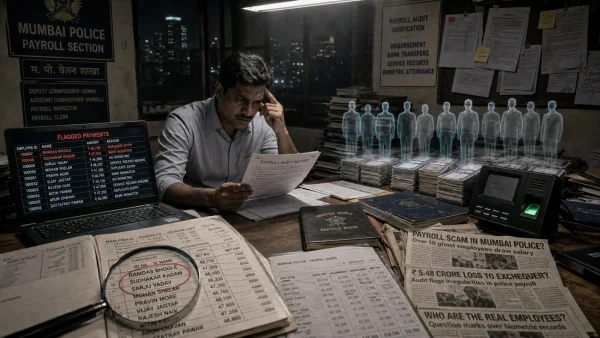
A startling case of alleged financial irregularity has come to light after it was reported that ₹6.41 crore in salaries was paid to 10 non-existent employees on the Mumbai Police payroll between 2019 and 2020. The alleged fraud, which reportedly remained undetected for nearly six years, has raised serious concerns about internal financial controls and oversight within one of the country’s largest police forces.
According to reports, the salaries were credited in the names of individuals who allegedly did not exist, suggesting the possibility of fabricated employee records and systemic failures in payroll verification.
If confirmed, the case represents not just financial misconduct but also a significant breach of public trust.
Who Were the Alleged 'Ghost Employees‘?
The names reportedly linked to the alleged fake payroll entries include:
Ramdas Bhogle
Sudhakar Kadam
Sarju Yadav
Bhagwat Bhosale
Gunaji Khavkar
Mahadev Haldankar
Rajendra Sonar
Uttam Thorat
Suryakant Patil
Pandurang Kadam
Investigators are examining how these names allegedly entered official records and how salary payments continued over an extended period without being detected.
How Could This Happen?
Government salary payments typically involve multiple levels of verification, including:
Employee appointment records.
Service books.
Payroll preparation.
Treasury or finance department approval.
Bank account verification.
Internal audits.
The existence of alleged ghost employees for such a long period raises questions about whether these safeguards were bypassed or whether internal checks failed.
Investigators will need to determine whether the alleged fraud resulted from negligence, deliberate manipulation, or collusion.
Questions Higher Authorities Must Answer
The case has prompted several questions that citizens are likely to expect answers to:
How were employees allegedly added to the payroll without proper verification?
Who approved the appointments and salary disbursements?
Were biometric attendance, identity verification, or service records ever checked?
Why did internal audits fail to detect the alleged irregularities sooner?
Has the full amount been recovered, or is recovery underway?
Have criminal or departmental proceedings been initiated against responsible officials?
Could similar irregularities exist in other government departments?
These are questions that only a thorough investigation can answer.
Could This Have Happened Without Insider Involvement?
Financial experts note that payroll systems generally require approvals at multiple stages.
If salaries were indeed paid to fictitious employees over several months, investigators are likely to examine whether there was any insider involvement or breakdown in administrative oversight.
At this stage, however, responsibility can only be fixed after the investigation is completed and evidence is examined.
Taxpayer Money at Stake
Every rupee paid as salary in a government department comes from public funds.
When public money is allegedly diverted through fake payroll entries, the loss is ultimately borne by taxpayers.
Beyond the financial impact, such cases can also affect public confidence in government institutions and raise concerns about the effectiveness of internal controls.
The Need for Stronger Oversight
The alleged scam has renewed calls for stricter financial monitoring in public institutions.
Experts suggest measures such as:
Regular payroll audits.
Mandatory biometric verification.
Periodic employee record reconciliation.
Independent financial inspections.
Greater use of digital verification systems.
Such safeguards can help reduce the risk of fraudulent salary payments.
A Matter of Public Accountability
The Mumbai Police plays a critical role in maintaining law and order. Allegations of financial irregularities within such an institution inevitably attract public attention because they involve both taxpayer money and institutional credibility.
If the allegations are proven, accountability will not stop at identifying the immediate beneficiaries. Investigators may also examine whether supervisory failures or administrative lapses enabled the alleged fraud to continue for years.
The Bigger Question
A payroll system does not issue salaries on its own. Every appointment, approval, and payment is expected to pass through official channels.
If ₹6.41 crore was indeed paid to 10 alleged ghost employees over an extended period, the question extends beyond who received the money.
It also becomes:
Who approved the payments? Who verified the records? Who missed the warning signs? And why did it take nearly six years for the alleged fraud to come to light?
For taxpayers, these questions deserve clear answers. Public institutions are built on accountability, and when public money is involved, transparency is not optional—it is essential.