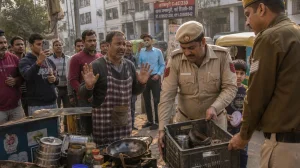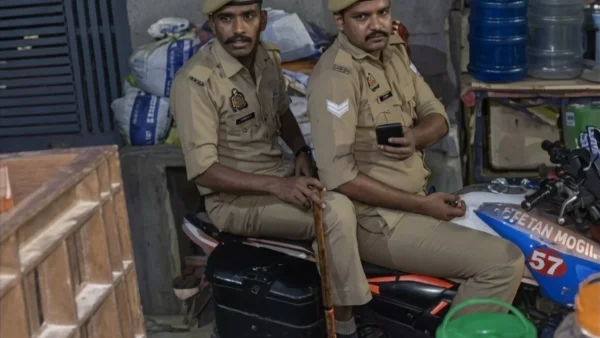
A viral video from Khoda Colony in Ghaziabad, Uttar Pradesh, has triggered public outrage after a woman shopkeeper alleged that two police personnel took fruit drinks and biscuits from her shop without paying and threatened to shut down her business when she demanded payment.
According to the woman’s account, she is a widow raising two young children, and the small roadside shop is her family’s only source of income. She alleges that instead of paying for the items, the officers intimidated her by warning that they could have her shop closed.
The authenticity of the video and the allegations have not been independently verified, and the police have not publicly responded to the claims at the time of writing.
A Small Shop, A Big Allegation
The incident has resonated widely because it involves someone who says she depends entirely on a modest business to support her family.
According to the allegations:
Two police personnel entered the shop.
They took fruit drinks and biscuits.
When the woman asked for payment, they allegedly refused.
She claims they then threatened to use their authority to shut down her shop.
If established through an official inquiry, the allegations would raise serious concerns about abuse of authority.
The Power of the Uniform Comes With Responsibility
Police officers are entrusted with maintaining law and order, protecting citizens, and enforcing the law impartially.
Their authority is significant—but it is also accompanied by professional and ethical responsibilities.
If public servants misuse their position for personal benefit or intimidation, it can weaken public confidence in law enforcement.
At the same time, any determination of misconduct must be based on a fair investigation rather than solely on viral videos or social media claims.
Are Police Doing Their Duty Perfectly?
No institution is free from allegations of misconduct.
Across India, the vast majority of police personnel carry out demanding duties under difficult conditions, often working long hours in challenging environments.
However, when allegations of misconduct arise, they deserve prompt and impartial examination.
Isolated incidents, if proven, should not be used to judge the entire police force. Equally, proven misconduct should not be ignored because it involves a few individuals.
Maintaining public trust requires both acknowledging good policing and addressing wrongdoing.
What Action Can Be Taken if the Allegations Are Proven?
If an inquiry finds that police personnel misused their authority, the government and police department have several mechanisms available, including:
Departmental disciplinary proceedings.
Suspension pending investigation, where warranted.
Recovery of any unlawful benefit.
Criminal action if an offence is established under law.
Mandatory ethics and public conduct training.
Strengthened supervisory oversight.
The specific action would depend on the findings of the investigation and applicable service rules.
What Can Governments Do to Reduce Such Incidents?
Experts on police reforms often recommend measures such as:
Body-worn cameras during field duties.
CCTV coverage in public interactions where feasible.
Independent complaint mechanisms for citizens.
Faster departmental inquiries into misconduct allegations.
Regular ethics and sensitivity training.
Strong protection for complainants against retaliation.
Such measures can improve both accountability and public confidence.
A Question of Trust
For many citizens, the police uniform symbolizes safety and justice.
When allegations emerge that officers may have used that authority to intimidate a small shopkeeper, the issue extends beyond the value of a few food items.
It becomes a question of whether every citizen—especially those with limited means—can expect to be treated fairly by those tasked with enforcing the law.
The Bigger Question
The viral allegations have sparked a wider conversation:
If a widow running a small shop fears asking for payment from public officials, what message does that send to ordinary citizens?
The answer will depend on the outcome of any official inquiry.
If the allegations are found to be true, accountability will be essential—not only to address the individual incident but also to reinforce the principle that public authority is meant to serve citizens, not intimidate them.
Ultimately, the strength of policing is measured not only by its ability to enforce the law but also by its commitment to fairness, integrity, and respect for every member of the public.