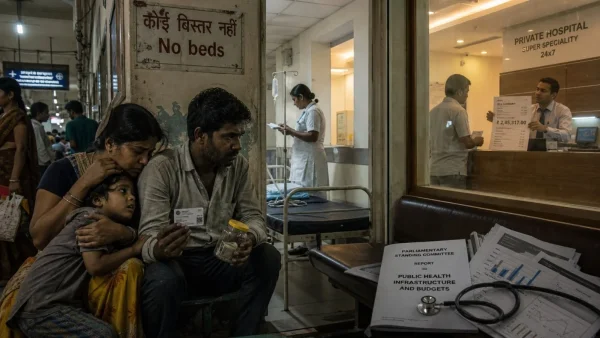
A Parliamentary Report Has Put India’s Healthcare Problems Under the Microscope — The Question Is Whether the Government Will Act
India’s healthcare debate often begins at the hospital gate: “Is there a bed?”
Then comes the next question: “How much will it cost?”
And, for millions of families, the final question is the most frightening:
“How are we going to pay for this?”
A recent parliamentary discussion on healthcare has brought several of these structural problems back into focus. Among the concerns highlighted are inadequate public spending, limited government-hospital capacity, the large cost gap between public and private treatment, gaps in health-insurance protection, concerns around private-hospital billing and the growing role of private-equity investment in hospitals.
But there is an important caveat: the committee’s observations and recommendations are not themselves proof that every private hospital is overbilling or that every acquisition harms patients. They are policy concerns that require examination and government action.
The First Number That Should Make Policymakers Uncomfortable: 1.43%
Government health expenditure was about 1.43% of GDP in 2022–23, according to National Health Accounts data cited in recent policy analyses. That remains below the 2.5% of GDP target set out in the National Health Policy, 2017.
That doesn’t mean India spends only 1.43% of its entire healthcare bill.
It means the government’s health expenditure relative to GDP remains below its own policy ambition.
And that distinction matters.
India has made progress: government health expenditure as a share of total health expenditure has increased over time, and per-capita government health spending has also risen.
But the uncomfortable question remains:
If 2.5% was considered the policy goal, why is the country still below it? Healthcare is not like announcing a new highway.
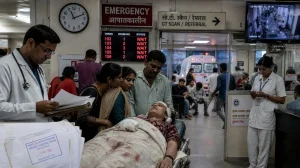
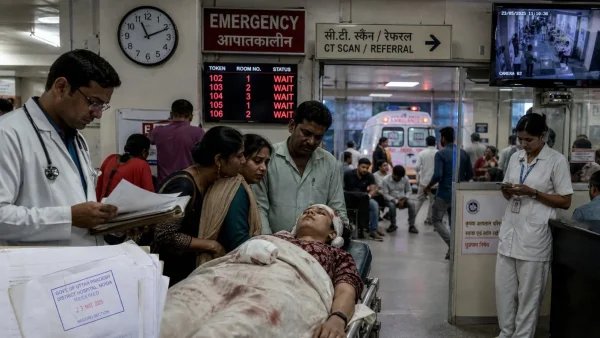
You cannot wait until the patient arrives in the emergency room to start building the system.
The Bed Problem: When “Government Hospital” Means “Please Wait”
Another structural weakness is public-sector hospital capacity.
A recent analysis puts government hospital availability at approximately 0.79 beds per 1,000 people. (ResearchGate)
The number is not merely an infrastructure statistic.
It translates into:
overcrowded hospitals,
longer waiting periods,
pressure on doctors and nurses,
patients being referred elsewhere,
families turning to private hospitals when public facilities cannot accommodate them.
And once a patient moves into the private sector, the financial equation can change dramatically.
Private Healthcare: A Lifeline That Can Become a Financial Shock
Private hospitals are indispensable to India’s healthcare system. They provide enormous capacity, specialised treatment, technology and emergency services.
But the problem arises when the patient’s need for treatment collides with an opaque pricing system.
The parliamentary concerns around differences between government and private hospital charges deserve serious examination.
There are also long-standing concerns about unnecessary diagnostics, excessive billing and the absence of uniform pricing structures in parts of the private healthcare market.
That doesn’t mean every test ordered by a private hospital is unnecessary.
Sometimes expensive diagnostics are medically essential.
The real question is:
Who decides what is medically necessary—and how transparent is that decision to the patient? A family in an emergency isn’t exactly in the strongest position to negotiate the price of an MRI.
And Then There Is the “Missing Middle”
Perhaps one of the most important issues is the population that falls between the cracks.
A NITI Aayog report on India’s health-insurance “missing middle” estimated that at least 30% of the population—around 40 crore people—lacked financial protection through health insurance at the time of its analysis. (Niti Aayog)
These people are particularly vulnerable because they may not qualify for government-sponsored insurance while also lacking adequate private coverage.
They aren’t necessarily the poorest of the poor.
They are the people who can be earning, paying rent, paying taxes and running businesses—but one major operation can still destabilise the household financially.
They can afford healthcare—until they actually need it. That’s the insurance paradox.
The Private-Equity Question: Is Healthcare Becoming an Investment Product?
Another issue that deserves attention is the increasing participation of private-equity investors and financial investors in India’s hospital sector.
Investment can be beneficial.
It can bring:
capital,
modern infrastructure,
technology,
professional management,
expansion into new cities.
But healthcare is different from selling smartphones.
A hospital has a social responsibility that cannot be measured purely through quarterly returns.
If financial ownership creates pressure to maximise revenue, policymakers need to ensure that clinical decisions remain driven by patient welfare and medical necessity, not financial incentives.
This is why stronger regulation, transparent pricing and monitoring matter.
The Government Cannot Simply Say: “Go to a Private Hospital”
This is perhaps the central issue.
If government hospitals don’t have sufficient beds, equipment or specialists, patients naturally move toward private providers.
But if private treatment is unaffordable, the patient is trapped between two systems:
Public hospital:
Private hospital:
“Bed available. Here’s the bill.”
And somewhere in between is the Indian family wondering whether selling savings, borrowing money or taking a loan is the only way to keep someone alive.
India’s health-financing problem is therefore not simply about how many hospitals exist.
It is about whether people can actually afford to use them.
But Let’s Not Turn This Into “Government Good, Private Bad”
That would be an oversimplification.
India needs both sectors.
Public hospitals are essential for universal access and financial protection.
Private hospitals provide enormous capacity and specialised services.
The answer isn’t to destroy private healthcare.
The answer is to regulate it properly while strengthening the public system.
Recent research on publicly funded insurance schemes in Maharashtra, for example, has identified problems involving reimbursement rates, claims processing, monitoring and private-hospital participation—showing that simply having an insurance scheme does not automatically create affordable healthcare. (PubMed Central (PMC))
The Real Healthcare Crisis Is the Gap Between a Policy and a Patient
India has no shortage of health programmes.
We have:
public hospitals,
health insurance schemes,
medical colleges,
digital health initiatives,
primary-health centres,
national health programmes.
The challenge is whether these systems work when an ordinary citizen actually needs them.
Because a government scheme existing on paper doesn’t help a patient lying outside an overcrowded emergency ward.
A health-insurance card doesn’t help enough if the nearest empanelled hospital refuses admission.
A hospital building doesn’t solve the problem if there aren’t enough doctors, nurses, medicines or functioning equipment.
The Report Is a Warning—Not a Verdict
This distinction is important.
A parliamentary committee’s recommendations are not equivalent to a criminal investigation or a judicial finding.
Claims of “unnecessary diagnostics,” “excessive billing” or harmful consequences from private-equity ownership should therefore be investigated through data, audits and regulatory oversight rather than treated as proof that every hospital is guilty.
Likewise, the 1.43% expenditure figure should not be presented as evidence that the government is doing “nothing” on healthcare. Public health spending has increased over the years. (Nation Press)
The stronger criticism is more precise:
The country’s own health-policy ambitions have not yet been fully achieved.
So What Should the Government Do?
1. Move Toward the 2.5% Health-Spending Target
A credible, time-bound roadmap should explain how public health expenditure will rise and where the additional money will go.
2. Build More Public Capacity
More beds are important, but so are:
doctors,
nurses,
specialists,
ICUs,
diagnostics,
medicines,
ambulances.
A bed without a doctor is basically an expensive piece of furniture.
3. Regulate Private-Hospital Pricing
Patients should receive clear information about:
procedure costs,
room charges,
diagnostic charges,
professional fees,
package rates,
additional expenses.
4. Create Stronger Billing Audits
Suspicious patterns—such as repeated unnecessary investigations or unexplained billing—should trigger regulatory scrutiny.
5. Close the “Missing Middle” Insurance Gap
The roughly 40-crore estimate from the NITI Aayog’s earlier analysis demonstrates the scale of the challenge. (Niti Aayog)
Affordable insurance products and stronger public financial protection are essential.
6. Monitor Private-Equity-Owned Hospitals
Investment should be welcomed, but clinical independence, pricing transparency and patient rights must remain non-negotiable.
7. Strengthen Primary Healthcare
The best hospital is sometimes the hospital a patient never has to reach.
Preventive care, early diagnosis and functioning primary-health centres can reduce pressure on expensive secondary and tertiary hospitals.
And Here Comes the Sarcasm
India’s healthcare system sometimes works like this:
Government: “Healthcare for all.”
Citizen: “Great. Where?”
Government hospital: “No beds.”
Citizen: “Private hospital?”
Private hospital: “Certainly.”
Citizen: “How much?”
Private hospital: “Let’s discuss after admission.”
Citizen: “Insurance?”
Insurance: “Terms and conditions apply.”
And suddenly the patient’s blood pressure isn’t the only thing rising.
The Question the Ministry Cannot Ignore
The parliamentary recommendations ultimately return the responsibility to policymakers.
A committee can identify problems.
It can recommend reforms.
It can put numbers on paper.
But implementation belongs to the government.
The real test will therefore not be another report, another committee or another announcement.
It will be whether an ordinary Indian can walk into a hospital and receive timely, quality treatment without being pushed into financial distress.
Because healthcare should not be a luxury product.
A country cannot call its healthcare system successful merely because world-class hospitals exist.
The real measure is whether the ordinary citizen can afford to survive the visit.
And perhaps that is the biggest message from the latest parliamentary scrutiny: