A fresh environmental controversy is brewing in Maharashtra after the state government approved the diversion of nearly 83,700 square feet of forest land for two projects involving Adani Group companies.
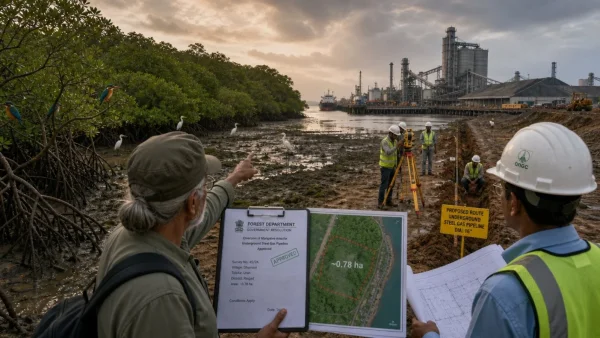
The approvals cover land in Raigad and Amravati districts and were issued through two separate Government Resolutions of Maharashtra’s Forest Department. The larger portion involves reserved forest as well as nala and creek mangrove forest in the Alibag area of Raigad district. (Forest Clearance)
The second approval concerns reserved and identified forest land in Amravati for an underground natural-gas pipeline.
But there is an important distinction: this is being described as diversion of forest land for specified project purposes, not an unrestricted sale or permanent transfer of the forest to a private company.
And that distinction matters.
Where Exactly Is the Land Going?
The total area involved is approximately 0.78 hectare, equivalent to roughly 83,700 sq ft.
1. Raigad — Adani Cementation Limited
The larger diversion covers 0.6497 hectare, or approximately 69,900 sq ft.
The land is located around Shahapur and Shahbaz villages in Alibag taluka, Raigad district.
The area includes:
Reserved forest
Nala mangrove forest
Creek mangrove forest
The land is being diverted for infrastructure connected with the proposed Raigad Cement Bulk Terminal, including:
A berthing jetty
Conveyor corridor
Backup facilities
Approach road
Government documents confirm that the proposal involves diversion of 0.6497 hectare of forest land for the project.
2. Amravati — Adani Total Gas Limited
The second diversion covers 0.1281 hectare, approximately 13,800 sq ft.
This land will be used for an underground steel pipeline intended to establish a natural-gas distribution network in Amravati city and surrounding areas.
Put together, the two approvals cover about 0.78 hectare, or roughly 1.9 acres.
The Mangrove Question Is the Most Sensitive Part
The Raigad project isn’t simply about ordinary vacant land.
The documents specifically identify portions as mangrove forest.
Mangroves are environmentally important coastal ecosystems. They can provide habitat for wildlife, help protect coastlines and contribute to flood and storm protection.
And this particular Adani project has been under environmental scrutiny for years.
A site inspection associated with the proposal had earlier recorded that construction would pass through reserved forest and mangrove areas and could involve the cutting of approximately 150 mangrove trees/shrubs.
That history makes the latest diversion particularly significant.
This Isn’t a New Proposal That Appeared Overnight
The Raigad cement-terminal project has been moving through regulatory processes for several years.
The Ministry of Environment, Forest and Climate Change granted in-principle approval for diversion of 0.6497 hectare in 2021, according to the Maharashtra Forest Department’s compliance documentation.
The project also went through the Maharashtra Coastal Zone Management Authority (MCZMA).
In 2020, MCZMA had deferred the proposal and asked Adani Cementation to look for an alternative because of the mangrove presence at the proposed site.
Later regulatory proceedings considered mitigation and conservation measures, and the Bombay High Court recorded the project’s regulatory history in a 2025 judgment.
So the current approval is part of a long-running regulatory process, rather than a sudden decision made this week.
What About Compensatory Afforestation?
This is one of the most important details that shouldn’t get lost in the political debate.
According to the Forest Department’s compliance report, Adani Cementation deposited approximately ₹26.99 lakh toward compensatory afforestation for 1 hectare of degraded forest land.
The documentation says compensatory afforestation is to be undertaken by the Forest Department and that the plantation should, as far as possible, use local indigenous species, including 10% rare, endangered and threatened species of Raigad district.
There have also been commitments relating specifically to mangrove compensation.
Court records note that the project proponent had undertaken to replant 10 times the number of mangroves cut, while MCZMA had recommended compensatory plantation of approximately 1,600 saplings over one hectare against the loss of 158 mangrove trees.
But Can You Really Replace a Mangrove With a Plantation Somewhere Else?
This is where the environmental debate becomes complicated.
Planting trees elsewhere can compensate for forest diversion under regulatory frameworks.
But an ecosystem isn’t simply a collection of trees.
A mangrove ecosystem is connected to:
Tidal flows → mudflats → fish → birds → coastal biodiversity → local livelihoods → flood protection.
So environmentalists can reasonably ask:
Can planting saplings on degraded land truly recreate the ecological functions of the mangrove ecosystem being disturbed? That is a legitimate question even when the project has obtained regulatory approvals.
The Development Argument
There is also another side.
The Raigad project involves infrastructure for transporting and handling cement through waterways.
Earlier regulatory proceedings recorded the argument that transporting cement through waterways could be more fuel-efficient and environmentally preferable to transporting it by road or rail. The project also proposed mechanised handling and conveyor systems intended to reduce material leakage and fugitive emissions.
The Amravati project, meanwhile, involves an underground gas pipeline intended to expand natural-gas distribution.
Therefore, the government’s case is not simply:
“Forest versus corporation.”
It is essentially:
“Can specific infrastructure projects be permitted in environmentally sensitive areas while imposing mitigation and compensation conditions?” That’s the real policy question.
Why Is Adani’s Name Making This More Controversial?
The environmental issue has inevitably acquired a political dimension because the beneficiary companies belong to the Adani Group, one of India’s largest business conglomerates.
Any approval involving forest, coastal or other environmentally sensitive land for a major corporate group is likely to attract scrutiny.
Critics are likely to ask:
Would the same approvals be granted to a smaller company?
Were alternatives properly examined?
Were environmental safeguards sufficiently stringent?
Is the compensation adequate?
Will the promised mangrove restoration actually happen?
Who will independently monitor compliance?
What happens if the ecological damage exceeds projections?
These questions should be answered with documents and monitoring data rather than political slogans.
“83,700 Sq Ft” Sounds Huge—But Here’s the Context
The headline number can sound enormous.
But 83,700 sq ft is about 1.92 acres, or roughly 0.78 hectare.
That doesn’t make the environmental question insignificant—the location matters more than the raw size, particularly because part of the Raigad diversion involves mangrove forest.
At the same time, saying that “83,700 sq ft of forest has been handed over to Adani” can be misleading if interpreted as an unrestricted ownership transfer.
The approvals concern diversion of forest land for specified non-forest uses subject to conditions. The legal status of the forest land is stated to remain unchanged in the compliance documentation.
The Conditions Matter
The Forest Department documentation contains several conditions, including that:
The legal status of the forest land remains unchanged.
The diverted area can be used only for the approved purpose.
Compensatory afforestation costs must be borne by the project authority.
The project authority must preserve existing mangrove patches and maintain regular sea-water flow.
Forest authorities must retain access for monitoring.
The permission can be withdrawn if specified conditions are breached.
That last point is particularly important.
Approval is not supposed to mean “do whatever you want.”
The Bigger Question: Who Will Watch the Watchmen?
Environmental clearances often contain pages of conditions.
The real test begins after approval.
Will authorities inspect the site regularly?
Will mangrove survival rates actually be measured?
Will construction stay within the approved footprint?
Will tidal water flow remain unaffected?
Will compensatory plantations survive beyond the first monsoon?
Will violations result in penalties—or merely another compliance report?
Environmental protection isn’t measured by how many conditions appear in a government order. It is measured by whether those conditions are actually enforced.
And Here’s the Sarcasm
For an ordinary citizen:
Cut a tree → explain yourself.
For a major infrastructure project:
Forest land → application → assessment → clearance → conditions → compensatory plantation.
And then comes the most important step:
“Please ensure compliance.”
Because apparently the forest’s future now depends on one particularly powerful phrase:
“Subject to conditions.”
What Should the Maharashtra Government Publish?
Instead of allowing the issue to become a political shouting match, the government could answer the controversy with complete transparency.
It should publish:
1. The full Government Resolutions
Including every condition attached to the diversion.
2. Exact maps
Showing precisely which forest and mangrove patches are affected.
3. Environmental assessments
Including the anticipated ecological impact.
4. Mangrove compensation plan
Including location, number of saplings and survival targets.
5. Monitoring reports
Published periodically and accessible to the public.
6. Project compliance reports
Showing whether Adani companies have followed every condition.
7. Details of alternatives considered
Especially for the environmentally sensitive Raigad portion.
Final Take
The headline “83,700 sq ft of forest land handed over to Adani” captures attention, but the full story is more nuanced.
Maharashtra has approved the diversion of approximately 0.78 hectare of forest land for two Adani Group projects—a cement-terminal infrastructure project in Raigad and a gas pipeline project in Amravati. The Raigad portion includes reserved forest and mangrove forest.
The project has been through a regulatory process stretching back several years, with environmental safeguards, compensatory afforestation and mangrove-restoration commitments documented along the way.
So the real controversy isn’t simply:
“Why did the government give forest land to Adani?” It is more important:
“Was the diversion genuinely necessary, were alternatives properly examined, are the environmental safeguards adequate—and will the government actually enforce every condition after construction begins?” Because development is necessary.
But so are forests.
And when the two collide, the government has to prove that the word “development” isn’t simply being used as a permission slip for environmental damage.