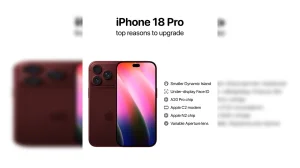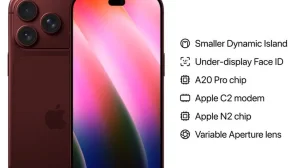
Even though Apple isn’t showing off its new Pro iPhones for months yet, information about the iPhone 18 Pro and iPhone 18 Pro Max is becoming clearer. Initial reports suggest a cleaner front, more intelligent camera hardware, a next-generation 2nm chip, and larger batteries – particularly for the Pro Max.
Cleaner front design and refined materials
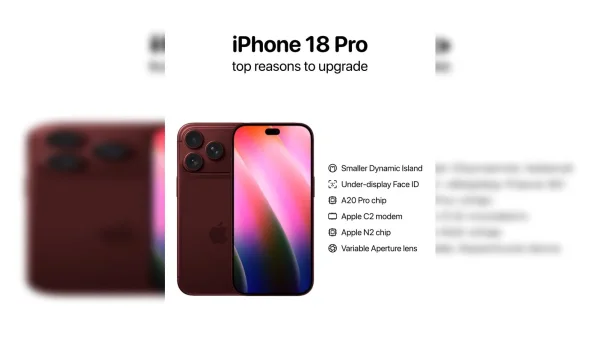
The iPhone 18 Pro might finally get rid of the ‘pill’ and the large Dynamic Island. Many leaks indicate Apple is testing the Face ID technology to be placed under the screen, which could shrink the notch to just a small hole for the front camera. Some early designs even have that camera in the top left corner.
The Dynamic Island probably won’t disappear completely, but it could be made smaller and less noticeable. The intention is to still have quick controls and live information available at a glance, while making the screen look cleaner and more fully filling your view during videos, games, or when you’re reading.
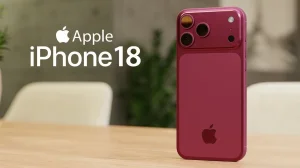
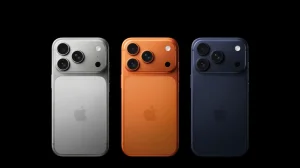
On the back, Apple will most likely keep the three cameras in a slightly raised section. The glass on the back and how it connects to the metal frame will probably have slight improvements. There are rumours of new Pro-only colours, including a very dark purple, burgundy and a brown colour like coffee, which are being tested.
Camera hardware: variable aperture and faster sensors
Improvements to the camera are a major focus of the leaks. A main rumour is the variable aperture on the main camera; the lens will physically change to allow more or less light in. This will improve photos in low light and make backgrounds in photos naturally blur. It might be on the Pro Max first.
Another possible change is a new image sensor with three layers. This is said to make the camera read images faster, reduce image ‘noise’ and give a wider range of tones from dark to light. Alongside larger apertures on the main and telephoto cameras, the iPhone t8 Pro range should take clearer photos at night and smoother videos with less noise.
The 48MP main camera will be very important in making these improvements. Because the hardware will do more of the work, Apple might not need to use as much heavy processing of the images, leading to more natural looking skin and textures in all lighting.
A20 Pro silicon and battery life outlook
Inside the iPhone 18 Pro and iPhone 18 Pro Max will be a new A20 Pro chip, made using TSMC’s 2nm process. Leaks suggest an advanced way of putting the chip together which places the memory on the same piece of silicon as the CPU, GPU, and Neural Engine. This will speed up data and reduce delays.
Early predictions are that the performance will be about 15% better and the battery will be up to 30% more efficient than the previous version. Combined with a more powerful Neural Engine, this efficiency could allow for more advanced AI on the phone – improving photos in real-time and making voice commands quicker – without the phone getting too hot.
This closer connection of components might also create more room inside for better cooling or a larger battery. The focus of the design seems to be a good balance: consistent performance, the phone staying cooler, and a longer lasting battery, particularly when using the camera or playing games.
Thickness, weight, and thermal headroom
The iPhone t8 Pro Max might be a little thicker to accommodate a battery of around 5,100 mAh. This could bring its weight to over 240 grams; many users would probably accept this if it means longer battery life. And if Apple also improves the cooling system, the performance should remain more consistent during demanding use.
Connectivity and display updates
The phone’s connection to networks will also be updated. A next-generation C2 modem is expected for the Pro models, and there’s talk of mmWave 5G returning in countries where it’s available. Improvements to efficiency could also improve performance in areas with a weak or crowded network and reduce battery usage during long downloads or streaming.
Another rumoured feature is NR-NTN support. This standard will allow a direct connection to satellites in low Earth orbit. This could extend emergency and basic data access when you don’t have a normal mobile signal. Specifics are still being worked out, but Apple is definitely looking into satellite features.
The screen sizes should be similar to what we’re used to: 6.3 inches for the iPhone 18 Pro and 6.9 inches for the iPhone 18 Pro Max. The most important change to the front of the phone will be the cleaner look, thanks to a smaller notch and a reduced Dynamic Island, making videos and apps that use the whole screen less interrupted.
Pricing outlook and launch timing
Apple is expected to announce the iPhone 18 Pro and iPhone 18 Pro Max in September 2026, as they usually do. Many reports say the Pro models will be launched first, with other versions coming later. Of course, the exact dates will depend on how production and getting enough stock goes.
Price is the biggest unknown. In India, the iPhone 17 Pro started at Rs 1,34,900 and the Pro Max at Rs 1,49,900, so Apple might try to keep the prices around those numbers to avoid even more expensive phones. But component costs and exchange rates could push the final price up or down.
There are no trustworthy numbers for the US or other countries yet. A reasonable starting price, with the price going up depending on the storage size, seems likely if Apple wants to show they’re giving good value despite the visible improvements and the new 2nm chip.
Early upgrade advice
If you have an iPhone 14 Pro or older, the leaks about the iPhone 18 Pro suggest a big upgrade: a cleaner front, better photos in low light, a faster processor, and a bigger battery on the Max. If you have a more recent Pro model, you might want to wait for official details and see the phone in action before buying.
As always, the leaks are about test versions and plans that could change before the phones go into full production. However, the general direction is clear. The iPhone 18 Pro and iPhone 18 Pro Max are looking like a more significant update, with the Face ID under the screen, a variable aperture lens, a 2nm A20 Pro chip and better battery life leading the way.