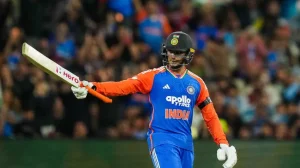
Hours before India and Pakistan meet in the ICC Men’s T20 World Cup 2026, Abhishek Sharma really showed what he could do in India’s practice in Colombo, with a net session which looked more like a declaration of intent than a simple warm-up. The left-handed batsman hit both spin and pace bowling with the same ease, clearly warning Pakistan at the R Premadasa Stadium.
Abhishek Sharma recovers from sickness
Abhishek being there at all was a big lift. Just days before, whether he would play was not known, after a two-day stay in hospital in New Delhi because of a stomach upset. He missed India’s last match against Namibia, but on Saturday there was no sign he was out of form. The world’s No. 1 T20I player went straight into full practice and immediately began to attack. He hit a number of huge sixes and strong drives into the nets – a sign that his bat speed and self-belief were still there. He began with spin, facing Kuldeep Yadav and Varun Chakravarthy, hitting with the turn time and again, and then dealing with the googly from the back of his stance. Switching to pace brought even more power. Little movement of the feet, quick hands, and very good judgement of length turned good balls into scoring chances. The whole session made it clear what was happening. Abhishek’s speed, the variety of his shots, and his willingness to hit straight from the start suggest India’s plan for the Pakistan game hasn’t changed: take control of the powerplay and hold on to it.
Why his return changes India’s T20 plan
India’s batting has not always looked good in this competition. Abhishek coming back gives them their preferred attacking style at the start. His ‘slam-bang’ style isn’t just an option, it is at the heart of India’s powerplay plan in T20 matches. Abhishek and Ishan Kishan as the likely opening pair bring two left-handed players who can get past the infield and make the most of width. It also lets the middle order relax, with Suryakumar Yadav controlling the innings and finishers such as Hardik Pandya and Rinku Singh free to aim for the last eight overs. The team’s balance is also improved. Abhishek being in the side could put Sanju Samson back on the bench, or into a flexible middle-order job if the state of the pitch asks for it. Either way, India get more stability and better control of match-ups against Pakistan’s bowling.
Net practice and being ready for Pakistan’s spin attacks
India’s preparation went beyond just hitting for distance. The batsmen faced a lot of throw-downs, changes of pace from bowlers coming in from the side, and made-up angles to copy Pakistan’s mystery spinner Usman Tariq. Captain Suryakumar Yadav’s message was direct: India will not give in to unusual bowling. Surya put it simply before the game: the team practices against similar bowling and will keep things simple when under pressure. This is the same as Abhishek’s method. He picks up the length early and hits with a steady head – a useful quality against spinners who depend on trickery. The Premadasa pitch can be uneven, and the boundaries are large on the square. This makes hitting straight and finding gaps more important than only swinging across the line. Abhishek’s ability to hit down the ground and over extra cover could be very important.
Team choices and the state of the Colombo pitch
India’s debate over the bowling is a good problem to have. Jasprit Bumrah is certain to play. The last pace bowler’s place could go to either Arshdeep Singh, with his left-arm swing, or Mohammed Siraj, with his fast, short balls. Spin offers a second choice: Kuldeep Yadav, the specialist wrist-spinner, or Washington Sundar, the spin-bowling all-rounder who makes the batting stronger. The state of the pitch in Colombo favours spin in the middle of the innings, but dew can ruin the best plans. If the team expects dampness later, they may prefer the control of Washington alongside Varun Chakravarthy, with Axar Patel’s usefulness already certain. Pakistan are also thinking about changes. A move from a spin-heavy attack to a more balanced two-and-two could be coming. Match-ups suggest Mohammad Nawaz might not play, given India’s group of left-handed batsmen, though final choices will depend on the pitch and weather.
What’s at stake, how the two teams have done in the past, and important contests
Both sides have come into the game having not lost, with two wins each. This Group A game is about more than points. It is a step towards the Super 8s and a mental advantage which could be felt throughout the tournament. Recent results have gone India’s way, but pressure makes form less certain. Control of the powerplay often decides India versus Pakistan games. If Abhishek does well against Shaheen Afridi and Naseem Shah, India could control the first six overs. If Pakistan take early wickets, they can put pressure on the middle overs with spin and pace. Look at the contests within the game. Abhishek against Shaheen with the new ball is a great sight. Suryakumar Yadav against Usman Tariq brings skill against mystery. Jasprit Bumrah against Babar Azam is top-level ability on both sides. Hardik Pandya against Shadab Khan at the end of the innings could change the game in a few balls. Fielding and running between the wickets could be the hidden factor that decides the game. With the large square boundaries, twos matter. The side which is sharper at this will steal a few runs which often prove to be important in close World Cup games.
Likely teams and a picture of the game
India’s likely XI: Abhishek Sharma, Ishan Kishan, Tilak Varma, Suryakumar Yadav, Hardik Pandya, Shivam Dube, Rinku Singh, Axar Patel, Washington Sundar, Jasprit Bumrah, Varun Chakravarthy. Pakistan’s likely XI: Saim Ayub, Sahibzada Farhan, Salman Ali Agha, Babar Azam, Usman Khan, Faheem Ashraf, Shadab Khan, Shaheen Afridi, Abrar Ahmed, Usman Tariq, Salman Mirza. The ground is the R Premadasa Stadium in Colombo, a place which rewards skill and good match-ups. Expect both captains to look at dew and match-ups in the middle of the innings. For India, the main thing is still Abhishek Sharma. From a hospital bed to high-energy nets, his return has changed the feeling of the game. If practice was anything to go by, Pakistan's bowlers have been warned. The real answer comes under the lights.