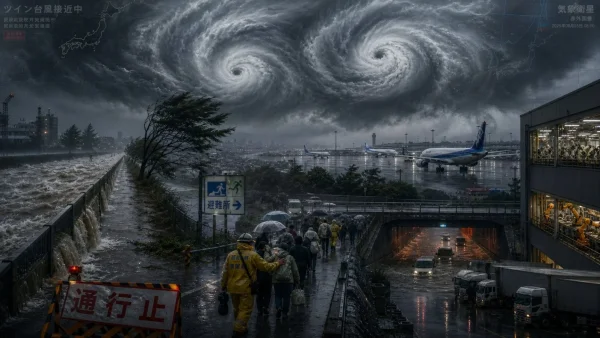
It was no surprise when Japan put the kibosh on more than 100 of its flights on Friday with the two systems bearing down on the archipelago. You had to have evacuations and idled production lines. From the airlines to the automakers and even the military, everyone is making moves to get ready for what could be an unsettled weekend, heeding warnings from the top about what’s to come.
Flights, factories and drills disrupted
JAL was the one to cut 70 of them, while ANA called off 50; it’s the Okinawa and Kagoshima runs that are feeling it. If you were a traveller, you were in for some hiccups as the carriers shuffled their planes and staff to brace for the worst.
Then there’s Toyota, which put a hold on things at a Kyushu plant since the roads were closed and moving parts around was no longer an option. Nissan has some lines of its own they plan to stop. The military, for its part, nixed the V-22 Osprey’s first run to Miyako Island, which was supposed to be part of some joint U.S. training.
Why the storms are hard to predict
You have Severe Tropical Storm Mekkhala and Tropical Storm Higos, and when they get in each other’s way, you can get the Fujiwhara effect. It’s a thing where the cyclones alter one another’s course and pace. Makes it hard to say for sure where they’ll be or how strong they’ll get as they come in.
Mekkhala has been a typhoon but has been stepped down; still, it’s been putting down a lot of rain in the south and west of the country. You’re talking gusts of 144 kph (89 mph) and a storm field that’s only growing as it gets to the more heavily populated islands.
Current positions and strength
As of Thursday, you could find Mekkhala some 110 km to the southeast of Miyako in Okinawa, chugging along at 15 km/h. The numbers say it will be in southern Japan by Saturday before it makes a turn to the east.
Higos is over to the east of the Philippines and is on its way. We figure it will head northeast and make for the Pacific side of the mainland by Sunday, where it might cross paths with Mekkhala in the vicinity of Kyushu and Shikoku.
Local alerts and risks
In the Kyoto area, the word from officials is to get out if you can – they’ve asked a few thousand to do just that given how the hills are primed for a slide. They’re also on record saying those orders could be broadened if the rain lingers in the city.
The rivers in Kyoto and Osaka are running high. So the advice is to be on your toes for any flooding, particularly in the underpasses and low spots that have a habit of filling up when you have a couple of days of this kind of weather.
What to expect next
Over the weekend, Mekkhala should be edging past the islands of Kyushu and Shikoku. Should the two of them come together, the whole dynamic of where the rain falls can change in a hurry, and that makes it tricky to put plans in place.
Southern and western Japan are in for more of the same. With the ground already sopping and the rivers on the up, you’re looking at landslides and flash floods as the main worry, and then the odd power issue when the wind picks up.
For most, it’s not so much a total stand-down as a series of interruptions. The airlines have been cancelling in the southwest, but if the winds get too much at the hub airports, you can bet on more of the same. And in Kyushu, if the roads don’t open, the supply chain will feel it.
If you live in one of the districts where the risk is higher, keep an eye on the local bulletins and be prepared to act. A slight wobble in the track and the heaviest of the rain can be on a new set of catchments in no time, as the authorities will tell you.
Here is what has been put forward by those in charge:
– Heed the official word and evacuation notices
– See where your flight is at and build in some time
– Stay away from the river, underpasses and any steep inclines
– Don’t be surprised by some hold-ups in the factories and on the road in Kyushu
The next 48 hours will tell us if Mekkhala and Higos are going to be on their own or start to orbit in a Fujiwhara. One way or the other, the weekend is going to be a bit of a puzzle, but if they do converge, you can count on some unannounced warnings and a few sudden turns.
Emergency crews in Japan have already made a point of being in the right places. With the likes of the airlines, the manufacturers and the military all rethinking their approach, the priority is to see people stay safe and the essentials run as the storms move through.