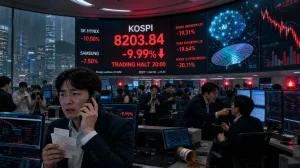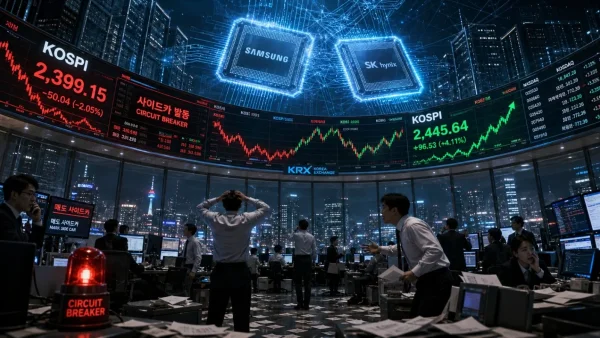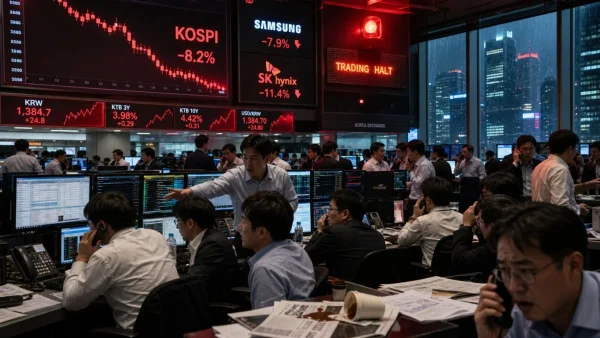
It was a jarring day for the equity market in South Korea on Friday. The index fell as much as 8.2%, which was enough to bring on a 20-minute halt and show just how dependent the Kospi is on the whims of the AI-driven chip business. Foreigners were in a hurry to sell, and they didn’t mince words with their positions in Samsung Electronics or SK Hynix, sending them over 9% in the red.
What made the selloff so hard-hitting
You had US tech giving up its early ground overnight. The good news from Micron and Qualcomm was drowned out by the niggling question of who is going to pay for all this hyperscaler AI spending. That kind of thing puts a damper on risk in Asia, and the Kospi, being so chip-heavy, is right in the line of fire when sentiment changes.
A far cry from the mood at the close of the last session. There was some reason to be upbeat then: Micron was in a bullish frame of mind and SK Hynix was talking about a US listing. But come Friday, investors were looking at a less rosy picture. Apple is raising prices because it can’t get enough memory chips, and there are whispers that OpenAI might put off an IPO for another year.
Where the money is and isn’t going
The selling was noisome. Out of 915 names, you only had 111 in the green against 792 in the red. In the morning alone, foreigners put 2.7 trillion won ($1.7 billion) of Kospi stock on the block; later on, they were tabulated as net sellers of 2.6 trillion won ($1.68 billion).
That pressure made its way to the currency and the bond market. The won was at 1,548.2 to the dollar, a 0.33% step back from 1,543.1. Yields inched up, too. The three-year Korean treasury, the one with the most action, was at 3.757%, 0.5 of a basis point higher, while the 10-year was 4.165%, up 4.4 bps.
In short, here is what happened today:
– An 8.2% drop in the Kospi and a 20-minute pause in trading
– More than 9% in losses for both Samsung and SK Hynix
– 2.7 trillion in won sold by the morning by foreign hands
The big players have the reins
If you’ve been watching the Kospi this year, you know it’s been whipsawed by Samsung and SK Hynix. Put them together and they make up close to 60% of the index. Then you have the leveraged ETFs that retail likes to play with, and their daily rebalancing makes for some wild intraday moves. Some will tell you it’s not unlike the meme-stock days.
This was the second time we’ve had to hit the brakes on trading this week, and it says something about the feedback loop between what people think of AI and the way the Korean market is put together. Han Ji-young from Kiwoom Securities put it down to the volatility of a market with so many chips in it, though she called the fears over waning memory demand ‘a bit much’.
Looking at the investment side of things
Then there is the matter of how much will be put out in the years to come. We’re told Samsung Group is set to put 1,000 trillion won ($645.87 billion) into the country over a decade, with 300 of that possibly for new factories in the southwest. They’ll be making those plans public on Monday. Word is SK Hynix has some sizeable numbers of its own to put on the table the same day.
All of that cements Korea in the middle of the AI supply chain. But it also brings up the old argument about margins and cash flow in the here and now. On Friday, you could see traders rethinking how fast the world can take in any new capacity.
Some global headwinds to consider
What we saw in Korea was in the wake of some shakiness in US tech. Fabien Yip of IG International points to Apple: ‘When one of the biggest buyers in the world can’t handle a cost increase, you have to ask if demand is as elastic as we thought and if these margins are here to stay.’ He sees the OpenAI IPO hold-up as a sign of the kind of choppiness that comes with retail interest in tech.
Charu Chanana at Saxo Markets has a word of caution: ‘The tailwind is there, but it’s in select spots. The headwind is a lot wider.’ She sees a risk that ‘a strong memory cycle now could put a brake on the rest of the AI trade down the line. And the market is beginning to factor that in.’
With the outflows from abroad and the circuit-breakers having gone off twice in as many days, all eyes are on Monday’s announcements and whether the US tech mood calms down. For now, the Korean market is going to be at the mercy of whatever the global AI story is telling us.