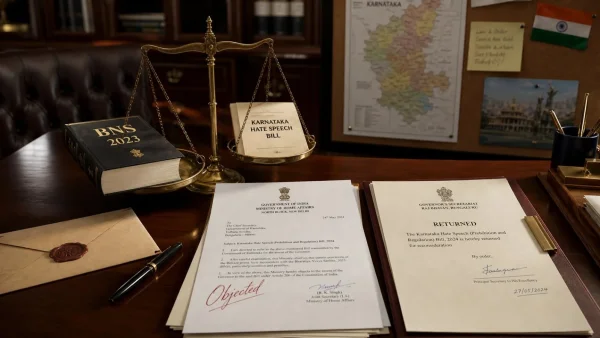
In short, the Home Ministry has let Karnataka know that a new law of this kind might be superfluous; there are criminal provisions on the books that do the job of curbing the behaviour the state is after. This puts more pressure on a Bill that is already making waves and means there will be some back-and-forth before any word on Presidential assent.
What the Centre told Karnataka
An office memo from the Ministry’s Centre-State Division on May 12 put it plainly: the issues the 2025 Karnataka Hate Speech and Hate Crimes (Prevention) Bill is meant to handle are for the most part covered by the 2023 Bharatiya Nyaya Sanhita and other current statutes. The message was that a stand-alone state law would only lead to duplication and a loss of uniformity.
This was made known after the state had put the Bill in front of President Draupadi Murmu for her sign-off. It was sent up to Delhi in February once the Governor put his foot down.
When the letter from the Centre came in, the Department of Parliamentary Affairs and Legislation in Karnataka got in touch with the state Home Department on May 20 to get its take, so they can have an answer for the MHA in good time.
You can boil the Ministry’s position down to three things they put to the state:
– The BNS, 2023 has you covered
– A state law of your own is an invitation for inconsistency
– There is no need for it right now
How the Bill reached Delhi
Chief Minister Siddaramaiah and his Congress team saw the Bill through both houses at the Belagavi winter session that wrapped up on December 19. They had to make their way past the BJP and JD(S), who were having none of it in the legislature.
Then in January, Governor Thaawarchand Gehlot put the Bill back, holding off on assent. He was wary of it having a dampening effect on the kind of open discourse the constitution is supposed to allow. Since the Governor wouldn’t clear it, the state’s next move was to put it before the Centre for the President to look at.
What the draft law is after
Under the terms of the draft, if you put out something in public – be it in words, writing, a sign or even electronically – with the aim of sowing enmity, ill-will or hatred, that is hate speech. It applies whether the person in question is alive or not, and to whole communities as well as individuals.
It also looks at prejudice along lines of religion, caste, gender, sexual orientation, tribe, and so on. As for hate crime, the Bill has it defined as anything from publishing or spreading such talk to abetting it in a way that stirs up trouble against a group or an individual.
Penalties proposed
If you are found guilty of a hate crime, you are looking at one to seven years in jail and a fine of Rs 50,000. Do it again and the ceiling is seven years with a fine of Rs 1 lakh.
Politics and pushback
The BJP has called the whole thing a heavy-handed move to stifle free speech and a ploy for political score-settling. Their line is that the criminal code has enough in it to deal with provocation and communal targeting.
Siddaramaiah’s side is standing by the Bill. They say it is the only way to put a stop to the kind of organised hate and provocation we are seeing. State officials see it as a way to keep order and have the backs of those who are vulnerable.
Gehlot’s note from earlier has only added to the row over how far the Bill goes. He was concerned about ambiguity and the possibility of it being used to stifle a democratic debate.
What comes next
The home and law departments in Karnataka have to get on the same page and put together a formal reply to the Centre’s objections. When the state gets back to them, all of it will be on file as the process moves on.
At this point, the Centre is indicating it would rather work with the national framework of the 2023 Sanhita than have a state version on top of it. The Bill is in a holding pattern until the talks between Bengaluru and New Delhi are done and the President makes up her mind.