You could call it a structural change in the offing for how fixed income is accessed, priced and hedged. Tuhin Kanta Pandey, the SEBI chair, has made it clear there is a coordinated push behind these new products, and he sees them as a way to frame both the risk and the upside for any portfolio after consistent returns.
Why SEBI’s bond push matters now
There has always been a kind of paradox in the Indian bond market: plenty of scale but not enough to go around when you want to trade. As Pandey will tell you, bonds don’t see much action, getting out can be hard and with under 1% of that being retail, costs are what they are. For an investor, a thin secondary market means more execution risk and fewer options for tactical plays on credit or duration.
SEBI isn’t looking for a one-off solution. The plan is a web of reforms. Back in May 2026, Pandey put it plainly: you have to get liquidity, market structure, the right kind of education and a mix of issuers on the same page to make debt a real engine for wealth and funding.
New tools on the way: ETFs and derivatives
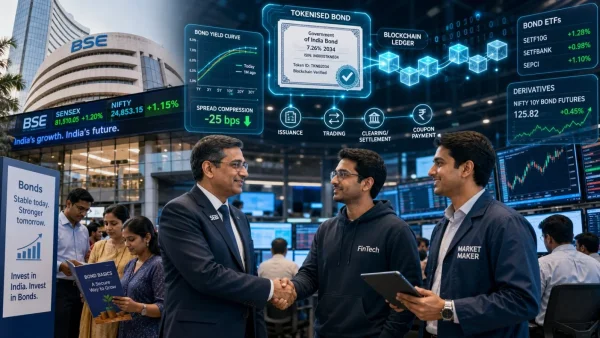
The regulator is chipping away at the development of bond ETFs and index-based derivatives. In Pandey’s view, they do a few things: they add some life to the market, let in the smaller retail player and give institutions a way to cover their interest-rate exposure. Do it right and you’ll see tighter spreads and clearer pricing.
There is also a market-making framework from the Union Budget to back this up. SEBI is in talks with the RBI, the Ministry of Finance and others in the market to make it work. The idea is to have market makers firm up two-way quotes and keep slippage to a minimum.
Infrastructure and rulebook: tokenisation, brokers, LODR
In six to nine months we should see a pilot for the tokenisation of corporate bonds. The thinking is that a digital ledger can make for quicker settlements, better traceability and some automation. But as for the innovation, Pandey has been careful to say it will be done with a watch on investor protection.
Then there is the question of cost and specialisation. SEBI is mulling over a separate box for debt brokers. They are also having a look at whether a company listed only for its debt has to be held to the same LODR standards as an equity name. Some fine-tuning here could make compliance less of a headache without losing sight of disclosure.
Municipal and securitised debt revamp
SEBI is having a re-think on municipal debt to put some money behind urban infrastructure and open up municipal bonds to a wider audience. For those after a quasi-sovereign type of exposure, it may well be a new option on the table.
As for securitisation, a consultation paper is out to bring SEBI in line with the RBI’s approach on standard assets. It’s about making the listing and the disclosures a bit simpler and giving the regulated entities some clarity.
Retail and issuer participation: the missing link
A product is only as good as the people who buy it, and Pandey knows you can’t just expect households to wade in if they don’t speak the lingo. That’s where Project Jagrook comes in – a series of campaigns to put the plain English on coupon, yield, rating and so on.
On the other side, SEBI and the exchanges are going to be doing some outreach to the SMEs and others who have yet to list their debt. A more varied pool of issuers is a good thing; it takes some of the concentration risk off the table for fund managers.
Here are the milestones to have your eye on:
– Bond ETFs and derivatives coming to market
– The tokenisation trial
– How the market-making rules play out
– What happens with the debt broker classification
– Any changes to the LODR for debt-only names
What the numbers signal for investors
If you look at the figures, there is some movement. We’ve gone from some Rs 17.5 lakh crore in outstanding corporate bonds in FY15 to in excess of Rs 59 lakh crore today – a CAGR of 12% or so. And between FY21 and FY25, the market was putting up an average of Rs 8 lakh crore a year in fundraising.
FY26 saw Rs 9.1 lakh crore in debt, almost double what was raised in equities. SEBI’s own study on household savings shows that in FY25, some Rs 7 lakh crore of it made its way to the capital markets, with total assets in the neighbourhood of Rs 141 lakh crore by year end.
So the test in the near term is whether the liquidity holds. With the right mix of market-makers and new instruments, you might find that hedging is cheaper and the price is fairer. It gives the investor a more reliable way to put money to work and get out of it, all while SEBI makes sure trust and transparency are non-negotiable.