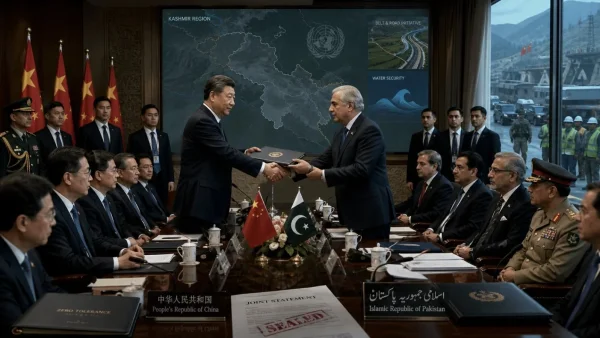
It was an opportunity for China to re-endorse Pakistan’s position on Kashmir during the PM’s trip to Beijing, using some of the same old UN phrasing to cement a partnership that is already tight. India put up a wall, as you would expect, and made it plain that Jammu and Kashmir is their business to handle now that Article 370 is gone – a fault line in the region that is as old as it is hard-edged.
Security anxieties drive diplomatic signalling
If you ask Indian officials, what came out of Beijing isn’t so much a change in policy as a way to cover your bases. Some in the intelligence community will tell you that harking back to pre-2019 UN formulations is a way of ‘selectively ignoring’ how things are on the ground. But it is also a sign of China’s concern about trouble in Pakistan spilling over to its own people and projects.
There has been enough ruckus from attacks on Chinese in Karachi and Balochistan to make Beijing nervous, per one source. You could say the new tone is meant to put minds at ease, especially where the CPEC is concerned. Pakistan has in turn put down some guarantees on the safety of Chinese citizens.
The joint statement from May 26, 2026, makes note of the fact that the Pakistani side gave the Chinese a run-down on the ‘latest’ in Jammu and Kashmir. In New Delhi, they see that as an outside party opining on a constitutional matter that is long since settled.
Kashmir framed under UN Charter, India pushes back
Beijing put it this way: the Jammu and Kashmir file is a historical one and should be put to rest in a sensible, peaceful manner. They were in agreement on the need for dispute resolution in line with the UN Charter and the like.
India’s line is unambiguous. Jammu and Kashmir is part of India, period. There is no room for outsiders to have a say after 2019. To them, the way China and Pakistan are putting it is just old-fashioned posturing.
Zero tolerance on terrorism, with explicit naming
You won’t find anything in the document without a nod to security and a zero-tolerance approach to terror. They didn’t mince words either, singling out the TTP and the East Turkestan Islamic Movement, and making it clear that counter-terror work is key to keeping the region and Chinese nationals safe.
Beyond security: expanding tech and multilateral bets
But the visit wasn’t all about the hard stuff. Pakistan has given its blessing to a World AI Cooperation Organization, which is as good as an open door to the kind of tech and governance model Beijing has in mind.
They even got around to water, with an accord to work together across borders on resources. A few bilateral deals were put to pen and paper, though the fine print isn’t being shared just yet.
Then there is the multilateral side of things. Beijing has promised to stand by Pakistan for its stint at the UN Security Council in 2025-26 and for its work in the SCO. The statement also gave Islamabad some credit for its part in the US-Iran ceasefire and other peace-making in the area.
China’s regional play after the Taliban takeover
Influence in Afghanistan is something both have in common. After some recent talks in Urumqi, they’ve set up a new forum with Pakistan and Afghanistan to be put on by China. It’s another way for Beijing to have a hand in what happens now that the Taliban are back in charge.
Some in the Indian system see a larger story here: a pair of countries holding up the UN Charter as the basis for a multipolar world and standing against what they term fascism and militarism. It’s a way of calling out the West without having to say so.
India’s red lines and the road ahead
For New Delhi, anything to do with Jammu and Kashmir is a strictly internal and bilateral affair. They have little patience for anyone else’s input, and will argue that you can’t just quote some UN text and expect it to mean anything in today’s climate.
Intelligence types in India think Beijing is also feeling the heat from Pakistan’s own home-grown problems. With the kind of pressure the military is under in places like Balochistan, some outreach is to be expected in order to put China’s mind at ease.
To put a pin in it, here is what you need to know from the Beijing trip:
– China has its arms around Pakistan on the Kashmir question, UN style
– India says it is an internal issue, come what may
– Pakistan has put in place better protection for Chinese in the country
– Warnings have been issued on the TTP and ETIM
– The two are working on AI and water as well
Don’t expect much in the way of rhetoric going forward. The focus will be on the nitty-gritty of security as China wants to be sure its assets and people are looked after. Even as they stay in step on the message they put out on Kashmir and the region, the work will be practical.