It is going to be a hard ask for the exchequer. Government sources say the Fertiliser Ministry has put in for the full works – a subsidy of some Rs 3 lakh crore – in light of the jolt from Hormuz and the wider unrest in the region. Even as the Finance Ministry mulls over the numbers, officials are firm that there is no short-fall for the farmer in the Kharif season.
Why the subsidy demand spiked
You have to look at world prices and the fact that supply is getting tight with new geopolitical hot spots. For one, the closing of the Strait of Hormuz is sure to put the import bill for fertilisers in the red and make tendering a headache.
Krishna Kant Pathak, Joint Secretary with the Department of Fertilizers, made no bones about it at a get-together in May: if the market stays as it is, the tab for the year could top Rs 3 lakh crore. He put it in perspective by saying before all this, you were looking at close to Rs 2 lakh crore in subsidies.
Finance review and doubling ask
The 2026-27 Union Budget had put aside Rs 1.71 lakh crore for this. But the Department of Fertilizers has been to the Finance Ministry for a 100 per cent bump, making the case that the real need is much steeper if the situation in West Asia doesn’t cool down.
Availability for Kharif: stocks vs risk
For all the fiscal head-winds, the government says they have what it takes on the ground. “The overall stock position of fertiliser in the country remains comfortable,” was how Aparna S. Sharma, Additional Secretary in the Department of Fertilizers, put it in a May briefing ahead of sowing time.
The figures back her up. We’re talking 200.12 lakh tonnes in the tank against a 390.54 lakh tonne call for the Kharif season. That is over 50% of what you’d expect to be in demand, which is a lot better than the 33% you normally see.
Sharma gave us an update on Monday: “for kharif 2026, the Department of Agriculture has put the requirement at 383.9 lakh tonnes and we have 197.56 lakh tonnes in stock as of today.” In other words, we are at 51 per cent of Kharif demand, once again above the 33% mark.
Prices to farmers and import pressures
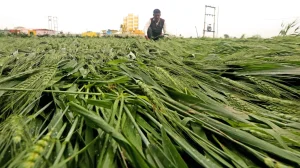
The tag for the farmer hasn’t moved. You can still get a 45 kg bag of neem-coated urea for Rs 242 and DAP for Rs 1,350 (50 kg). The state is underwriting a good chunk of the cost on urea and P&K to keep those MRPs where they are.
But there are roadblocks. Officials will tell you the global pool of fertiliser is shrinking and prices are up, so the whole tendering exercise has become more of an art. It comes down to two things: can you get the product and how fast is the price moving?
We have blunted some of the impact with long-term pacts and by sitting on nearly 20 million tonnes in reserve. Still, as Pathak will have it, keeping the shelves stocked is not without its price tag for the fiscus.
Here is what you should take away from the officials:
– A 100 per cent hike in subsidy is on the table
– There is enough to go around for Kharif
– The Hormuz closure means a bigger import bill
What the numbers say on production
If we can up our own game, it might ease the pain. Some softening is possible as we produce more here. Last year, for instance, we covered 73 per cent of our needs from within, even though we are still bringing in a lot of urea and DAP.
Domestic output of everything from urea to NPKs and SSP has gone up from 433.29 lakh tonne in 2021 to 524.62 lakh tonne in 2025. Urea alone has seen a climb from 225 lakh tonne in 2014-15 to 306.67 lakh tonne in 2024-25, as we’ve put in more capacity and run the plants harder.
Where we end up will depend on how long the trouble in West Asia lingers. It is for the Finance Ministry to decide, along with the results of the tenders and whether shipping through Hormuz gets back to normal. Then we will know if the final tab for the year is in line with the Budget’s Rs 1.71 lakh crore or if we are heading for the Rs 3 lakh crore figure.