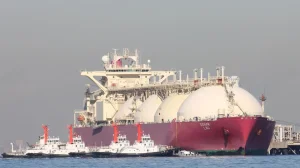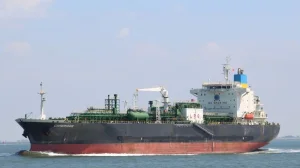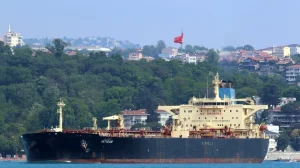
For those in the Indian refining and shipping business, a vessel like the Karolos getting through is proof that some of these routes are still open. But don’t be fooled; the situation is delicate. Vessel-tracking numbers put commercial transits at just five on Friday, down from 11 the day before, and only a slight recovery to six by Saturday.
Here are the headline signals to watch now:
– Five ships Friday vs 11 the previous day
– Six seen on Saturday morning
– 75 commercial ships diverted, US Central Command said
– Tehran demands sovereignty recognition to rejoin talks
Blockades and contested control
Then there is the matter of the blockade. President Trump has been at it again, saying Tehran will back down, but you won’t find any evidence of that. Iran is holding firm, making the recognition of its sovereignty over the strait one of the non-negotiables for any talks to end the war.
What we know about the tanker
We can see the Karolos in the Gulf of Oman as of Thursday, on its way to India. The draft is what you’d expect from a full run, which jibes with where we saw it near the UAE a week or so ago. Kpler, a tracking outfit, says it’s laced with Iraqi oil from Basra around May 10-11. A photo from a Sentinel 2 satellite has the story: a ship of the right size and colour was at a loading buoy in Basra the morning of the 11th.
It’s a case of duelling restrictions. US Central Command put out a word on X on Friday that they’ve had to turn aside 75 commercial ships since their own cordon went up. Yet in the Persian Gulf, you’re hard-pressed to find a sign that Iran is letting up.
The wider traffic picture
The drop-off in prewar levels of traffic is a risk factor for everyone from cargo owners to charterers, and it could mean some hiccups for buyers in Asia if things don’t even out. On paper, Friday was quiet enough: a bulk carrier, a couple of Iran-affiliated vessels, and a Chinese LPG ship. Saturday was a bit more active, with a livestock hauler and a few others putting in an appearance.
Data gaps that cloud the picture
But not everything is clear. We had two would-be entries on Friday, but no proper AIS pings to confirm them. One products tanker made for the southern coast and then put in a position report that didn’t add up. And on Saturday, a bulk carrier turned up on the screen heading for the northern Gulf, though its first fix had it crossing the strait on Friday. You have to be careful with the data; a lag in the system can throw off your count.
Other vessels under scrutiny
The Karolos isn’t the only one. The Agios Fanourios I is sitting in the Gulf of Oman after the US put a stop to its run from Iraq to Vietnam. Over in the Kiara M, a very large crude carrier, seems to have done a ship-to-ship transfer off the coast of Oman after leaving Basra.
And on Saturday, two tankers with ties to Iran – both under US sanctions – made it into the Persian Gulf. One of them, if you trust the automated readout, may have made a run across the Gulf of Oman on the 9th and 10th.
With the kind of interference we’re seeing with AIS, it’s tough to be sure. Ships will go dark in the hot spots and reappear much later on, sometimes as far as the Strait of Malacca. So the numbers you see now might get adjusted.
What comes next
What we’ll be watching is whether the Karolos makes it to India without a hitch and if the weekend’s small upturn in activity is here to stay. A move from either side in Washington or Tehran could put a different spin on the whole operation. For now, it’s about who’s moving, how long it lasts, and if there’s any give in the preconditions Iran has laid out. Until we know, every tanker that gets through is a big deal.