On paper, index funds offer to put you in line with the market for very little. But that kind of straightforwardness can be a cover for some real pitfalls. You see it in India’s current wave of passive money: some of these lingering notions can chisel away at your performance and throw a wrench in your portfolio. It’s a genuine opportunity for investors and their advisors, but one with its share of blind spots.
You can’t miss the change. Passive has become the norm, with 690 funds now holding close to Rs.15 trillion – roughly 20 per cent of all mutual fund assets. Put it in perspective: five years back you were looking at 160 or so funds and a tad over Rs.3 trillion. When you have this much scale, you have to be quick to tell the difference between what matters and what doesn’t before any mistakes add up.

The price trap and execution risk in passive products
Sure, the fees are attractive, but they don’t buy you a better result. We’re talking expense ratios of 0.05-0.1% for an index fund, with some ETFs touting 0.02-0.05% a year. The problem is, a lower tab doesn’t necessarily mean you’re hugging the index any tighter. In fact, a tracking error can nullify those savings in a hurry.
What you’re after is a fund that follows its index without flinching. One might be cheaper than the rest on the face of it, but if it’s a poor replicator or does its rebalancing in a clunky way, it will fall behind. Let that run its course and you’ll find the damage is worse than if you had just paid a few extra basis points in expenses.
With ETFs, the issue is even more pronounced. The act of trading is where the cost comes in. You have to factor in volume, impact cost, and spreads. Arun Sundaresan, who heads the ETF desk at Nippon Life India Asset Management, is of the view that you should be looking at all of that – from the exchange volumes to the tracking error and the fee – as one package.
Sundaresan will tell you it’s all connected. If you have low volumes, your impact cost goes up and with it your total outlay, well past what the expense ratio says. For anyone who wants a clean, liquid trade, not minding these things can make a supposedly cheap ETF a pain to deal with.
Diversification is not guaranteed by more indices
It’s a common habit to pile on a few passive funds under the assumption that every new index is another form of insurance. Not so. A lot of them, the market-cap ones in particular, are propped up by the same handful of large-caps. So you end up with overlap and concentration, not the spread you were after.
Take the broad-market type. The names you see in a Nifty 100 are going to be in your Nifty 500 or Total Market index as well. Since the math puts more weight on the big players, your holdings can skew to a couple of heavy-hitting stocks and sectors.
Then you have the hassle of having to rebalance a more complex set of funds. Sometimes less is more. You could pair a Nifty 50 with a Nifty Next 50 for some contrast. Or put down a Nifty 500 Equal Weight, which is 80 per cent mid and small cap, to sit alongside a Nifty 50.
It comes down to knowing what you have in your mix. A crowded passive roster may be well-diversified in theory, but when things get rough, it can feel like a one-way bet. “Real diversification means you know what you own, not just owning the same stock in different wrappers,” says Ajay Kumar Yadav, Group CEO and CIO at Wise Finserv.
Passive is simple, not ‘buy and forget’
There is a certain ease to an index approach. No manager to keep an eye on for style drift, no bad stock picks to wonder about. But don’t let that lull you into thinking you don’t have to check in on things, or make sure you’re still in step with your goals and risk tolerance.
Yadav would have you ask if the index you are in is still right for you. If you’ve strayed from the plan, it’s time to rebalance. He is for a once or twice a year look-see. It’s enough to stay on top of it without being a micromanager.
Anil Ghelani of DSP Mutual Fund has a way of putting it: “Think of it like a trip to the dentist for a general check-up. That’s how you should handle your investments, be they passive or active.” It’s a point he makes with smart-beta indices in mind, given they can be cyclical and come with their own set of risks.
Market risk stays; index choice matters more than fund choice
You can do away with the fund manager, but you can’t do away with equity risk. These funds are a reflection of the market and won’t let you off the hook for overvaluation or a frothy sector. “In a passive fund, there is no manager to say no to the index,” says Ghelani. The risk is what it is.
Yadav is blunt about it. “If the index is down 20%, so is your fund.” You don’t have the option to move to the sidelines or pare back on a pricey sector when the market is in a dip. You put your money in a fund and it does its job of tracking, but the onus is on you to take on the index’s risk in full.
Then again, risk isn’t one-size-fits-all when it comes to indices. “The way an index is put together is what defines the risk,” says Siddharth Srivastava, Head – ETF Product and Fund Manager at Mirae Asset Mutual Fund. You can have two indices in the same space with very different returns and risk profiles.
So you should be looking at the index before you even think about the fund. The numbers tell the story: NSE data shows 362 index funds are after 171 indices and 328 ETFs are on 118. And still, you see investors fixating on which AMC has the top fund, when they ought to be asking which index makes sense for their time frame and appetite for risk.
Srivastava will tell you that a misstep on the index side is more damaging than going with the wrong fund for the same one. If the benchmark is the same, the funds will perform in a pack; the only real variables are how well they track, the cost, and in the case of an ETF, the liquidity. It is the benchmark that drives the portfolio.
Nehal Mota, Co-Founder of Finnovate, puts it in order: “Picking the right index is the investment decision. Picking the best fund is just the optimisation to make sure you’re as close to that index as you can be.” You have to get that sequence right if you want to keep downside in check.
Not just for the uninitiated: making use of passive today
Some like to think of passive as training wheels, but that doesn’t do it justice. Sundaresan notes that if you want market returns and don’t want to worry about an active manager coming up short, this is where you go. It works for the new and the old alike.
And with all the product innovation we’re seeing in size, themes and sectors, as Srivastava points out, there is a place for passive in any plan. It’s not a question of whether it’s too basic, but how it fits into a goal-oriented approach.
If you are an ETF user, don’t assume the lower fee is an automatic win. You have to factor in brokerage, impact costs and the risk of execution. “ETFs let you trade in real time, but that’s only a plus if you know your way around bid-ask spreads and demat-based execution,” says Yadav.
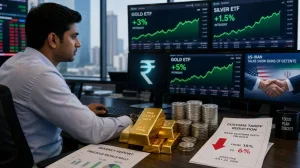
There can be hiccups. We’ve seen it with some silver and international ETFs where the price can drift from the NAV because you can’t create new units. A low-fee product can end up being an expensive one if you don’t watch for those premiums and discounts.
In the end, a Nifty 50 index fund that is run well will beat a shoddy, cheap Nifty 50 ETF. For the smaller investor, having the simplicity of an end-of-day NAV and not having to worry about exchange liquidity is a good way to stay disciplined.
With passive AUM set to hit Rs.15 trillion in 690 funds, it’s more important than ever to make the right calls. Fees are part of it, but they don’t write the story. The index is where the risk is, and your behaviour is what you’ll live with in the long run.
Here is a no-nonsense way to go about it:
– Know your goals, your horizon and your limits.
– Pick the index first, the fund second.
– Look at the fees, but also the tracking error.
– With ETFs, check the volume and the impact cost.
– Don’t have too much overlap in what you own.
– Rebalance once or twice a year.
– Don’t let the news or intraday chatter make you move.
Passive is a solid default. It uses the market’s efficiency to do the work for you and keeps costs down. But you have to avoid the myths that make you complacent.
The writing is on the wall. We’ve gone from a bit over Rs.3 trillion in 160-odd funds to nearly Rs.15 trillion in 690. Investors have bought into the logic of indexing.
What’s needed now is some discipline. Don’t be lured by the cheapest label. Question the liquidity. Go with a few good, complementary indices instead of a lot of the same thing. And for the record, passive is not without risk.
Make a habit of reviewing. Every six months or so, see if the index is still doing what you put it there to do. Smart-beta may need a closer eye. Do that, and you can have your market returns without the errors.
But be ready for the market to put you to the test. When the index goes down, so will your fund. When there’s no liquidity, the spread will show you. You have to be aware of these things to keep a low-cost strategy from becoming a costly one.
Get the order of operations and your expectations right and you can have the edge that was always there. Once you stop the guesswork and focus on the index and the realities of execution, the rest takes care of itself.