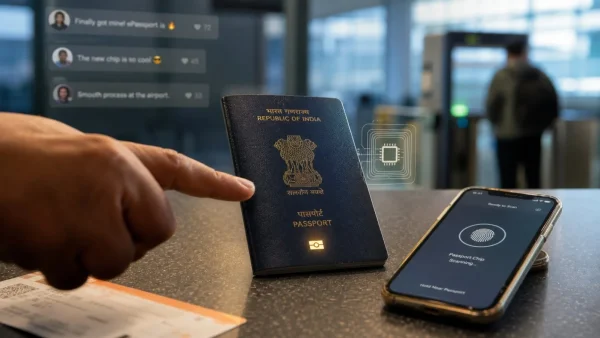
It has been the talk of the web after one put her old passport side by side with the new one and noticed the difference. If you are in the market for a renewal, you should know that unassuming mark is your cue that we are moving to biometric documents.
Why a tiny gold symbol on new Indian passports is trending
Pooja, an X user, had just got her passport back and was looking at the gold rectangle on the front. She wasn’t sure if it was for security, a way to track you, or what, so she put it to the internet to see what people made of it.
It didn’t take long for her to get some company. A lot of people said they had only just become aware of it themselves. Before you knew it, there was a whole thread of users chipping in to set the record straight on why the older booklets don’t have it.
What the rectangle means, according to users
If you read through the replies, the answer is pretty much the same: it’s an e-Passport. Some called it the international standard for a biometric symbol, put there to let you know there’s an RFID chip inside.
And it’s not something India is doing on its own. You will find the same kind of thing on most Western passports, commenters were quick to point out. Put simply, the new mark is for an electronic, chip-enabled booklet.
How people say it works
Then there is the nitty-gritty. With a chip in there, you can have the passport scanned and put to the test. One person even mentioned an app that lets you run the numbers from the chip in the booklet.
That makes sense to a lot of us who have been on the road. The chip is there to make scanning and identity checks go down without a hitch.
Here is the sum of it all, as the users put it:
– You see the gold rectangle, you have an e-Passport.
– There is an RFID chip in there.
– It is for biometric verification.
– The non-electronic ones from before don’t have it.
– Check the bottom of the cover for it.
What this could mean for travellers
If you fly a lot, the symbol is a heads-up that your new passport is in line with global standards. Some in the comments saw it as India following suit with the rest of the world on digital verification.
The upside is plain to see. When you can scan and verify with a chip, things run smoother. The cover might have a new look, but it is what is in the document that counts.
Claims about rollout and timelines
A few got into the numbers. One user said not many Indians have the e-Passport yet, though it is the way of the world. He also put it out there that we will see the end of the old ones in a year or two.
You hear that from more than one side. Another predicted the 1-2 year mark for phasing out the old stock. Someone else even made the case that e-Passports will be a must for getting into most places. Take these with a grain of salt, of course; they are just what is being said in the thread.
How the confusion started, and why it matters now
Pooja’s post was a case in point. She was fixated on the rectangle because it was a change from what she was used to. It made for a bit of a head-scratcher.
Well, the crowd had the answers. One of them laid it out: the little dot or rectangle is for the e-Passport and its chip. Others were more blunt and just said “it’s the chip.” In a way, they made a design oddity make sense.
A small sign of a larger trend
It is a fine detail, but it speaks to where travel is heading. e-Passports and biometrics are the order of the day. As one put it, you would be surprised what a small thing can do behind the scenes.
So if you are in for a renewal, here is the bottom line. You will see the gold on the cover, and you will be in a chip-enabled booklet. The days of the old look are numbered, but the intent is as clear as it gets.