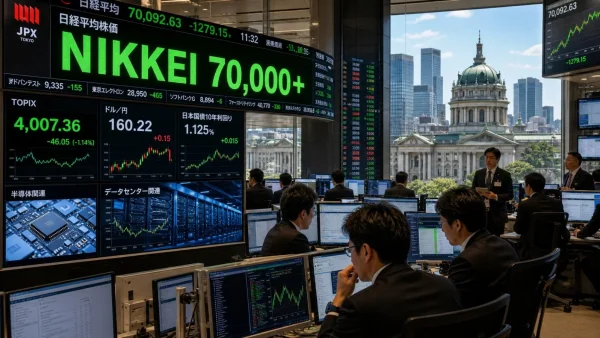
The stock market in Japan put down a marker on Tuesday when the index made that 70,000 crossing. Behind it was the Bank of Japan’s rate move and an assurance of accommodation. You could see risk appetite come back as a result, but not in a way that would have equity holders on edge.
Policy shift without a shock
With the benchmark up to 1 per cent – the most we’ve seen since 1995 – the BOJ is making its point, but it’s been at pains to stress a slow hand on the tiller. That does away with any notion of an overzealous tightening cycle that might stifle earnings or growth, something you can’t afford to worry about with global demand and energy costs being what they are.
They made the call in the middle of the Tokyo lunch hour, so there was no immediate reaction. But once the floor was open, the buying picked up as the message was read as good for both liquidity and the bottom line.
Record high reframes Japan’s market narrative
You had the Nikkei 225 pop by as much as 1% to set a new record over 70,000 before it settled, a sign that the old deflationary days are behind us and inflation is here to stay. The Topix, too, turned early red into a 0.2% gain at 4,007.36, which is a better read on the room than the headline number alone.
There’s a sense among those in the know that we’re in for a Japan of higher wages and fatter profits under more typical monetary rules. It only adds to the luster of a market that has been one of the top dogs in the world of late.
AI leaders carry the day, breadth lags
If you were in the right tech or infrastructure name with ties to the AI boom, you did well. Advantest, for instance, was up 5.1%. On the data-centre and power side, Fujikura and Furukawa Electric saw 9.9% and 7.5% moves.
But don’t let the index fool you. Only 83 of the 225 stocks in the Nikkei went up; 142 went down. A handful of big names are doing the heavy lifting. Even so, the BOJ’s tone was taken as an all-clear to stick with your long-term plays.
Some of the numbers from the session:
– Nikkei: up to 70,000 at its peak
– Topix: 0.2% in the green at 4,007.36
– Breadth: 83 up, 142 down
Currency and bonds flash caution
The yen was a touch stiffer at 160.215 to the dollar, 0.1% or so after the news. Yet it’s still in the 160s, where markets think the authorities will be watching like hawks for any sign of intervention.
A soft yen is a double-edged sword; it puts up import bills and stokes inflation via energy. So a measured approach to rates is what you want to see if you are to have any stability to speak of.
Bonds took a hit as yields were pushed up. The 10-year JGB future was 0.28 yen lower at 127.98, and the yield inched 0.5 bps to 2.625 per cent. When you expect less loose money, yields have a way of rising.
Why it matters for the next leg
This is a step in the right direction for policy, but not one that leaves risk assets for dead. The talk wasn’t hawkish enough to make the yen do a U-turn, which is to say the BOJ is firming up, but not in a way that will hurt the order book.
Then you have the rally itself. Money is flowing to the AI and data-centre side of things as the bet is on more hardware and networking. It’s been a good offset to some of the weakness elsewhere and shows how much a sector can drive the index.
What to watch next
All eyes are on whether the wage and pricing power is there to keep inflation in the BOJ’s sweet spot. And if the yen makes a hard run at 160, you can count on some nerves being tested on both sides of the table.
In the end, it comes down to the structure of the market. You have the reforms, the earnings, and the foreign money that have been the bedrock of this recovery. The BOJ is in no rush, and for now, that holds true even as the cost of borrowing creeps up.