A controversy surrounding Prime Minister Narendra Modi’s visit to IIT Delhi has taken a new turn after a report published by The Telegraph about alleged instructions given to students during the convocation was subsequently removed.
The report, headlined around students being told “how low to bow their heads” while receiving medals from the Prime Minister, quickly spread across social media and triggered a political debate about protocol, institutional autonomy and the treatment of students at high-profile political events. The original Telegraph page remains indexed by search engines, even though the article is no longer readily accessible through the newspaper’s website.
But now a second question has emerged:
Why was the report deleted? And that question may ultimately be more consequential than the original controversy.
What Did the Report Say?
The Telegraph report described extensive security arrangements surrounding Modi’s August 8 visit to IIT Delhi and reported that students faced repeated checks and restrictions on campus.
More controversially, it reported that students receiving medals had allegedly been instructed about how low they should bow their heads while receiving their medals from Modi, who was the chief guest.
The report also referred to instructions concerning students standing during Vedic chants at the convocation.
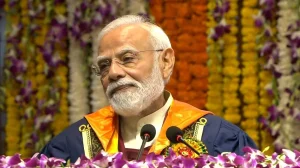
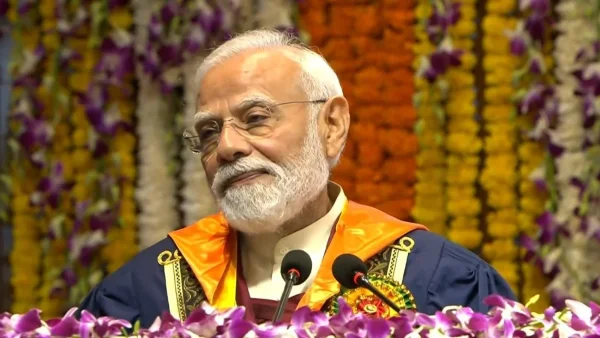
The Prime Minister’s Office had officially announced that Modi would attend IIT Delhi’s 57th convocation and present the institute’s highest honours to meritorious students. More than 3,000 students were to receive degrees, including 587 PhD scholars.
The alleged bowing instruction, however, became the headline-grabbing part of the controversy.
Then the Story Disappeared
Once the report went viral, political leaders and commentators began questioning the alleged protocol.
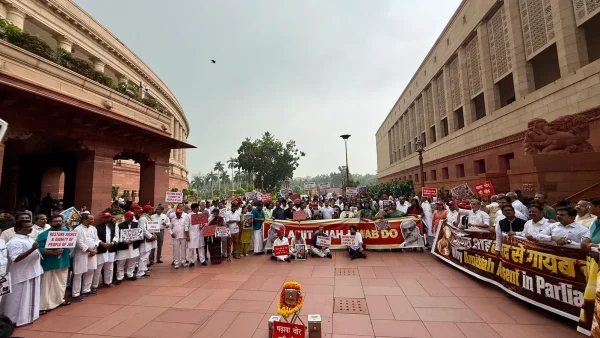
AIMIM chief Asaduddin Owaisi publicly questioned the reported instructions and linked the issue to broader questions about constitutional values and conduct at government educational institutions.
Congress leader Supriya Shrinate also questioned why the Telegraph report had been withdrawn.
The deletion therefore created a second story:
Was the article corrected, withdrawn because of an error, or removed under external pressure? At present, there is no verified evidence establishing that the government ordered or pressured The Telegraph to delete the article.
That distinction is crucial.
A deleted article can raise legitimate questions without automatically proving censorship.
“Government Made a Phone Call” — Fact or Speculation?
This is where the story needs to be handled carefully.
The sequence of events may look suspicious to critics:
Report published → report goes viral → political controversy → report disappears.
But that sequence alone does not prove:
Government called newspaper → newspaper was pressured → article deleted.
There could be other explanations.
The newspaper may have decided that the wording was inaccurate, lacked sufficient context, required correction, or did not meet its editorial standards.
Unless The Telegraph, government officials or another credible source establishes what happened internally, the alleged phone call remains an allegation, not a fact.
And that is precisely why the deletion itself deserves scrutiny.
The Bigger Issue: If It Was Wrong, Why Not Explain?
This may be the most interesting question in the entire controversy.
If the report contained an error, the simplest solution would appear to be:
Publish a correction.
Explain what was inaccurate.
Identify which claim was disputed.
Give the relevant institution an opportunity to respond.
Then update the story.
Instead, when a politically sensitive report disappears without a clear public explanation, speculation naturally fills the vacuum.
And in the age of screenshots and social media, deleting something rarely makes it disappear.
The internet has a surprisingly good memory.
IIT Delhi Is Not an Ordinary Venue
The controversy also touches on a larger question about the relationship between political power and educational institutions.
IITs are among India’s most prestigious academic institutions.
Their convocations are fundamentally about:
academic achievement,
research,
students,
teachers,
families,
and the transition from education to professional life.
When the Prime Minister attends as chief guest, substantial security arrangements are understandable.
The Prime Minister is a high-security constitutional officeholder.
But security is one thing.
Ceremonial deference is another. If students were merely instructed on the appropriate protocol for receiving medals from a dignitary, that could be regarded as ordinary ceremony.
If students were specifically instructed to bow to a particular degree or manner because of the identity of the dignitary, that raises a different question about institutional culture.
The facts need to be established.
Security or Spectacle?
Reports from students also described extensive security checks and disruptions around the campus during the visit. National Herald, citing the Telegraph report and student accounts, reported complaints about repeated identity checks and searches.
There is an obvious tension here.
A Prime Minister requires security.
Students deserve a functioning academic environment.
The challenge is to ensure that one does not unnecessarily overwhelm the other.
After all, IIT Delhi is supposed to be a place where young people are taught to question assumptions, challenge conventional thinking and solve difficult problems.
The irony would be hard to miss if the same students were simultaneously being instructed in precisely how to perform ceremonial deference.
The Sarcasm Writes
Itself IIT Delhi teaches students:
Think independently.
Question everything.
Challenge the impossible.
Then comes convocation:
“Just make sure you know exactly how low to bow.”
Of course, if the instruction was simply part of standard medal-receiving protocol, the controversy may be overstated.
But if that is the case, why not simply explain the protocol and put the controversy to rest?
What Should the Government and IIT Delhi Clarify?
Instead of allowing social media to conduct the investigation, the relevant authorities could answer a few straightforward questions:
1. Were medal recipients instructed about how deeply to bow?
If yes, who issued the instruction?
2. Was this standard convocation protocol?
If it was, has the same protocol been used for other chief guests?
3. Were students instructed to stand during Vedic chants?
If so, was participation mandatory or ceremonial?
4. Did IIT Delhi object to or dispute the Telegraph report?
If yes, what specific claims were incorrect?
5. Why was the Telegraph report removed?
Was it an editorial decision, a correction, a legal concern or something else?
These are reasonable questions.
They don’t require anyone to assume a conspiracy.
The Press-Freedom Question
The most important issue may now be the fate of the article itself.
News organisations make mistakes.
They correct stories.
They update reports.
They sometimes remove material when facts cannot be independently verified.
None of that is inherently evidence of censorship.
But when the subject is the Prime Minister, a prestigious educational institution and alleged instructions concerning political deference, transparency about editorial decisions becomes particularly important.
If a story was wrong, say so.
If a source was unreliable, explain it.
If facts were disputed, publish the response.
If the story was removed for legal reasons, state that where possible.
Silence creates suspicion. Explanation creates accountability.
The Real Story May Now Be the Missing Story
The original controversy was about how students were allegedly instructed to behave around the Prime Minister.
The new controversy is about why a newspaper’s report on those instructions disappeared.
And the second question is arguably more important for democracy.
Because governments will come and go.
Prime ministers will change.
IIT batches will graduate every year.
But the principle of a free press should remain.
If the report was inaccurate, correct it. If it was accurate, explain why it was removed. And if anyone pressured the newspaper to suppress legitimate reporting, that deserves scrutiny too. At this point, however, there is insufficient evidence to state as fact that the government made a phone call ordering The Telegraph to delete the story.
That allegation should be investigated rather than simply repeated.
And perhaps that is the real lesson of this episode:
In a democracy, the answer to uncomfortable journalism should be facts—not mysterious disappearances.