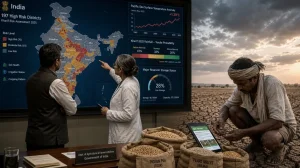
Karnataka’s drought alarm has escalated into a national concern, with Chief Minister DK Shivakumar urging Prime Minister Narendra Modi to send a central team for an immediate on-ground assessment. Citing a 30% rainfall deficit and fast-rising risks to crops and drinking water, the state wants early intervention to shield farmers and stabilise food prices.
Why Karnataka’s drought appeal matters nationally
The state’s farm economy leans heavily on the southwest monsoon. With 84. 79 lakh hectares under rainfed agriculture and 74% of the state’s annual rainfall arriving in this season, a shortfall can ripple through markets and livelihoods.
Shivakumar flagged a national spillover: Karnataka is a major pulses producer. Any major drop in output could strain the availability and prices of pulses, especially tur dal, across India.
In a letter to the Prime Minister, the CM warned that without rapid support, the drought could aggravate stress on farmers, water availability, and food inflation. He framed the situation as an emerging disaster that requires the Centre’s early evaluation and assistance.
The data behind the distress
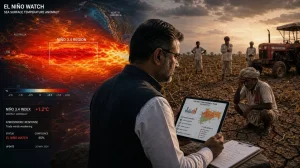
The India Meteorological Department had forecast below-normal rainfall for the 2026 southwest monsoon due to El Nino. On the ground, that projection has materialised.
As of July 11, 2026, Karnataka received only 203 mm of rainfall against the normal of 292 mm, a deficit categorised as a deficient monsoon. Of 31 districts, 18 are in deficit to large-deficit territory. At the taluk level, 141 out of 240 taluks are deficient to severely deficient.
The Malnad region, a crucial catchment for the Cauvery, Tungabhadra and Bhadra rivers, recorded the steepest shortfall at 34%. Coastal Karnataka followed at -30%, North Interior Karnataka at -24% and South Interior Karnataka at -18%, pointing to basin-level stress that could curb inflows.
Reservoir levels mirror the pressure. In the 14 major reservoirs, total storage as of July 10 stood at 303 TMC, 34% of the total capacity of 895. 65 TMC. The CM cautioned that weak inflows could affect irrigation supply, drinking water security and hydropower in the coming months.
Kharif sowing has also lagged. As of the first week of July 2026, only 28.36 lakh hectares had been sown, 34% of the seasonal target of 84.10 lakh hectares. Farmers, facing poor soil moisture and uncertain rains, are holding back, the CM noted.
What the Chief Minister has asked from the Centre
Shivakumar posted his letter online, seeking urgent central intervention as contingency actions commence in the state. He argued that an early visit by a central study team would validate field realities and fast-track assistance.
His request aims to protect farmers, ensure drinking water priorities, and reinforce drought mitigation already underway. The CM also said that such a visit would reassure communities that the Centre stands by them.
Here are the CM’s key asks from the Centre:
– Depute a Central Team for on-ground assessment
– Enable early evaluation to guide relief decisions
– Extend timely assistance to support farmers
– Reassure affected communities through a field visit
State actions and opposition pushback
The Karnataka government has rolled out crop advisories and district-wise contingency plans in consultation with agricultural experts. Departments have been directed to implement mitigation measures, while reservoir water has been prioritised for drinking given the shortfall.
The opposition BJP challenged the government’s approach. Karnataka BJP president B Y Vijayendra accused the administration of focusing on letter-writing rather than swift relief delivery. He alleged that promised drought reviews were not conducted and key portfolios remained ineffective.
Vijayendra urged the government to immediately announce relief, including Rs 50,000 to affected farmers, and to appoint ministers for district-wise drought assessments until a central team arrives. He argued that the government must demonstrate on-ground action to match the crisis.
Forecast context and what comes next
Karnataka’s agro-climatic profile makes it one of the most drought-prone states, with about 77% of its geographical area in dry and semi-arid zones. That vulnerability, combined with El Nino-linked monsoon weakness, has amplified risks this season.
For now, the state has asked the Centre to step in early. According to the CM, a central team’s findings would shape the scale and timing of support. With sowing delayed and reservoirs low, any policy lag could deepen rural distress and nudge food prices higher.
Shivakumar framed the moment as a test of rapid coordination. He argued that timely central support would shore up the state’s response and stabilise a situation that is already straining farms, water systems and household budgets. The next decision rests with New Delhi.