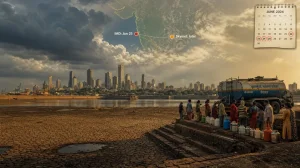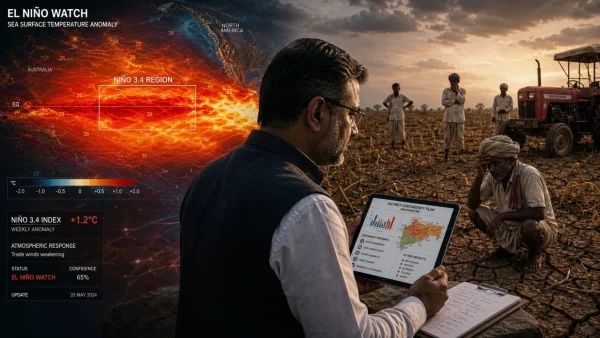
The southwest monsoon has hit a patch of rough weather at the very moment the Pacific has put on the gas. Now that El Nino is an official and the sea is breaking temperature records, the odds are up for a lean July and August. That has put the farms and the inflation-watchers on notice.
Pacific heat races ahead of schedule
If you look at the numbers from the central Pacific, things are moving fast. We’re talking 29.32 C in the Nino 3.4 zone – a new high for 16 days in a row, by the book of the Climate Reanalyzer and NOAA OISST figures.
It is 1.6 to 1.8 C over the norm, which is hard to come by this time of year. The 2026 line has put aside the last few years and is in a contest with the kind of early blips we saw with the 2015-16 super El Nino, even if Nino 3.4 doesn’t usually top out until later.
And it is not as if the ocean was cool to begin with. By the reckoning of Copernicus and NOAA, May 2026 was in a dead heat with 2024 for the title of warmest. This new phase is just piling on to the heat that was there all along.
Monsoon momentum falters onshore
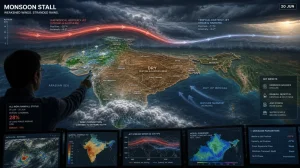
It was off to a good start, but the monsoon has lost some of its verve. The people in the know say the rain bands are down, the clouds have scattered, and there are drier patches than you’d expect.
Kerala got its first rains on June 4, a bit late but nothing to write home about. After that, the letdown. Between the 1st and 10th of June, all-India rainfall was 26 per cent in the hole, and the IMD says it will be like that through the 15th.
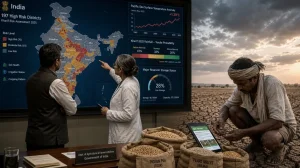
Not everywhere is in the same boat. You see the biggest deficits in the first fortnight in the centre, west and south, while the east and north-east are holding up or are even wet. But in the rain-fed areas, farmers are on tenterhooks; sowing is only as good as the rain behind it.
Forecast signals turn from caution to confirmation
The U.S. National Oceanic and Atmospheric Administration made it clear on June 11: El Nino is here. They put out an advisory with a 63 per cent shot of it being very strong by the time winter comes around. Over in India, the weather office is still hedging, saying the Pacific is neutral but ‘in transition’.
The policy side has been reining in, too. Back on May 29, the IMD put a cap on the seasonal outlook at 90 per cent of the long-term average, a step down from the 92 per cent they were on in April.
They hiked the chance of a deficient season from 35 to 60 per cent. Put it all together and you have an 84 per cent probability of a below-normal monsoon or worse. The core of it, where most of the cropland is, is the one to watch.
A thinner buffer for the core months
El Nino has a way of throwing a wrench in the atmospheric works, and the Walker cell that puts the rain on the subcontinent is no exception. Still, scientists will tell you it is no sure thing for a drought; there are other forces at play.
Take the Indian Ocean Dipole. In April we were looking for a positive IOD, but the latest word on June 11 is neutral, with maybe a weak one to come in the back end of the season. The kind of cushion you had in some of the old El Nino years is not as much in evidence this time.
Government response and what happens next
There is some unease in the Union Ministry of Agriculture and Farmers Welfare. They have put the Indian Council of Agricultural Research and the state departments to work on some new contingency plans for the kharif run-up. They want to see them by June 20.
It is a matter of going through the districts and making a call on where a poor monsoon could do the most damage in terms of yield and drought, based on the ground, the water and how they are set up to irrigate.
Here is what you will see officials doing:
– Get the El Nino plans in order before the 20th
– Put a focus on the monsoon’s heartland
– Rely on the district-level info on soils and irrigation
– Keep a close eye on the sowing and the rain
What to watch next
July and August will be the make-or-break. That is when the atmosphere tends to get with the program and the El Nino makes itself felt. If the present course holds, 2026 may well be another year of a strong El Nino and a monsoon that falls short.
As it stands, the divide is plain. The Pacific is on a tear. And in India, the monsoon is flagging right when you can least afford it, which is why there is a push to act at the district level before the planting is done.