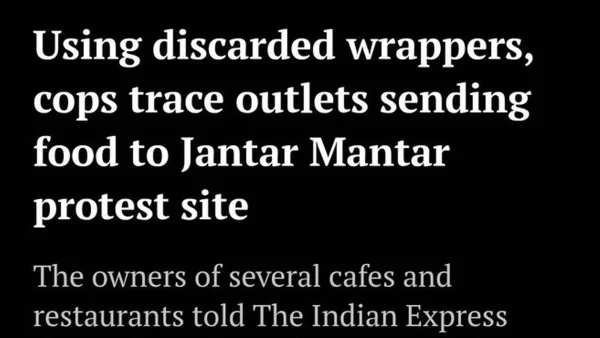
A report by The Indian Express has triggered a fresh debate over the balance between law enforcement, surveillance, and the rights of peaceful protesters, after it claimed that Delhi Police traced food deliveries made to the Jantar Mantar protest site by examining discarded food wrappers and visiting restaurants.
According to the report, owners of several cafés and restaurants told The Indian Express that police officers visited their establishments and reviewed records of food orders and deliveries made over the past few days to identify supplies reaching the protest venue.
The reported actions have prompted discussions over whether monitoring logistical support to protests is a legitimate policing strategy or raises broader concerns about privacy and democratic freedoms.
Discarded Wrappers Allegedly Used to Trace Food Orders
According to The Indian Express, Delhi Police officers reportedly collected discarded food wrappers from the protest site and used the information printed on the packaging to identify restaurants that had fulfilled orders.
The report further states that officers subsequently visited several cafés and restaurants to review delivery records relating to food sent to Jantar Mantar.
The article cites restaurant owners who described police inquiries into the orders placed and delivered in recent days.
The report does not, by itself, establish the broader purpose or outcome of these visits.
A Debate Beyond Food Deliveries
The reported actions have shifted attention beyond the protest itself to a larger constitutional question.
Supporters of the police approach argue that law enforcement agencies may collect information relevant to maintaining public order or investigating potential legal violations.
Others contend that scrutiny of food deliveries to a peaceful protest could discourage individuals and businesses from providing lawful assistance, raising concerns about privacy, freedom of association, and the practical ability of demonstrators to receive basic supplies.
The issue has therefore become part of a wider conversation about the boundaries of policing during public demonstrations.
Online Opinion Divided
The report has generated extensive discussion on social media.
Among the reactions:
“If people are peacefully sending food, why should restaurants be questioned?”
“Police have a duty to gather information if there are security concerns.”
“Monitoring food deliveries feels like surveillance of civic participation.”
“Businesses shouldn’t have to worry about serving customers who are exercising their democratic rights.”
“The full context matters—an official explanation would help answer many of these questions.”
These comments reflect public opinion and online discussion rather than established facts about the reported police actions. The Bigger Constitutional Question
Where Does Security End and Surveillance Begin?
Public protests often require logistical support, including food, water, medical supplies, and transportation.
As demonstrations become increasingly supported through digital payments and app-based deliveries, questions are emerging about how authorities monitor these activities and where the line should be drawn between legitimate policing and intrusion into lawful civic participation.
Legal experts have long noted that democratic societies must continually balance public order with constitutional freedoms, including the rights to peaceful assembly and expression.
The Debate Is No Longer Just About Food
Whether the reported police visits were part of a routine inquiry, a security assessment, or another investigative process, the story has expanded into a broader discussion about how democracies police public protests in the digital era.
For supporters of the reported actions, tracing supply chains may be viewed as a legitimate investigative tool. For critics, it raises questions about whether ordinary acts—such as sending food to demonstrators—could come under official scrutiny.