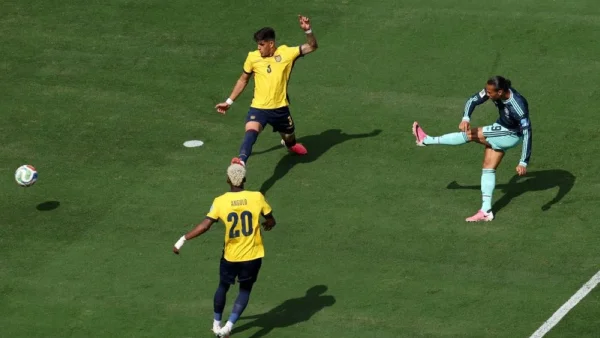
It didn’t take long for Sane to make his mark on this World Cup. A little under two minutes in, he was off the mark against Ecuador, and with it, a bit of history in the making. The winger’s effort was Germany’s second-fastest in the competition and his own first at a showpiece event.
Why this lightning start matters
You can’t put a price on an opener in the first two minutes. It rattles the other side, gives you the reins, and sets the tone. For Germany, Sane’s shot in their last Group E match was a way to assert some early dominance.
Then there is the personal side of it. At 30, after all this time at the top, he had never notched one in a World Cup or Euros before. To do it here and now means something for him and the side.
A 92-year wait ends for Germany
If you look at the books, Sane is the first of his countrymen in over 92 years to put one past the keeper in the opening two minutes of a World Cup game. You don’t see that kind of window very often, even from a nation with four trophies to its name.
The outright record is still in the hands of Ernest Lehner, who did it in 25 seconds back in 1934 with Austria on the other end. Sane has staked his claim for number two on the list, which is no small thing in a country with such a storied past.
How the global record stacks up
Worldwide, the standard is set by Hakan Sukur of Turkey. He made it 11 seconds in 2002 against South Korea and has been untouchable since.
There are others in the fast lane, if not in the first 60. Think of Bryan Robson for England in 1982 (28 seconds), Clint Dempsey for the U.S. in 2014 (30) or France’s Bernard Lacombe in 1978 (31).
You have a couple from 1938: Arne Nyberg of Sweden and Emile Veinante of France both at 35. Add in Florian Albert and Adalbert Desu from 1962 and 1930 at 50, and Denmark’s Mathias Jorgensen in 2018 at 55.
In all, 13 times has a goal been put in the net in the first minute of a World Cup. Sane is just on the outside of that circle, but his was the one that put Germany in a position of strength against Ecuador.
The moment and the message
It wasn’t simply about how quick it was. It was about the impact. Germany wanted to close out Group E on their terms and they were given an opening. Ecuador, on the other hand, had to retool before they could even get into a rhythm.
For Sane, it’s a statement. It shows he can be a threat in the half-spaces and will make teams pay for high lines. It’s also a way to put to rest some of the expectations that come with being a star in a big tournament.
Context for fans tracking milestones
From now on, Sane’s is the number to beat for any German side wanting to break through. With 25 seconds being a hard act to follow, getting in under two had been a near-impossibility for the better part of a century.
Hakan Sukur’s 11-second run puts a fine point on how uncommon sub-20 is. Sane’s 1:49 is right in the sweet spot: early to make a difference, but within the realm of what can be done again.
Key takeaways
What to remember from it:
– 1:49 on the clock when Sane scored
– The second-fastest by a German in World Cup history
– First time in 92 years a German has done it in the first two minutes
– Sane’s first in a major final
– An early goal that put the shape on the Group E finale
What it means looking ahead
In a tournament like this, an early one is a luxury. It takes the pressure off you and puts it on them. That Germany can put one together in a matter of seconds is a quality you want to have when it comes to the knockouts.
As for Sane, the stat is more than a piece of trivia. It’s proof that his style of play can be the deciding factor from the first blow of the whistle. When margins are this thin, you want that sort of edge.