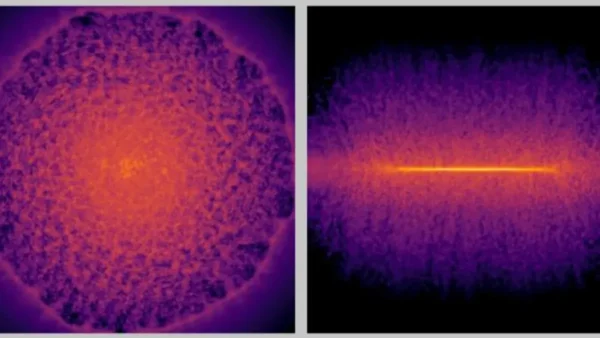
In a major breakthrough for astronomy and computational science, the investigators have created a computerized model of the Milky Way. As we know, this is the most detailed model ever created for the Milky Way galaxy now. This computational wonder, which is led by Keiya Hirashima and his RIKEN Center for Interdisciplinary Theoretical and Mathematical Sciences team in Japan, uses artificial intelligence to model more than 100 billion stars and thus, to track in an accurate way the galaxy’s intricate evolution.
A Leap in Galactic Modelling
The Milky Way simulation has been historically hard to make. There was a problem with the previous models in that they were unable to very well represent our vast galaxy system, all the while confusing stars because they were in groups. Simulation that already existed was limited to solar systems of not more than an equivalent of one billion stars which was still not close to Milky Way’s complicated structure.
The prototype still managed to impress everybody, but it was the final one that completely turned the tables. By getting deep learning thoroughly in sync with the traditional physics-based modelling, Hirashima’s team was able to reach a precision that was beyond imagination previously. Their novel approach enables the simulation to be 100 times faster compared to its predecessors while 100-times more stars are being utilized.
AI’s Role in Accelerating Discovery
Deep learning is playing a major part in this upgrade with its imitation model trained on high-resolution data of supernovae. The AI model is capable of making predictions on how gas is to be distributed in the wake of a supernova explosion spread over 100,000 years. The researchers are enabled to run simulations that are not only of a short-term nature but also covering the whole galactic evolution in a long-term way, and all this without losing any bit of the detail or inefficiency.
This is a radical strategy. It shortens the time for the simulation of a billion years of galactic history from decades to only 115 days. From a practical point of view, what could be done in 36 years now will be finished within four months at the maximum. The efficiency of such a process represents a great stride in our knowledge of the cosmos.
Implications Beyond Astronomy
Even though this accomplishment symbolizes a great breakthrough in astrophysics, its impacts are more than just sea science. The methodology of Hirashima and his team that the researchers at Nagoya University have developed also stands out in the scientific community as promising for the applications of other fields requiring modeling of a variety of complex systems across the scales and timeframes.
The potential areas of application are climate and weather models, where the events on the small scale can significantly impact the larger systems. The involvement of AI in the process of using a high-performance computing system could expedite the models; hence, they would be more accurate and efficient.
A New Era of Scientific Discovery
Not only about speed or scale, but the breakthrough in simulating the Milky Way is significantly altering our perception of the evolution and structure of the galaxy. Pioneering the way element-forming life within the galaxy was, if we want to put it in such a way, by providing a detailed map of how individual stars and supernovae contribute to the galaxy’s development, this simulation offers insights into how elements essential for life formed within our galaxy.
Hirashima points to the integration of AI with high-performance computing as a significant move that overturns the challenges of multi-scale, multi-physics computational science. It is a ground-breaking event showing that AI is not only a pattern recognition system but a real tool for scientific exploration.
Future Prospects
Scientists are committed to polishing up the method used to visualize further developments and investigations related to its applications that could be wide and far-reaching like in other scientific fields being revolutionized. And then follow-ups would be concerned with matching these methods to the ground and with modeling the Earth system and so forth.
To sum up, this simulation that uses AI is definitely a breakthrough in our exploration of the cosmos. New AI technology based on traditional physics is now making it possible to understand not only our own solar system but also the whole galaxy at large. Therefore, the future will see similar breakthroughs in different scientific fields thanks to the combined efforts of the two sciences – physics and AI_ERROR.