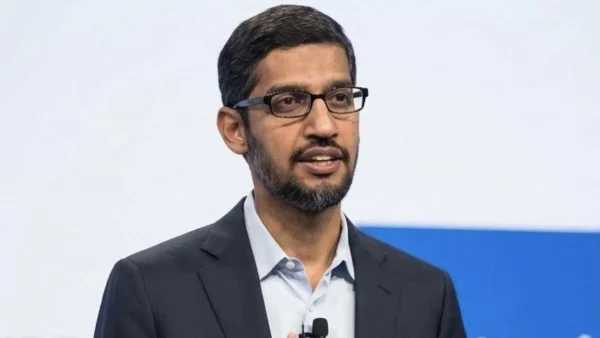
Artificial intelligence (AI) still remains the central topic of conversation in the context of the digital world evolution. The realities of CEO robots were recently disclosed by Sundar Pichai, the CEO and parent company Alphabet, who even hinted that a possibility exists whereby robots will fill such a position as the chief executive officer. This daring forecast put forth by Mr. Pichai opens up a new world of possibilities for the leadership of industries and the ways in which people might fit into the picture in the days to come.
The Dynamic Leadership that Continues to Evolve
In a recent interview Sundar Pichai made an interesting comment on AI’s potential to be responsible for tasks that have always been the exclusive realm of human executives. He contended that the duties of a CEO could be relatively “easier” for AI when taking into account the future. Besides its basic operational functions, AI is now seen by tech gurus as the probable new route to executive management if not the revolutionizer of that sector as well.
Pichai’s comments are indicative of a more general feeling among tech directors. Not only the heads of OpenAI and Klarna, but also the people who are in charge of the other tech firms share the view that a day may come when AI could surpass the top human jobs. The market ground OpenAI CEO Sam Altman took for the issue was the positive one, whereas Klarna CEO Sebastian Siemiatkowski, on the other hand, warned of AI’s power to remove jobs of all ranks, including even his own.
AI: Risk or Reward?
With AI, the bright side of the coin is that there will be fewer mistakes and more new things. However, one has to agree that it is not without risk and one major risk is the socio-economic disruption that could take place because of AI’s coming into power. Pichai brought out that while some people might suffer from the effect of AI’s taking away their jobs, on the other hand, many others might find their task upgraded. It is possible that the shift will necessitate the people who are to fill the new positions to train in a new way. He remarked that the content creation services will not only have a bright future but will also have a multitude of new positions to be filled as the use of AI will become more rampant.
However, there are still some negative aspects as well. The Nvidia CEO Jensen Huang is still doubtful that AI can take over human roles at the level of diversity. He believes that AI might be very good in certain tasks, but it is missing the complete capabilities in the sense of human judgment and decision making.
Embracing AI for a Brighter Tomorrow
Acknowledging that the opinions about AI’s possible uses can be polarized, one thing that is for sure is that every person and organization have to be open to the new AI-centric world in order to be able to scale up their operations or simply live up to whatever way of life they desire. Pichai is encouraging all professionals regardless of the field they are in to accept AI and also gain the skill of using it accordingly. Even if you are a teacher or a doctor, the knowledge to make use of AI tools will improve work performances and give you openings for new roles.
AI’s influence on top-level management positions is increasingly discussed as more and more companies invest in AI technologies. To be able to cope with the positive outcomes, leaders must be able to see the total picture, that is, how organizational structures, and workforce activities will be affected by the technological advancements.
Getting Ready for the Robotic Age
The idea of the CEO being automated forces us to think about the role of the human and their accountability and regulatory issues in an AI-dominated future. If the machines are the ones who have the control and decision-making authority, then how will companies make sure that their decisions are ethical and that they are in alignment with their long-term goals? These are the kinds of questions that companies will need to address as they incorporate AI technologies into their business processes.
Additionally, as Pichai pointed out, there are still a number of challenges that AI has to overcome in order to fully exploit its capabilities in the executive sector. Although the technologies are advancing quickly, the accomplishment of that state where they are seamlessly integrated with the current systems will need sound and careful installation and constant monitoring.
Balancing Innovation with Caution
At this time, when this technology re-invention is about to begin, it is very necessary to balance innovation with caution. The fast progress of AI opens doors to never-seen-before opportunities but also brings along certain risks if not handled with responsibility. Companies are supposed to be alert to the possible wrongdoings while at the same time looking for ways to take on the changing power of AI.
Ultimately, Sundar Pichai’s vision of an AI-driven future calls upon us to review and reinvent the concept of operation and leadership, irrespective of whether we are involved in business, policy-making, or are just individuals. Being responsive to change and working towards the future-oriented preparation ultimately assures that AI is more of a helper than a problem-causer in the process of progress.
To sum up, Mr. Sundar Pichai’s claim that the task of a CEO could be one of the first to be replaced by AI could be seen as shocking and provocative, but what it really does is to highlight the need for businesses to adapt fast in a constantly changing environment. No one knows what will happen, but one thing is for sure, without any doubt, combined effort between humans and machines will determine the result of our transition to the automated age.