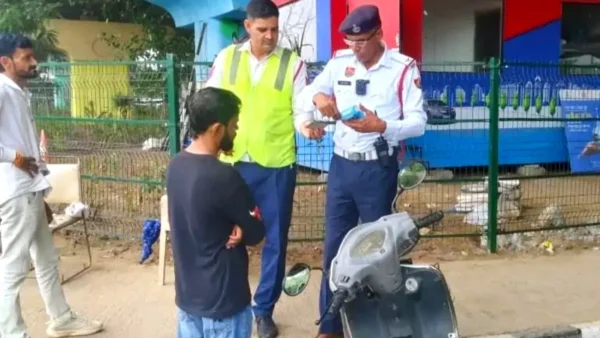
In an incident that has sparked widespread discussion on social media, Gurugram Police seized a scooter after discovering that it had accumulated 96 pending traffic challans amounting to approximately ₹10 lakh.
According to the police, the vehicle was stopped during a routine traffic enforcement drive for violating traffic rules. A check of its registration details revealed a staggering history of unpaid e-challans, making it one of the most extreme cases of repeated traffic violations.
The incident has raised an obvious question among the public: When the outstanding fines are many times higher than the value of the vehicle itself, what happens next?
How Can a Scooter Receive 96 Challans?
With the expansion of AI-enabled surveillance cameras and automated traffic enforcement systems, violations are now detected more efficiently than ever before.
Common offences that generate e-challans include:
Jumping red lights.
Riding without a helmet.
Triple riding.
Driving in the wrong lane.
Over-speeding.
Stopping beyond the stop line.
Violating no-entry restrictions.
Driving without valid documents.
If violations continue over months or even years without the fines being paid, the penalties can accumulate into substantial amounts.
Why Was the Scooter Seized?
Traffic police have the authority to seize vehicles in certain situations, particularly when repeated violations indicate persistent non-compliance with traffic laws or when legal procedures require impounding.
Seizure serves multiple purposes:
Preventing further violations.
Ensuring compliance with legal proceedings.
Recovering pending penalties through due process, where applicable.
The exact legal outcome depends on the applicable provisions of the Motor Vehicles Act and subsequent proceedings.
Can the Fine Really Be More Than the Scooter’s Value?
Surprisingly, yes.
Traffic penalties are linked to the number and nature of violations, not the market value of the vehicle.
This means a two-wheeler worth ₹50,000 can accumulate fines running into several lakh rupees if the owner repeatedly violates traffic rules and ignores notices.
The law penalizes the offence—not the price of the vehicle.
What Are the Owner’s Options?
Once multiple challans have accumulated, the registered owner may have to:
Verify the pending challans.
Contest any challan they believe was issued incorrectly through the prescribed legal process.
Pay the applicable penalties if the challans are valid.
Comply with any court or transport authority directions.
Simply abandoning the vehicle does not automatically erase the legal liability associated with the registered owner.
The Rise of Digital Traffic Enforcement
Across India, cities are increasingly relying on:
Automatic Number Plate Recognition (ANPR) cameras.
AI-based traffic monitoring.
Integrated e-challan systems.
CCTV surveillance at major intersections.
These technologies reduce the need for physical interception and allow authorities to detect violations even when drivers are not stopped on the spot.
While many road safety experts believe this has improved enforcement, critics argue that motorists should also have accessible mechanisms to check and resolve pending challans before penalties snowball.
A Lesson Beyond One Scooter
The Gurugram case is unusual because of the sheer number of pending challans, but it also highlights a broader issue.
Many vehicle owners remain unaware of unpaid e-challans issued through automated systems. Regularly checking pending violations can help avoid unexpected legal and financial consequences.
Ultimately, traffic fines are not intended to generate revenue—they are meant to encourage safer roads. Whether the vehicle is a luxury car or a modest scooter, repeated violations can prove far more expensive than following the rules in the first place.
In this case, the scooter may have been worth around ₹50,000, but the cost of ignoring traffic laws reportedly reached nearly ₹10 lakh—a reminder that on today’s roads, repeated violations can become the most expensive part of owning a vehicle.