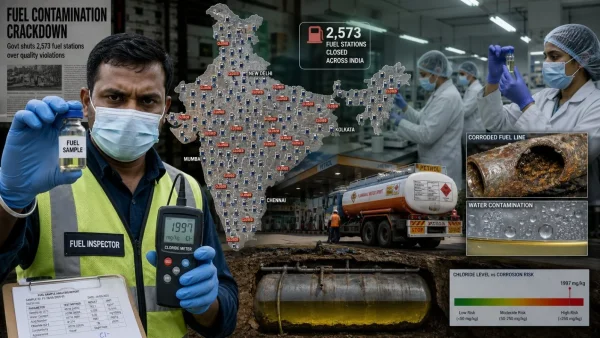
India’s controversy over E20 petrol has entered a new phase after petrol sales were stopped at 2,573 fuel outlets nationwide as part of an intensified quality-control campaign.
The development comes weeks after the Petroleum Ministry said that more than 2,000 samples had been tested for chloride and sulphide contamination and that only two cases of chloride contamination had been identified at that point. The government said sales at those outlets were immediately suspended.
The latest action, however, is considerably broader.
According to Autocar India, as of August 25, petrol sales had been stopped at 2,573 non-compliant outlets: 1,257 under Indian Oil, 915 under Hindustan Petroleum and 401 under Bharat Petroleum.
That has inevitably intensified public questions:
If the problem was initially described as isolated, why are thousands of outlets now facing restrictions?
What actually happened at the 2,573 pumps?
An important distinction is necessary.
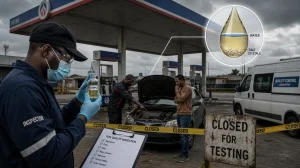
The 2,573 outlets were reportedly identified during a nationwide quality-control exercise for non-compliance. The action does not mean that all 2,573 outlets were proven to have contaminated petrol.
According to Autocar India, inspections focused heavily on water ingress and the condition of storage-tank water probes, while fuel outlets can also face restrictions for other technical, operational or financial violations, including adulteration, tampering with metering equipment and unauthorised installations.
Therefore, the figure of 2,573 should not be described as proof that 2,573 pumps were selling contaminated E20.
But the scale of the action is still significant.
Why did E20 become controversial?
E20 is petrol containing up to 20% ethanol.
India has promoted ethanol blending as part of its strategy to reduce crude-oil imports, improve energy security and create additional demand for agricultural products.
The government has repeatedly defended the programme, saying it was introduced through a phased and technically evaluated process involving institutions including NITI Aayog, automobile manufacturers, oil marketing companies, ARAI and other technical bodies.
But concerns about fuel quality have intensified since reports emerged of chloride and moisture contamination in some E20 samples.
The issue became particularly controversial after the Society of Indian Automobile Manufacturers (SIAM) sent a July 28 communication to the Petroleum Ministry raising concerns about chloride contamination. SIAM subsequently withdrew the communication, saying the figures required further verification.
Automakers’ internal concerns
The controversy did not end with SIAM’s withdrawal.
A Reuters investigation reported that internal communications among major Indian automobile manufacturers—including Maruti Suzuki, Tata Motors and Mahindra—showed concerns about elevated chloride and moisture levels in some E20 samples.
According to Reuters, manufacturers had tested more than 250 samples and found elevated contaminants across multiple states. The companies subsequently distanced themselves from some of the earlier conclusions while calling for further scientific examination.
This is one reason the controversy has refused to disappear.
On one side are government agencies and oil companies saying nationwide testing has found fuel within prescribed limits.
On the other are automakers’ internal test results and continuing concerns about contamination in parts of the supply chain.
What does the government say?
The government’s position remains that E20 fuel is safe when it meets the prescribed specifications.
In August, Indian Oil, BPCL and HPCL said their nationwide testing found chloride levels within the applicable limits. The companies reported chloride levels of approximately 0–3 ppm in tested samples and said inspections of underground storage tanks had not found widespread water ingress.
The Petroleum Ministry has similarly rejected claims of widespread E20 contamination.
In an official statement, the ministry said extensive testing across refineries, distilleries, depots and retail outlets found fuel within prescribed specifications.
The government has therefore rejected the idea that India is facing a nationwide E20 contamination crisis.
But then why the aggressive crackdown?
This is where the latest developments have created confusion for consumers.
The government says the intensified inspections are designed to identify and eliminate risks throughout the fuel-supply chain.
The nationwide campaign has reportedly examined not only petrol pumps but also storage facilities, tankers and other parts of the distribution network. Water ingress has been a particular focus because ethanol-blended fuel can be sensitive to water contamination.
In other words, the latest action can be interpreted not necessarily as an admission that E20 itself is defective, but as evidence that authorities are taking fuel-quality controls much more seriously.
Is contamination inherent to ethanol production?
One claim circulating widely is that chloride contamination is effectively unavoidable because chloride can enter the ethanol-production process through water and agricultural inputs.
There is scientific literature discussing contaminants and impurities associated with industrial ethanol production and the need for purification and quality control.
However, the specific claim that a 2013 peer-reviewed Electrochimica Acta paper proves chloride from process water and chlorine-based pesticides is “unavoidable” in final fuel ethanol requires careful qualification.
A scientific paper discussing the presence, behaviour or removal of chloride does not automatically establish that contamination at harmful concentrations is unavoidable in commercial fuel ethanol.
Industrial purification, feedstock selection, water treatment and quality specifications can all affect the final product.
Therefore, the relevant question is not whether chloride can theoretically enter the production chain.
It can.
The crucial question is:
Can commercial fuel ethanol consistently be produced, transported, stored and blended while remaining within the required chloride specification?
That is a question that must be answered with transparent supply-chain testing.
The 3 ppm question
The government has specified a stringent chloride limit for ethanol used in petrol blending.
The current controversy is therefore not simply about whether chloride exists.
It is about whether fuel supplied to motorists consistently remains within the permitted specification and whether quality-control systems can detect contamination before the fuel reaches vehicles.
That distinction matters.
A fuel sample containing a trace amount of chloride within specification is very different from fuel containing substantially elevated contamination capable of causing corrosion or other component damage.
What about vehicle damage?
This is another area where the debate requires evidence rather than sweeping claims.
Automakers have raised concerns about contaminants potentially affecting fuel-system and engine components, and motorists have reported problems ranging from reduced performance to component failures.
But every engine failure reported by a consumer cannot automatically be attributed to E20 or contaminated fuel.
To establish causation in an individual case, investigators would need to examine:
Fuel samples from the vehicle or dispensing station
The vehicle’s service history
Fuel-system components
Chloride and moisture levels
The vehicle’s compatibility with E20
Whether contamination occurred before or after purchase
Storage conditions
Maintenance and other possible causes
A transparent mechanism for such testing would give consumers far more confidence than competing political statements.
Where does accountability lie?
The controversy raises a legitimate governance question.
Fuel passes through a long chain involving:
ethanol producers → refineries/blending facilities → storage depots → tankers → underground tanks → petrol pumps → consumers.
If contamination occurs somewhere along that chain, responsibility should be traced to the point where the failure happened.
Simply stopping sales at a retail outlet may protect future customers, but it does not necessarily answer how the contaminated product got there.
Nor does it automatically address the question of compensation for motorists who can demonstrate that contaminated fuel damaged their vehicles.
Did the government “know and lie”?
That is a serious allegation, but the evidence currently available does not establish it as fact.
The government has consistently maintained that E20 is safe when it conforms to specifications and has cited extensive testing to support that position.
At the same time, reports based on automakers’ internal testing indicate that contamination concerns were being discussed within the industry before the issue became public.
The appropriate question is therefore not whether a political slogan can prove that the government “lied.”
The more important question is:
When did authorities become aware of contamination risks, what evidence did they have at each stage, and what corrective action did they take?
That timeline should be made public.
What consumers deserve now
The government and oil companies should publish a comprehensive account of the nationwide inspections, including:
The exact number of outlets inspected;
The precise reason each outlet was found non-compliant;
How many outlets had fuel-quality violations;
How many involved water ingress;
How many involved chloride contamination;
The actual test results and locations;
Where contamination entered the supply chain, where established;
How affected motorists can obtain independent fuel testing; and
What compensation mechanism exists where contaminated fuel is proven to have caused vehicle damage.
Such disclosure would help distinguish a genuine fuel-quality problem from exaggerated claims circulating on social media.
The politics of E20
The ethanol programme has significant economic and political implications.
The government argues that ethanol blending reduces India’s dependence on imported crude oil and supports domestic agricultural and energy-security objectives. It has also argued that without ethanol blending, petrol prices could have been significantly higher during periods of elevated global crude prices.
Critics, meanwhile, argue that the costs of the transition—including possible lower mileage in some vehicles and compatibility issues—have not been adequately addressed.
The controversy has therefore become much bigger than fuel chemistry.
It is now about energy policy, consumer protection, agricultural economics, automobile technology and government transparency.
The bottom line
The figure of 2,573 petrol outlets facing sales stoppages is real, according to Autocar India and other reports.
But it would be inaccurate to claim that all 2,573 were shut specifically because contaminated E20 was detected.
Similarly, there is credible evidence that automakers raised concerns about chloride and moisture contamination, but there is not yet sufficient evidence to conclude that E20 fuel across India is inherently contaminated or that the government deliberately deceived the public.
What is beyond dispute is that consumer confidence has been damaged.
The government now has an opportunity to restore that confidence—not through political statements, but through complete transparency.
Because motorists deserve to know one simple thing:
When they pay for a litre of petrol, are they getting fuel that meets the promised standard—and if something goes wrong, who will be held responsible?