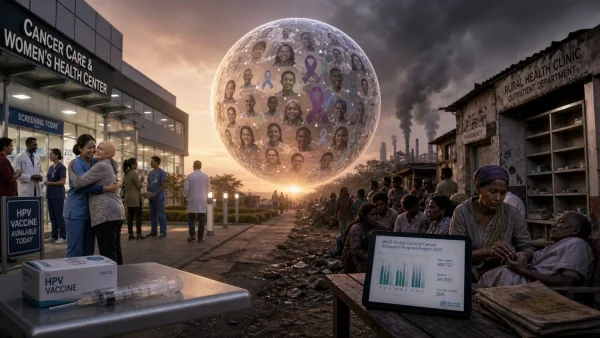
In a clear message from the WHO, cancer is once again front and centre: if nations do not move with some resolve, those numbers will top out at 35 million annually in 2050. And it is not just the patients; the agency puts it at 92 per cent of the population who will have to come to terms with the disease, one way or another.
You see the urgency and the opening in the World Health Organization’s Global Status Report on Cancer 2026, done in conjunction with the International Agency for Research on Cancer. It lays out what is on the line when policy lags and what is possible when you put prevention and care first.
A near-universal impact, unless action scales
There is no underestimating how much cancer is a part of everyday life. We are talking 20.6 million diagnoses and close to 10 million fatalities in a given year. Put another way, the WHO has the number of lives lost to the disease at 26,000 a day, around the world.
If you look at the projections, annual cases are on track for 35 million by 2050. One in five will be diagnosed, but the reality is that the ripples of the disease will be felt by almost everyone at some point.
Here are the key takeaways from the report to put things in perspective:
– A run-up to 35 million cases a year by 2050
– Globally, one in five will get cancer
– 92 per cent will be impacted by it
– More than 26,000 die each day
Gaps that decide who survives
In many ways, the report makes survival down to where you live. Take breast cancer: an 87 per cent five-year survival rate in wealthier nations, compared to 42 per cent in places with lower incomes.
Then there is the matter of coverage. You will not find cancer care in the universal health plans of more than a third of countries, which means for a lot of people it is a question of whether they can afford the bill or if treatment has to wait.
For Dr Tedros Adhanom Ghebreyesus, the WHO Director-General, these are inequities born of choice. ‘Cancer is a deeply personal disease that touches nearly all of us. But whether a person survives should never be a function of their birthplace or their income,’ he said.
Where the burden falls today
Asia has been the hardest hit in 2024, with over half of the world’s cases (50.7 per cent) and deaths (56.5 per cent).
Even with a population of just 9 per cent, Europe has been home to 21 per cent of the world’s cancer cases and 20 per cent of its fatalities.
On a global scale, lung cancer is still the top killer. For men, it is prostate and colorectal cancers that make up the bulk of new diagnoses; for women, it is breast, then lung and colorectal.
The impact of cancer is not confined to the clinic. A first-of-its-kind WHO survey found that at least 45 per cent of those affected have put up with some form of financial difficulty. Over half have had to deal with their own mental health, and for caregivers, the strain is almost universal.
Prevention is an option, yet we are not moving fast enough
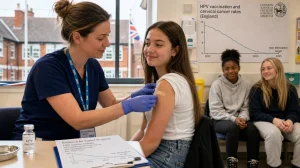
Some 40 per cent of all cases can be tied back to risks we could do something about. There are behavioural and environmental factors, and then there are infections like HPV, hepatitis B and C, and H. pylori.
Dr Elisabete Weiderpass, head of IARC, says that while some nations have made inroads with prevention, there is not enough of it. “We are seeing the face of cancer change as obesity, inactivity, poor diets and pollution go up. It has to be a political priority,” she puts it.
There is reason for optimism, though. Tobacco use has been down 27 per cent since 2010. Better sanitation and vaccines for HPV and hepatitis have put a lid on some of the cancers they cause. National control plans are now in place in 82 per cent of countries, a marked increase from 2010.
Where access is an issue
For all the policy work done, many are still left out when it comes to treatment. In high-income countries, you will find 68 to 94 per cent of essential medicines; in low- and lower-middle-income ones, the figure is between 9 and 54 per cent.
It makes a difference to the patient. An early diagnosis is of little use if one cannot pay for care, and a new therapy is no good if it does not get to the right clinics.
What the WHO is calling for
The WHO is making the case for a more people-focused approach, from how things are funded to who gets treated. The plan is to fold cancer control into universal health coverage, put more support in place for social protection and see that new innovations are not reserved for the well-off.
The report is clear on where leaders should focus:
– Put cancer care under the umbrella of universal health coverage
– Back patients and their caregivers with stronger social safety nets
– Put money behind health workers and the research they need
– Make sure everyone has a fair shot at the latest treatments
The point is made in no uncertain terms: what is decided today will be felt for years to come. “The choices made today will shape the cancer burden borne by future generations,” the report says.
It is a matter of life and death. With a proper balance of prevention, detection and fair treatment, there are millions of lives to be saved. If not, the forecast of 35 million cases a year by 2050 is no longer just a warning.