In his view, India at 80 is less of an occasion for commemoration than a matter of competitive strategy. To mark the day, Mistry has called for an alignment with Viksit Bharat that will see the industry drive nation-building. He is urging the kind of investments and innovation that can hold India’s ground against technological disruption and geopolitical uncertainty.
Why this intervention matters now
It is a timely statement as India makes its way through economic fragmentation and rapid technology cycles. Mistry contends that there is growing confidence in where India is headed, a sentiment bolstered by the Prime Minister, Shri Narendra Modi Ji, and the self-belief of 1.4 billion people.
Put in a global perspective, today is about speed, scale and resilience. The thrust of his argument is that India’s market edge will be defined not by what has gone before but by the quality of execution and how well the public and private sectors put their vision into practice.
The competitive playbook for industry
Mistry does not deal in empty rhetoric; he lays out priorities that are as much a competitiveness agenda as anything else. The private sector has to be the anchor for long-term growth and build the sort of value chains that ensure strategic and economic self-reliance.
He sees no separation between national ambition and the performance of enterprise, linking the two to infrastructure, technology and jobs. In his opinion, boardrooms should be thinking like nation-builders and gauging success by societal impact as well as the bottom line.
Businesses would do well to act on these points:
– Invest with conviction across the cycle
– Be relentless in your innovation and do it at scale
– Put meaningful employment in place nationwide
– Put up world-class infrastructure
– Systematically nurture talent
– Put in place the capabilities for self-reliance
The standard for execution
There is a warning from Mistry that what is built in India must be matched by the manner of its building. He is insistent on integrity in governance and respect for the environment and community. An enterprise is only as successful as its contribution to the society it operates in.
One could say this raises the bar on ESG discipline and capital allocation. It is a signal that the story of India’s growth will be appraised on its inclusion and institutional credibility, not just the GDP figures.
Viksit Bharat as a national calling
To Mistry, Viksit Bharat is a collective aspiration, not some distant economic figure. He speaks of a model of prosperity that is compassionate, technologically advanced yet culturally rooted, and strong without being overbearing.
Such a vision puts the onus on all stakeholders. It is a challenge to institutions to look past the near term and regard nation-building as a shared responsibility, not something left to the government alone.
A partnership model for the next chapter
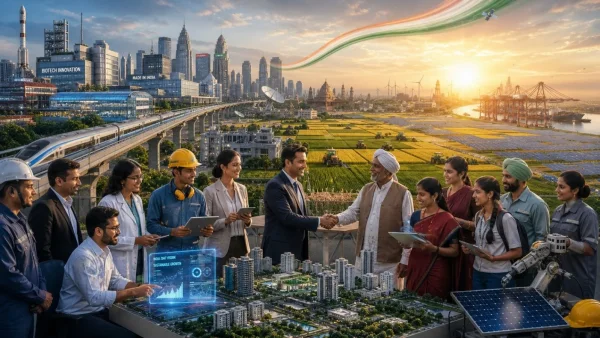
The road ahead is a compact of three: government, enterprise and society. Mistry talks of the courage to innovate and the wisdom of experience, combined with youthful energy and the conviction that the best is yet to come for India.
He has a few near-term priorities in mind to make the collaboration imperative clear:
– Bring policy, skills and capital into alignment
– Make technology inclusive as you scale it
– Turn infrastructure into productivity
Culture as a strategic asset
Mistry does not see culture as a form of nostalgia but as an operating system. The Tiranga is held up as a testament to endurance and faith in the future. India’s true advantage, he would have it, is the ability to absorb change and not be lost in the process.
He refers to a civilisational instinct to welcome knowledge while holding on to wisdom, and to use progress to give timeless values a new lease of life. In markets that are in constant flux, that combination can be a moat.
What comes next
His final word is plain: independence afforded the right to dream, but now there is an obligation to make them extraordinary. He is calling for a recommitment to an India that is more confident, inclusive and green.
This is a generational task. “We have been given a remarkable country,” he says, “and the duty is to leave one that is even more so.” That is what freedom means.
Published on August 17, 2026, the piece is not a policy document but a nudge to move faster and hold oneself to better standards in execution. Should the industry take that to heart, the promise of India at 80 will become an enduring advantage.