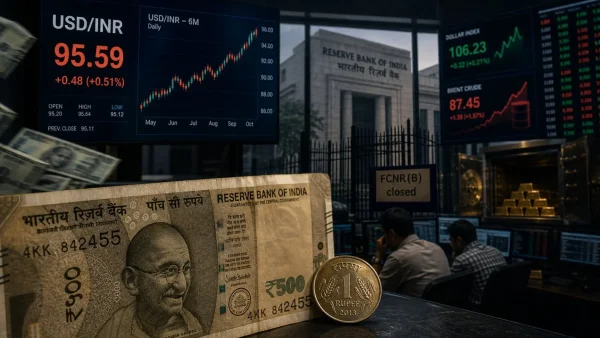
Sentiment was cooled by the Reserve Bank of India’s unanticipated move to shut its FCNR(B) swap window a month ahead of schedule, and the rupee gave way in early trade. Weakening to 95.59 against the US dollar, it has brought the RBI’s strategy and any near-term support into sharper relief.
It was a softer start to the day. After closing Friday at 95.42 with a 3 paise gain, the rupee opened at 95.48 and was seen in the interbank market around 95.50 before easing to 95.59.
RBI’s timeline shift and the new signal
Market expectations have been reset by the bringing forward of the cut-off for the concessional FCNR(B) deposit swap facility to August 31, rather than September 30. For their part, banks were able to use the window for zero-cost hedging on eligible foreign currency deposits mobilised in time.
The RBI cited an encouraging response as reason for the step; official figures show the scheme has pulled in over $50 billion. In fact, as of August 13, the concessional swap facility had drawn $56.84 billion, with $52.3 billion coming from FCNR deposits.
Market positioning after the surprise
According to traders, the announcement came out of the blue and has prompted a re-evaluation of the cushion the rupee gets from these flows. Amit Pabari of CR Forex Advisors sees support holding for the moment but says the risk-reward is still skewed to the weaker side.
He points to 95.20-95.30 as the zone to watch. Should that hold, he expects the USD/INR to make its way to the 96.20-96.50 area over the next few days.
Buffers, flows and intervention
India’s external buffer is in better shape thanks to deposit inflows. Foreign exchange reserves put in a $14.136 billion increase to reach $707.002 billion in the week to August 7, a four-month high. That was on the heels of a $10.512 billion rise to $692.866 billion the week before.
Bankers report the RBI was selling dollars through state-run outlets last week to keep volatility in check. With a bigger war chest, the central bank has more latitude to counter any disorderly activity as the swap support runs its course.
External cues temper the blow
The dollar has taken some softening after US retail sales came in below par, lessening the chances of a Fed rate hike next month. The index was down 0.12 per cent to 99.54, a small reprieve for emerging market currencies.
Then there is oil. Brent futures were up 0.47 per cent to $88.94 a barrel. On the domestic front, equities opened in the red: the Sensex was at 77,717.05, off 284.85 points, while the Nifty fell 69.25 to 24,297.05. Foreign buyers put in Rs 508.12 crore on Friday.
Why ending the window early could matter
The FCNR(B) backstop was put in place to steady the rupee and speed up inflows. But the mobilisation has been stronger than anyone thought and the carrying cost of the scheme is rising, so experts believe that is what led the RBI to close things out early.
One treasury head at a private bank said apart from the cost, there is no obvious case for the premature closure. The limited reaction from the rupee indicates the market may have already moved on from the temporary cushion.
In short, here is what the market is making of today:
– RBI has moved the FCNR(B) swap cut-off to August 31
– By August 13 the concessional facility had $56.84 billion
– $52.3 billion of that from FCNR deposits
– Reserves are up to $707.002 billion as of August 7
– Last week the RBI was offloading dollars via state-run banks
The road ahead for the rupee
The rupee has been in the 95 range this month after a brief dip to 94.30 in July, even with the volume of inflows. Now the early closure removes a channel of support at a time when importers are demanding dollars and oil prices are high.
What happens next will be determined by the path of the dollar, oil, foreign fund flows and how much the RBI chooses to intervene. There is also the question of US rate expectations to factor in, though India’s reserves provide a buffer should weakness set in.