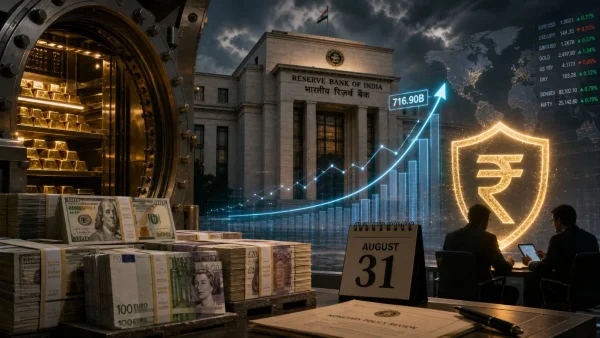
The numbers tell the story: according to the RBI, the country’s stockpile has made a decisive run toward an all-time high in the week to August 14, adding $9.905 billion to reach $716.90 billion. It is a welcome surge for the rupee and affords policy makers the latitude to handle capital flows without ruffling the markets.
Why this spike matters now
This is no isolated event. A week prior, reserves were lifted by $14.1 billion to $707 billion, then the best figure of the fiscal year. The pattern suggests some deliberate policy engineering at work, not a passing market whim.
The RBI has been keen to front-load hard-currency inflows. With foreign currency coming in at a rate of $56.8 billion – $52 billion of it via FCNR(B) deposits – the central bank has brought forward the close of its swap facility window to August 31. It is a tactical way to put buffers in place before the risk environment changes.
A stronger hand for the RBI
At $716.90 billion, the reserves are well within sight of the $728 billion peak from earlier in the year. That proximity is more than cosmetic. It gives the RBI the firepower to steady the rupee and rates and keep speculative pressure at bay when external conditions get tough.
What changed inside the reserves
There has been a broad-based reinforcement of the composition. Foreign currency assets, which make up the lion’s share, went up $7.2 billion to $581.85 billion. Gold holdings have put on some weight too, up $2.67 billion to $111.41 billion.
On the other side, Special Drawing Rights were down $5 million to $18.740 billion, though the reserve position with the IMF saw a $5 million rise to $4.89 billion. All part of building liquidity while diversifying.
The key figures for the week:
– Total reserves: $716.90 billion
– Weekly change: +$9.905 billion
– Foreign currency assets: $581.85 billion
– Gold reserves: $111.41 billion
Policy design and competitive dynamics
With the FCNR(B) window open until August 31, it has become the fulcrum of the build-up. Add in the support expected from external commercial borrowings and India is better placed to compete with other emerging economies for stable dollar funding.
The metal’s appreciation in the reserves is also a calculated move. It offers a cushion and shows a willingness to step back from a purely dollar-heavy stack, something reserve managers are doing as rate and liquidity cycles shift.
What to watch next
Two things come into focus. Will the momentum from FCNR(B) and commercial borrowings hold through the end of August? And how far will the RBI be willing to go in nudging reserves to that $728 billion mark without stirring up currency volatility or crowding out private capital?
One can expect the markets to judge how much the RBI makes of its larger war chest. There is more room to intervene and take the edge off rupee swings, but over-smoothing could have the effect of deterring natural hedging. The flows in the coming fortnight should make the balance clear enough.
The near-term scoreboard
Back-to-back increases have given India’s external buffer a reset at a time when it is needed. The data is reflecting the RBI’s efforts to draw in foreign currency, and the country has moved from being on the defensive to a more cautious offensive posture.
It is a clear indication that policy is dictating results. Should the inflow window stand firm to August 31, the reserves will likely harden further, cementing India as one of the more resilient places for global capital to park in the emerging market space.