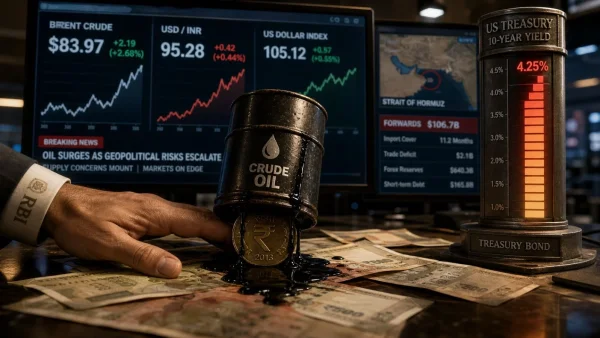
The numbers tell the story: on 7 August 2026 the rupee was down 6 paise to 95.28 per US dollar. Fresh strength in crude and US Treasury yields have put a crimp on financial conditions. With the dollar holding its ground and Brent in the vicinity of $84, the next chapter for the rupee will be written by the RBI and incoming employment figures from the US.
Oil shock reshapes currency narrative
Brent has been on the rise, up nearly 4% overnight and another percent in Asia to trade close to $84 a barrel. What set it off was fresh unease over the Strait of Hormuz; Iran has put forward proposals with Oman to penalise any vessels it considers hostile.
That kind of spike is problematic for India, an importer of some 85% of its crude. It means a higher import bill and inflation worries, which in turn sees oil companies demanding more dollars. The rupee had found some footing above the 95 level when Brent was under $80 and the RBI was selling, but the oil rebound has put an end to that sentiment.
According to traders, how much the central bank intervenes will be the deciding factor in the near term. Oil is the macro lever that matters most for the rupee right now, making other supportive signals seem secondary.
There are a few pressure points for the market to be aware of:
– Brent in the $84 range
– Penalties and proposed restrictions on Hormuz transit
– A pick up in dollar demand from importers as oil prices jump
Dollar and yields keep pressure on EM FX
One does not find much respite in the US. The Dollar Index is running near 100 (a 99.95) on the back of hawkish talk from the Fed. Alberto Musalem, head of the St. Louis Fed, made his position clear last week in favour of a rate hike and cautioned against any premature easing based on AI productivity.
Bond markets are in agreement. The 30-year yield is at 5.17%, a 2007 high, as investors anticipate a protracted period of tight policy and more US borrowing. Such long-end yields have a way of luring capital into dollar assets and putting the rupee and other emerging market currencies under a thumb.
All will be watching the July jobs report later today. After 57,000 in June, economists are calling for 80,000 with the unemployment rate at 4.2%. A good showing would cement the view that rates are here to stay.
RBI playbook in focus: spot and forwards
Those in the market say the rupee could have opened in the 95.35-95.40 band were it not for some dollar sales from the RBI to check the early weakness at 95.28. Lately the central bank has not hesitated to step in directly to smooth things over.
Then there is the matter of the short dollar forward book, which has swelled to a record $106.7 billion. While those deferred obligations have kept the rupee from sliding in recent months, the upcoming settlements will be scrutinised for clues on the medium-term path.
Finrex Treasury Advisors point out that the RBI has taken inflows at Rs 94.92, creating a sort of floor. Their view is that exporters may take advantage of any rupee firmness to sell, while importers will buy on dips with the oil risk back in play.
Levels and market tone
Amit Pabari of CR Forex Advisors sees a setup that is vulnerable. Given the dollar is near 100 and yields are up, he puts support at 95.00-95.10 but thinks a move to 96.00-96.20 is not out of the question should global conditions deteriorate.
The intraday action has shown the strain. Brent futures were up 1.20% to $83.48 and the dollar index 0.02% to 99.95. Add in profit-taking after the rupee’s run and buying from importers and the pressure is evident.
Equities have felt it too. In early trade the Sensex was 235.36 points lower at 78,699.80 and the Nifty 24.30 points off at 24,608.25. FII were net sellers on Thursday, shedding Rs 17.86 crore worth of stock.
What comes next
Three things will write the script in the near term: oil driven by geopolitics, a Fed that is data-dependent yet hawkish, and the RBI’s appetite to stand up to volatility. An escalation at Hormuz or a strong US jobs print could reset the board for the dollar and rates.
At present the bias is to the downside. Whether the 95.00-95.10 line holds or the rupee is tested at 96.00-96.20 will come down to intervention and the vagaries of oil.