Today’s observance of National Space Day 2026 carries a distinct message: the Chandrayaan-3 landing was only the start. The theme ‘Towards Viksit Bharat – Innovating, Collaborating and Aspiring Global Space Leadership’ is forward-looking in nature, and it serves to link national pride with tangible objectives in human spaceflight, space stations and practical applications.
National Space Day 2026: Date and why it matters
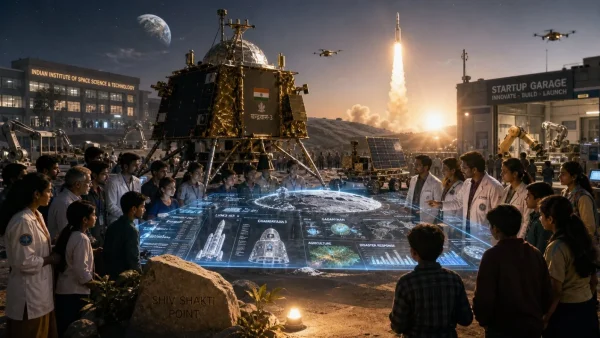
Each year on August 23 the day is marked to recall how the Vikram lander of Chandrayaan-3 made its way to the Moon on that date in 2023. The spot was christened Shiv Shakti Point, a fitting symbol for a milestone that put India in the company of just three other nations to have soft-landed on the Moon, and the first to do so at the south polar region.
In 2023 the Government of India made this an annual event to put the scientists and engineers of the mission in the spotlight and to put some inspiration in students to take up STEM. This year the theme reflects a drive to foster a self-reliant and competitive space ecosystem via collaboration between industry, academia and startups.
One sees that ambition in the way space technology has come to be used. There are satellite services for everything from agriculture and water to health and governance. ISRO has been in concert with government departments to make use of data in a way that is of benefit to society.
From a lunar touchdown to broader impact
It all began with the LVM3-M4 lift off from Sriharikota on July 14, 2023. The 43.5-metre tall, 642-ton rocket had three objectives when it sent the lander and rover on their way: in-situ science, mobility and a safe soft landing.
Once down on the surface, the Pragyan rover and the instruments on Vikram were at work for some 14 Earth days, or a single lunar day. They measured the plasma environment, seismic activity and surface temperature among other things; Pragyan even verified sulphur near the south pole. ISRO has since reported the rover was making new discoveries in the vicinity of Shiv Shakti Point.
What the success changed
Having taken lessons from Chandrayaan-2, the mission proved India could pull off a complex soft landing. It was a matter of precision engineering and perseverance as much as it was about joining an elite group with the ability to reach the south polar region.
‘Chandrayaan-3 gave India not just a moment of national pride, but the confidence to think bigger,’ says Deepak Acharya of INOX India, an industry partner. He views the mission as a turning point from merely proving what is possible to constructing the next phase of planetary exploration, be it human spaceflight or space stations.
Some key moments in the observance stand out:
– 23 August 2023: The Vikram’s arrival at Shiv Shakti Point
– 14 Earth days: The span of operations on the surface
– 23 August 2024: The inaugural National Space Day
– 2025 outreach: 1.5 lakh students and 15,000 teachers
– 23 August 2026: A theme of global leadership
The next chapter: human spaceflight and beyond
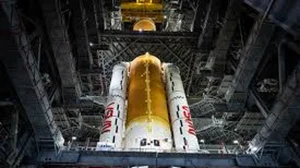
With the growth following Chandrayaan-3, the focus is now squarely on Gaganyaan. With the first crewed mission on the books for the first quarter of 2027, ISRO has laid out plans for a number of uncrewed flights to precede it, assuming the tests in question go as planned. The agency has been at work qualifying the crew module and monitoring the systems vital for return.
There have been some notable validations of late. On Nov 3, 2025, ISRO put the main parachutes through their paces in an Integrated Main Parachute Airdrop Test at the Babina Field Firing Range in Jhansi, subjecting them to extreme conditions with success. Then in July, a sea trial confirmed the worth of the home-grown tracking system, an important step for Gaganyaan and what is to come.
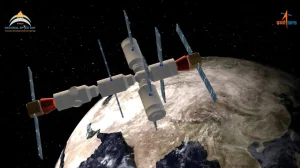
Gaganyaan is being positioned as more than a singular programme; it is the bedrock of a human spaceflight roadmap that will be sustained over time. The proposed Bharatiya Antariksh Station is set to have its first module in low-Earth orbit by 2035, and India is aiming for a crewed landing on the Moon by 2040. Space Vision 2047 adds further targets, from next-generation launchers to follow-on Chandrayaan and Gaganyaan missions.
A growing ecosystem
One sees India’s space ambitions are no longer confined to government laboratories. There is a burgeoning space economy with startups, industry and universities all putting together components and applications. Take the 2026 ISRO Robotics Challenge: it has students developing autonomous systems for planetary exploration, which is a way of making classroom innovation answer the demands of an actual mission.
The same can be said for the way Chandrayaan-3 is viewed in 2026. While the mission is still cause for celebration, it also serves to underwrite a pipeline of technology and talent to ensure India remains competitive in a fast-moving global arena.
Why this day resonates beyond space enthusiasts
National Space Day is about both memory and momentum. It is a chance to honour the day India made its mark on an unexplored part of the Moon and to consider what must be put in place for the nation’s economic and technical good. That duality has the attention of entrepreneurs, researchers and decision-makers alike.
The second National Space Day in 2025 was a case in point, drawing in policymakers and scientists as well as the public, with outreach to some 15,000 teachers and 1.5 lakh students. As the country marks the occasion in 2026, one can expect that initial engagement to have broadened into everything from hackathons to practical projects.
For those wanting to put the years ahead in context, the key figures are:
– August 23 is the date for National Space Day
– This year’s theme is ‘Towards Viksit Bharat – Innovating, Collaborating and Aspiring Global Space Leadership’
– Gaganyaan’s inaugural crewed flight is slated for Q1 2027
– The Bharatiya Antariksh Station is in the works for 2035, the Moon for 2040
– Chandrayaan-3 was the first to the lunar south pole
What ties it all together is relevance. Navigation and mapping are aids to disaster response and logistics; communications satellites reach the most remote parts of the country; earth observation is used for water and crop management. In short, space is infrastructure.
As India gets ready for National Space Day 2026, the issue is not if the current momentum will hold but how fast it can be scaled. Chandrayaan-3 showed the country could get to a hard-to-reach spot on the Moon. Now the job is to make of that a continuous line of leadership and collaboration.