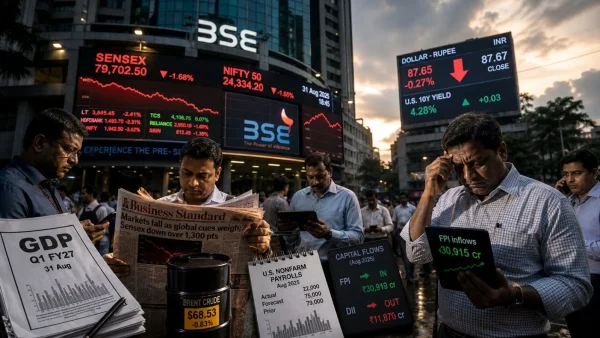
In fact, the week ahead could be enough to reset near-term trends on Dalal Street. One has to pay close attention to what the next round of signals portend for risk after foreign portfolio investors were responsible for Rs 30,919 crore in inflows in August, even as the benchmarks gave way.
The sensitivity of positioning to macro headlines was plain to see last week. The BSE Sensex was down 276.32 points (0.35 per cent) and the NSE Nifty 76.35 (0.31 per cent), a pullback that occurred in spite of strong foreign interest.
Why this week matters
According to analysts, the market will be steered by two bookend releases. First there is the Q1 FY27 GDP reading for India on 31st August to give a clear picture of domestic momentum. Then on 4th September the US non-farm payrolls will come out and set the tone worldwide for the Fed’s September decision.
Ajit Mishra at Religare Broking sees the jobs numbers as a potential mover for the dollar, Treasury yields and flows into emerging markets. Hariselvan Radhakrishnan of HST Wealth says the incoming data is pivotal, with investors rethinking the Fed’s course following some hawkish words from Kevin Warsh at Jackson Hole.
Domestic cues to watch
Traders will not be content with the headline GDP figure alone; they will be looking at a range of high-frequency indicators for confirmation. Mishra puts the rupee, FX reserves, GST collections and the PMI readings for manufacturing and services in August among the key inputs that can either support or undermine the growth story.
Then there is the matter of energy. Ponmudi R of Enrich Money describes it as a wild card. With supply lines disrupted by the Middle East situation and commodity costs on the rise, the Q1 GDP data is going to be an important barometer for risk sentiment here at home.
Investors will have their eyes on the following over the course of the week:
– Q1 FY27 GDP on 31st August
– August manufacturing PMI
– August services PMI
– Monthly GST collections
– Foreign exchange reserves trend
– Rupee versus the dollar
– FPI activity and auto sales
Global triggers and policy calculus
The most significant trigger on the global front is the US employment report due 4th September. Mishra expects the outcome to have a ripple effect on the dollar and cross-border flows, while also swaying what is expected of the Fed in September.
Ponmudi would add that US monetary policy is the main catalyst these days in the aftermath of Warsh’s Jackson Hole appearance. Markets will be poring over the August jobs and inflation figures to see if the recent wagers on a rate hike in September stand up to scrutiny.
What it means for positioning
One gets the sense from the soft index moves and firm foreign inflows that traders want hard evidence. The 31st August GDP release will tell us if domestic growth is enough to counter higher energy bills and outside uncertainty. A solid number should steady nerves, but a lacklustre one will only deepen caution.
Expect global risk appetite to be decided later in the week. Should the US labour data take the edge off rate-hike concerns, EM equities may do well through the currency and yield channels. Otherwise, a firmer dollar and yields could put pressure on flows while India makes its own trade-offs on growth and inflation.
The bottom line
There is little room for disappointment in the current climate and the calendar is full. The Sensex and Nifty made room for a correction last week even with Rs 30,919 crore coming in from FPIs in August, so the data has to make the case for risk. For the time being, the twin signposts are the GDP on 31st August and the US payrolls on 4th September.