In celebrating National Space Day, India has put out an unambiguous message to the global market: the country is flying on home-built chips. Whether for the computing needs of a launch or the science behind lunar imaging, made-in-India semiconductors have found their way into the heart of key missions, redefining what self-reliance means for the nation’s technology sector.
Union Minister Ashwini Vaishnaw was plain about the change, writing on X: ‘Made in India chips are powering Indian Space Missions.’ MeitY, the Ministry of Electronics and Information Technology, has confirmed that components designed and made in the country are in use throughout the space programme.
The strategic turn to self-reliance
For MeitY, the fact that India can build critical space-grade hardware at home is a matter of both policy and substance, one that fortifies the entire ecosystem. It is a deliberate step back from the kind of foreign dependence once seen in more sensitive missions.
Under this approach, design, fabrication and mission integration are brought under a single roof. In an industry with little tolerance for delays or unreliability, having a firmer grip on the components yields more predictable outcomes and allows for quicker iteration.
Mohali’s Semiconductor Laboratory at the core
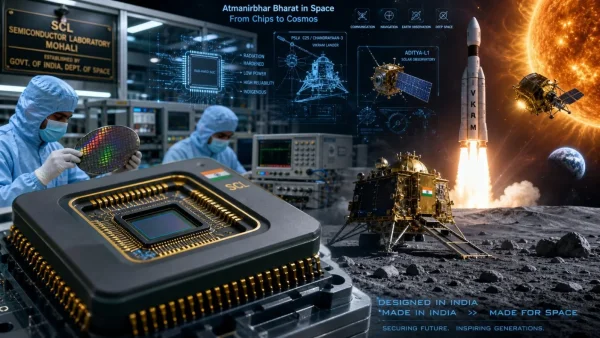
One looks to the SCL in Mohali for the source of this capability. The laboratory puts together flight-grade chips meant to withstand the rigours of space – vacuum, radiation and extreme temperature variations that would see off ordinary electronics.
What SCL has to offer is a full-stack operation suited to the constraints of space. Its catalogue includes Application-Specific Integrated Circuits, radiation-hardened chips and sensors for pressure, acoustics and acceleration, as well as electro-optical CCD and CMOS imagers.
Hardware already in space
Proof of concept is evident in some of India’s recent flagships. The Chandrayaan-3 lander, for instance, had an India-made camera chip from SCL Mohali on board to handle the imaging work on the Moon’s surface, a testament to indigenous skill in precision electro-optics.
Then there is Aditya-L1 on the solar side, which makes use of the SCL’s radiation-hardened Analogue-to-Digital Converter chips for its observations. Such hardening is essential for heliophysics work where the quality of the data hinges on the stability of the chip.
Even the launch stack has semiconductor expertise built in. The Vikram processor from SCL is found in rockets and satellite launch vehicles to provide the necessary onboard computing. By putting an indigenous processor in place, external bottlenecks are minimised and mission assurance is broadened.
The official line on the matter can be summarised thus:
– Vaishnaw on X: ‘Made in India chips are powering Indian Space Missions’.
– MeitY confirms the use of domestic components in the space programme.
What to watch next
The ministry sees the home-grown capacity for space-grade chips as a reinforcement of India’s technological independence. With new missions in the offing, locally made chips will likely take on a larger part of the operational picture.
There are practical reasons for this trajectory. A higher degree of indigenous content brings the mission designer and the chip engineer closer together, which can speed up development and ensure supply resilience without any compromise to the mission at hand.
Competition and ecosystem implications
Space hardware is where national tech ambition is put to the test. By fielding domestically produced ASICs, processors and precision imagers, India is setting up its programme to compete on the merits of control and reliability, not on when an import arrives.
Should the momentum continue, one can expect to see faster cycles and components made to order as new satellites and payloads go from the drawing board to deployment. It is a compounding advantage that comes with fewer outside dependencies.