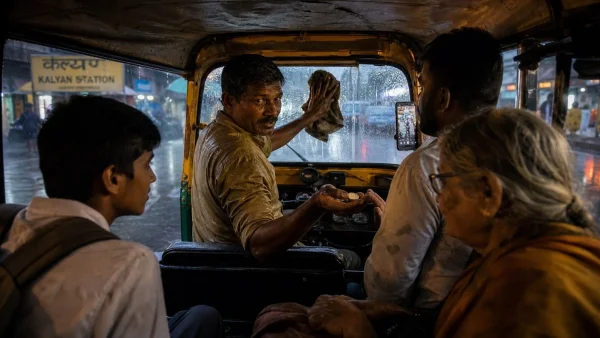
It was a small matter during a commute in Mumbai but has since become a larger debate. An auto driver put an end to any notion of a tip after a shared trip to Kalyan Station by giving back Rs 5, all the while the passenger thought he could use the extra cash. Social media has been abuzz with the story.
What set this ride apart
You had the elements working against you: the rain was coming down hard and the vehicle was old, with a wiper that was no good for anything. According to the passenger, the driver made do by clearing the windshield with his own hands as he drove through it.
And yet he would not be put off from returning an extra Rs 5. Once the correct fare was settled, the passenger put forward Rs 20 and said to keep the change. The driver put the balance right back.
The fare math behind the moment
On this route the going rate for a shared auto is Rs 15 if there are four on board, or Rs 20 for three. The commuter says some will charge you Rs 20 regardless of whether they have filled the seats with four.
This driver had no such inclinations and took the Rs 15 from each of the four. The passenger, appreciating the equity of it, put forward another Rs 5 of his own volition. It was the turning away of that offer which gave the incident its character.
A post that asked a harder question
Under the heading “Being honest can cost you everything?” the account was put to social media. The post was meant to pose the driver’s actions as a matter of principle when funds are low and to see what others would make of it.
In his telling, the passenger found it a profound thing to watch a man who is clearly not making much choose to give back a few rupees. One is left to wonder, as the passenger put it: why is it that good people seem to be the ones who suffer?
Why this resonated beyond one ride
For those using public transport in a large city, there is always the concern of being overcharged in a shared service. When a driver honours the posted fare it goes some way to restoring confidence in the everyday transaction.
That is the wider picture at play here.
There is a certain counterpoint to cynicism in the way one individual chose to put honesty first, turning down an unearned tip and following the rules. It is a decision that gives one pause to consider what integrity is really worth.
How the internet has been reacting
The comments have been full of praise for the driver, with some musing on whether such honesty is ever truly rewarded outside the digital world. A few made the point that self-respect is the only return that matters; others see integrity as something rare and valuable in the course of everyday commerce.
More than a few reactions were less concerned with the Rs 5 and more with the character the driver put on show in spite of the hard work and bad weather. The prevailing sentiments can be summarised as follows:
– That you need no audience to have integrity
– Fair pricing is how trust is won with commuters
– There is more value in peace of mind than in money
– An occasion like this can put your faith in people back where it belongs
Competing behaviours on the same route
In the post, the writer sets up a contrast between those in the market who will bend the fare rule and those who do not. This driver, for instance, charged the four passengers the Rs 15 the rule dictates, not Rs 20.
It is more than a matter of arithmetic. The way a driver handles these things colours the perception of the whole sector and leaves the passenger with an idea of whether they can expect fair treatment on the next ride.
The bigger question: does honesty come at a cost?
The passenger puts his finger on a familiar dilemma. With uncertain earnings and the risk the weather brings, handing back Rs 5 is a sacrifice of sorts. But the driver’s line was drawn clearly enough: take what is owed, give back what is not.
As the post would have it, the trade-off is not merely financial. It is about how a worker defines success when under pressure and the effect small choices have on public opinion.
What we know, and what we do not
All of this comes from user-generated content of a trip to Kalyan Station. The report lays out the fare, the condition of the vehicle in the rain and the returned Rs 5. But there is no way to verify the wider claims beyond the post and the replies to it. One should read it as an anecdote, not as a survey of the market.
Where the conversation goes next
This has given commuters an opening to talk about what they expect from a shared auto and the worth of fair dealing. It may also make a passenger think twice before judging a driver who is operating under strain.
We may never know if honesty pays in cash. But in the case of at least one commuter, this story has redefined a meaningful ride and put the conversation on a different footing.