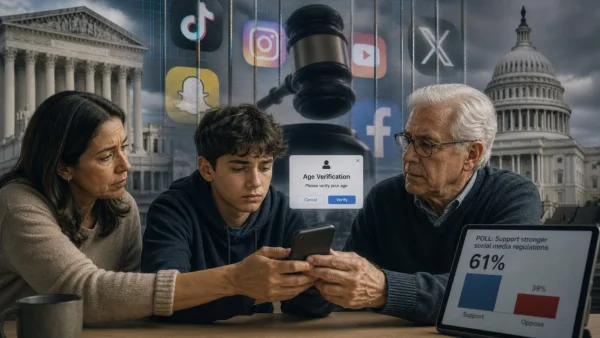
It is a rare cross-party convergence: three in five Americans are calling on Washington to put some reins on social media. The Reuters/Ipsos poll indicates a wide appetite for sterner oversight and age checks, even as state laws and lawsuits make short work of the way companies like Meta, Google’s YouTube, Snap and TikTok handle their younger users, raising the regulatory risk for all of them.
Public appetite for tighter control is bipartisan
One would not call it a fringe opinion, this support for stronger guardrails. Respondents to the poll were 61% in favour of firmer oversight of the social media companies, broken down as 71% of Democrats and 62% of Republicans. Independents were not so sure of where they stood.
There is a hardening of consensus when it comes to minors. Some 66% are behind the use of age-verification to bar children under 16 from these sites. In fact, child safety may be one of the few unifying questions in digital policy; support for such checks was 74% among Republicans versus 69% for Democrats.
Legal pressure is accelerating faster than federal action
Congress has been slow to put in place legislation for the protection of kids, but the states and the courts have not. On Wednesday a trial is set to open on the word of state prosecutors who allege Meta has engineered its wares to be addictive for the young. Meta puts the lie to those claims.
The stakes in court are high. Should the states win, Meta says it is looking at penalties of as much as $1.4 trillion. A New Mexico state court has already made an example of the company in a separate matter, ordering a $567 million payment to a teen mental health fund and dictating changes to how its platforms are used by young people.
Outside of the courtroom the situation is no less charged. Over a dozen states have put rules in place to limit what minors can do on social platforms in the name of online safety. That is running up against the industry’s resistance in what promises to be a test of the limits of age-based restrictions here in the U.S.
Age checks become the policy flashpoint
NetChoice, the trade group for the likes of Meta, Snap and TikTok, has taken to the courts to stop state laws that would force apps to verify ages, contending they are an affront to free speech. Yet public feeling is with the verifiers, driven by concern over the influence these platforms have on youth.
You see that tension in the words of some voters. An engineer from Tennessee who is for smaller government concedes there may be a need for an exception when it comes to restricting kids. Then there are those who are troubled by how easily a child can get around a parental block or by the hold the platform has on what a teenager is shown.
Americans see both harm and enjoyment
The mood may be turning regulatory but that does not mean people have given up on their apps. Fully 70% in the poll say they have fun with them, though 35% will admit the experience is a source of stress.
Opinions on overuse are not uniform. Some 52% feel they put in too much time, while 43% disagree. But when it comes to children, the concerns are of a piece. An 85% majority holds that social media is addictive for kids and can be bad for their mental health. One might argue this divide between an adult’s pleasure and the risks for the young is what has brought about the rare bipartisan consensus on oversight.
The practical side of this was put into words by one Kansas resident looking after her grandchildren: she will not have them on YouTube under her watch, but they have a way of circumventing her on their phones. Such real-world obstacles to blocking content are behind the push for more robust default protections.
Why Big Tech should take note
There is an inflection point in both policy and the market as public sentiment changes. Should age verification become the norm, firms will have to overhaul their recommendation systems and onboarding for those under 16. And litigation could compel such changes well ahead of any federal statute.
For the executive and investor, these are no longer theoretical risks. A host of state regulations and suits over youth harm add to the compliance burden and liability. The numbers from the poll provide political cover for a more forceful approach, potentially shortening the timeline for operational shifts.
Key findings at a glance
The national mood and policy direction are evident in the latest polling. Notable figures include:
– 61% in favour of tighter oversight
– 71% of Democrats and 62% of Republicans for stronger rules
– 66% for age verification of under-16s (74% of Republicans, 69% of Democrats)
– 85% who view social media as an addiction for children
– 70% who find their own online time enjoyable
Methodology and timing
Reuters/Ipsos put 4,505 U.S. adults through an online poll over the six days to August 3, with a 2 percentage point margin of error.
It is timely. Meta is contending with a trial set for Wednesday and a New Mexico order to fork over $567 million to a teen mental health fund while reworking its youth features. These matters will set the boundaries for the sector.
What comes next
The tussle between the states and the feds is likely to heat up. How far the states can go will be determined in part by NetChoice’s challenges to age-verification statutes. Congress is something of a wild card, yet the cross-party desire for oversight makes federal intervention probable.
The bottom line for the likes of Meta, Snap, TikTok and Google’s YouTube is a need to recalibrate in the face of legal exposure and calls for protection. It is only a matter of how soon the scrutiny becomes a nationwide rule.